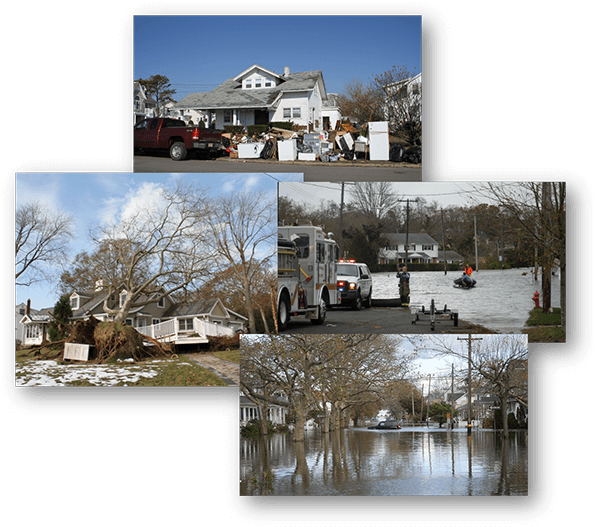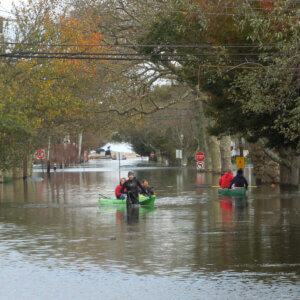
UCI Associate Director Tom Herrington was the featured speaker on Sept. 26 in a webinar series offered through the Rutgers Cooperative Extension entitled “Weathering the Storm: Increased Resiliency a Decade After Superstorm Sandy.” Herrington delivered the presentation “Beyond Recovery from Sandy: Setting the Stage for Future Community Resilience” (see video above).
In recognition of the 10th anniversary of Superstorm Sandy, the series is reflecting on how New Jersey has become more resilient to environmental impacts, with an emphasis on storms and extreme weather. The six-evening webinar series is free and open to all interested. Click here to register for one or more of the sessions or to learn more about the series.
The Monmouth University Urban Coast Institute (UCI) has received $1 million in state funding to establish the New Jersey Coastal Consortium for Resilient Communities (NJCCRC). The NJCCRC team of universities and the New Jersey Sea Grant Consortium will work to identify research needs and fill knowledge gaps that enable the state and communities to make more informed decisions on coastal resilience actions and respond to climate threats.
New Jersey’s fiscal year 2022 and 2023 budgets each included $500,000 to support the NJCCRC and its work. The initial phase of the work, which commenced in September, is being conducted by experts from the Montclair State University Earth and Environmental Studies Department; the New Jersey Institute of Technology Center for Natural Resources; Rutgers University’s Institute of Earth, Ocean and Atmospheric Sciences and Jacques Cousteau National Estuarine Research Reserve; the Stevens Institute of Technology Coastal Engineering Research Lab; the Stockton University Coastal Research Center; the UCI and New Jersey Sea Grant Consortium. Examples of the research to be carried out by the NJCCRC partners include:
The development of a framework for a real-time observing system that would monitor water conditions throughout the Barnegat Bay with a focus on measuring how the system is changing over time. A hydrographic model will also be developed that could draw on this data to predict how the bay’s circulation will change in the future.
Modeling how sea level rise is accelerating saltwater intrusion in the groundwater beneath marsh islands and whether steps such as sediment replenishment can protect the freshwater-dependent maritime forests that live in these environments.
Studies of how climate change is impacting the movements of sediments in coastal bays and along the shore and the effectiveness of beach dunes for improving coastal resilience in densely developed areas.
The funding was sponsored and supported by New Jersey State Sen. Vin Gopal, included as part of Gov. Phil Murphy’s proposed budget, and approved by the New Jersey Legislature.
“A decade ago, Superstorm Sandy exposed our coastline’s vulnerability on so many fronts,” Sen. Gopal said. “One of the keys to ensuring we’re in better position to withstand and rebound from future Sandys is to develop the fullest possible picture of the risks we face and what steps we can to take to address them. This funding will help marshal the expertise of six of New Jersey’s top universities for that purpose.”
In identifying the next phase and future work, the NJCCRC collaborators will work with state agencies and coastal stakeholders to determine research needs that should be addressed to inform an update of the 2020 New Jersey Scientific Report on Climate Change and to implement actions detailed in the 2021 New Jersey Climate Change Resilience Strategy and Coastal Resilience Plan. Additional universities and collaborators could join work on future projects as priorities and opportunities continue to be identified.
The NJCCRC will assemble an advisory panel with representatives from research organizations, nonprofits, local governments, private sector entities and other stakeholders who can provide input on its research priorities and work.
According to UCI Associate Director Thomas Herrington, the NJCCRC’s principal investigator, the collaboration has the added advantage of building closer working relationships among the state’s leading researchers on coastal resilience.
“In the aftermath of Superstorm Sandy, all of the core NJCCRC partners were called upon by state and federal agencies to work together in support of New Jersey’s response and recovery efforts. That effort has already improved the resilience of our coastal communities and environments,” Herrington said. “Each of the NJCCRC partners has its own strengths that when combined can be amplified to reduce the risk of coastal hazards turning into natural disasters.”
Join Specialist Professor in Public History Melissa Ziobro’s Museums and Archives Management Basics students on Oct. 28 as they unveil a poster exhibit that pairs excerpts from oral history interviews with archival photos in order to document and interpret Superstorm Sandy’s impact on Monmouth County. The 16-panel exhibit will remain on display at Monmouth University’s Murry & Leonie Guggenheim Memorial Library through Dec. 9.
Over the summer, Ziobro completed 21 oral history interviews with homeowners, first responders, government officials, non-profit leaders, social workers, and others impacted by the storm, which made landfall in New Jersey on Oct. 29, 2012. The interviews, conducted in advance of the 10th anniversary of the storm, join 17 others she conducted for the fifth anniversary. Together, the recordings and transcripts create an invaluable record for generations to come, adding to our understanding not just of Sandy as a historic event, but contributing to conversations on themes including coastal resilience, climate change, environmental justice, public/private partnerships, and emergency preparedness.
The event, “Tracking Sandy: Monmouth County Remembers,” will begin at 3 p.m. at the library. Following brief remarks by Urban Coast Institute (UCI) Associate Director Tom Herrington, light refreshments will be served.
The recent oral history work was supported with a faculty enrichment grant through the UCI’s Heidi Lynn Sculthorpe Scholars Program.
The panel is one of four free events being offered by Monmouth University to examine the disaster from a wide range of historic, economic and environmental perspectives. The others are:
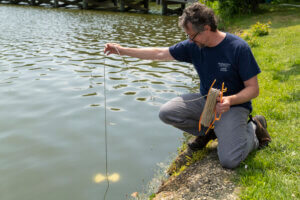
A 2021 CLONet training at Fletcher Lake in Bradley Beach.
ROI-NJ highlighted two UCI-supported programs at Monmouth University in its 2022 list of influencers in higher education. The publication annually profiles leading figures from New Jersey’s 74 higher ed institutions who’ve had the greatest influence and impact at their schools as well as within the business community.
For the first time this year, ROI-NJ included the category “They teach that in college?” which featured unique classes, programs and majors offered around the state. It included the Coastal Lakes Observing Network, led by Endowed Professor in Marine Science Jason Adolf and UCI Community Science Coordinator Erin Conlon, and Monmouth’s maritime archaeology course, taught by Professor of Anthropology Richard Veit and UCI Marine Scientist Jim Nickels.
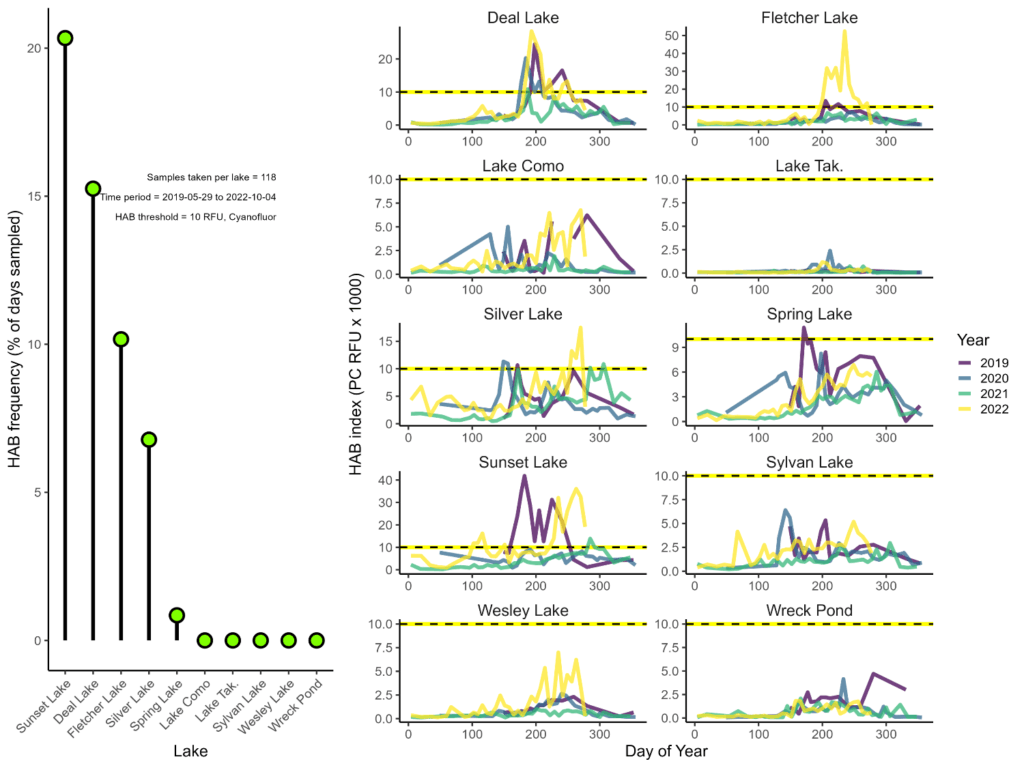
Through CLONet, Monmouth faculty and students train and equip community volunteers to conduct water sampling at their local lakes and file their results to an online database for analysis. The story notes that CLONet has provided “students hands-on field experience while shedding new light on the causes of harmful algal blooms afflicting New Jersey lakes.”
Maritime archaeology students explore the underwater history of New Jersey through readings, lectures and fieldwork, including the use of side-scan sonar and camera-equipped remote operated vehicle technologies in area waters. “It is one of many offerings that bolster Monmouth University’s highly regarded marine and environmental biology and policy program and the Urban Coast Institute,” the article said. Watch our video below for a glimpse at the course.
ROI-NJ also recognized the following people and programs at Monmouth:
Registration is now open for a free Virtual Ocean Pavilion dedicated to raising the visibility of the ocean in advance of the U.N.’s COP27 climate conference, to be held in Egypt in November. The Pavilion will include virtual booths hosted by numerous exhibitors, including the Urban Coast Institute, and live events beginning today.
Visitors to the Pavilion will find:
An auditorium featuring live and on-demand events focused on forging unity and helping to raise ambition for ocean-climate action.
A General Discussion Chatroom where visitors can interact with fellow youth and other attendees.
Exhibition booths to chat with experts and take away information in your virtual delegate bag.
A range of live and on-demand content that can be explored on the road to COP27.
The Pavilion’s live events kicked off on Aug. 30 as part of Africa Climate Week. Translation into multiple languages is available through Wordly during live events.
UCI Director Tony MacDonald will participate in COP27 as an official observer. He previously attended COP26 in Glasgow, Scotland, (see our COP26 Trip Journal) and COP21, where the famed Paris climate agreement was struck.
Congratulations to all of the Monmouth University School of Science students and faculty members who completed another successful season of its Summer Research Program. Take a peek below at two hands-on projects by Marine and Environmental Biology and Policy (MEBP) Program students and faculty. The UCI supported students working on these projects with grants through its Heidi Lynn Sculthorpe Scholars Program.
Restoring Jersey Shore Ghost Forests
MEBP senior Emma Gould worked with Professor Pedram Daneshgar to develop strategies for restoring coastal forests following salt flooding events. Utilizing a greenhouse experiment, the team simulated flood and determine which plants will help in restoring a maritime forest ecosystem.
Tracking Eastern Box Turtles in Monmouth County
Assistant Professor of Wildlife Ecology Sean Sterrett and his students analyzed the population and spatial ecology of local eastern box turtles at Weltz Park in Ocean Township. The team was able to locate and tag a sizable population of turtles, despite the park’s location in the center of a densely developed neighborhood.
Monmouth University scientists are conducting a first-of-its-kind study that uses genetic materials extracted from the ocean to determine whether the development of turbines and power infrastructure has an impact on fish populations and demographics in the Ocean Wind 1 project area, located off the southern New Jersey coast. Through a $1.3 million agreement with Ørsted, the team will sample the waters before, during and after construction for DNA shed by marine life in the area and compare the findings with data gathered through traditional trawls and fish tagging methods.
The project is the first to monitor potential changes to fisheries in a wind energy area using environmental DNA, or “eDNA.” This crime scene investigation-style approach to marine detection has emerged as a more humane and less expensive means of studying fish populations than traditional methods that require their capture. As fish swim through the waters, they leave behind dandruff-like cells and bodily fluids that can be analyzed and matched to the genetic barcodes of others to determine their species.
“Sampling for eDNA is especially effective for detecting uncommon, endangered or otherwise hard to catch species in the waters,” said Monmouth University Endowed Professor of Marine Science and project co-lead Jason Adolf. “There’s a degree of luck involved in trawling for fish, just as when you cast a line at your local lake. The genetic materials in the water can tell you a lot about what you didn’t catch.”
While eDNA is being increasingly used by scientists to determine the presence or absence of species in water bodies, recent research by Monmouth, Rockefeller University and the New Jersey Department of Environmental Protection found that the amounts of DNA floating in the water could also be used to estimate the biomass of fish in the area.
Adolf, project co-lead and Associate Professor of Biology Keith Dunton, and Monmouth University scientists will analyze samples collected during quarterly cruises within the wind energy area. The eDNA research is part of a larger fisheries monitoring effort funded by Ørsted that will also include the use of trawls, gillnets and acoustic telemetry (monitoring of tagged fish) by Rutgers University and Delaware State University scientists. The data will offer insights as to what impacts can be expected as offshore wind projects progress in the Mid-Atlantic.
“Currently, eDNA research needs to be done in conjunction with traditional fisheries sampling until we better understand the relationship between the data gathered by these methods,” Dunton said. “In the long run, however, eDNA may become a more common tool that decreases our dependency on capture and extractive methods and allows us to sample fish more broadly than is currently possible through traditional trawl surveys.”
Developed by Ørsted and PSEG, the 1,100 MW Ocean Wind 1 will be located 15 miles off the coast of southern New Jersey. At 1,100 MW, Ocean Wind 1 will provide clean energy to 500,000 homes in New Jersey, deliver thousands of jobs, and advance supply chain initiatives while helping the state meet its clean energy goals.
“We are thrilled to conduct this environmental monitoring with such a highly qualified research team and their fishing industry partners,” Ørsted Offshore North America Senior Environment and Permitting Specialist Gregory DeCelles said in a press release announcing the research. “This important study will collect a wealth of valuable data on important commercial and recreational species and can serve as a model for accomplishing fisheries monitoring at offshore wind sites on a regional scale.”
The eDNA research team also includes Saint Anselm College Assistant Professor Shannon O’Leary, who will conduct laboratory work to process and analyze the genetic materials captured in the samples. The monitoring work began in December and will continue until two years after construction is complete (currently anticipated to be 2026).
Urban Coast Institute Postdoctoral Researcher Chris Haak provided an update on the Northeast U.S. Regional Marine Fish Habitat Assessment (NRHA) project during the July 13 edition of the National Oceanic and Atmospheric Administration’s (NOAA) Central Library Seminar Series. Launched in 2019, the project evaluated habitat use patterns for marine fish and invertebrate communities on the northeast shelf, relating catch data from the NOAA Fisheries bottom trawl surveys to an array of environmental predictor variables. The team is building a Northeast Regional Habitat Assessment Data Explorerweb app to facilitate the analysis, visualization, and exploration of fisheries data and host NRHA products online.
An article in volume 45 of The Public Land & Resources Law Review (published in June) by Monmouth University Professor Randall Abate examines the legal movement by Indigenous and youth plaintiffs to compel governments to address the disproportionate burdens they bear from the climate crisis.
Abate provides a history and analysis of the most impactful climate justice cases in the U.S. and Canada, which he notes are now at the forefront of such litigation. Gleaning lessons from these examples, Abate concludes with a series of recommendations for the types of relief that should be sought and arguments that should be made to assure the best chances of success.
“Youth and Indigenous climate justice litigation is on the rise in the U.S. and Canada,” Abate writes. “After a series of unsuccessful efforts, a winning formula in these lawsuits is beginning to crystallize on both sides of the border.”
The article, “Youth and Indigenous Voices in Climate Justice: Leveraging Best Practices from U.S. and Canadian Litigation,” is available for download here. The journal is published by the University of Montana’s Alexander Blewett III School of Law and supports professional scholarship and student-written articles exploring legal issues related to public lands and land use, natural resources and the environment, and tribal and federal Indian relations.
By Randall Abate, Rechnitz Family/Urban Coast Institute Endowed Chair in Marine and Environmental Law and Policy
The world’s oceans are in crisis, decimated by a broad spectrum of threats including overfishing, biodiversity loss, plastics debris, vessel-based pollution, invasive species, and ocean acidification. The U.N. Ocean Conference gathers experts from around the world to collaborate to address these threats at all levels of governance.
The inaugural conference convened at U.N. Headquarters in New York City in 2017. After a pandemic-related postponement, more than 6,000 participants assembled in Lisbon for the second edition of this event from June 27 to July 1, 2022. The glistening blue waters of Lisbon’s breathtaking and expansive Atlantic coastline provided a valuable reminder of what was at stake during the conference discussions.
Shortly after our return from the COP26 climate summit in Glasgow in November 2021, Urban Coast Institute (UCI) Director Tony MacDonald and I resolved to keep the international engagement going and we set our sights on attending the U.N. Ocean Conference in Lisbon. Like the process of preparing to attend COP26, the application process to be approved as an observer organization at the U.N. Ocean Conference was similarly complicated and time consuming. We were finally approved to participate in March and immediately started the planning process to travel to and represent the UCI as participants in this important event.
The conference had a positive and solutions-oriented vibe that was spearheaded by science-based, grassroots initiatives; private sector innovations; and blue financing strategies. Some of these measures involve large- and small-scale blue economy initiatives that protect ecosystems and coastal communities, nature-based solutions like seaweed farming, and strategies for managing and repurposing marine plastics and preparing for a rollout of biodegradable plastic substitutes. The conference also included robust discussion of relevant global environmental treaties on ocean governance such as the United Nations Convention on the Law of the Sea (UNCLOS), the Biodiversity Beyond National Jurisdiction (BBNJ) treaty currently under negotiation, and the ocean-climate nexus measures in the Paris Agreement framework.
Reflections on UN Ocean Conference vs. COP 26
Speaking of global climate governance, I wanted to share a few observations on the similarities and differences between the U.N. Ocean Conference and COP26.
The U.N. Ocean Conference featured a much smaller-scale, upbeat, and supportive environment. This vibe was a refreshing contrast to COP26, with its three-ring circus atmosphere of diplomats and heads of state interviewing with the press at every corner, while the private sector and marginalized community constituents (e.g., youth, Indigenous, and small island developing states and least developed nations) engaged in a cheerleading competition for their causes. After the smoke cleared from the chaos, the COP26 outcomes fell far short of meaningful progress, especially given the emergency circumstances of the climate crisis. The U.N. Ocean Conference featured constructive collaboration on practical solutions without the COP26 drama (except for a few men dressed in shark costumes who were getting hassled by police when I arrived on Tuesday). Protests at COP26 were historic in size (approximately 100,000 participants) and impact, whereas U.N. Ocean had a much smaller and more subdued contribution from protesters. A brief video of the shark costume-clad activists and other protesters at the U.N. Ocean Conference is available in a brief video here.
Genuine stewardship passion abounded at the U.N. Ocean Conference. Everyone seemed to have devoted their careers to marine stewardship. Conversely, COP26 had a lot of politicians and private sector constituents dressed in fancy suits who didn’t devote their careers to environmental stewardship, but were transitioning to the climate governance space because that’s where the action is now.
Co-sponsored by Portugal and Kenya, the 2022 U.N. Ocean Conference devoted significant attention to the ocean governance challenges of small island developing states (SIDS) and least-developed nations. Pacific Island nations represent a remarkable 30% of the world’s exclusive economic zone (EEZ) territory. Some of these island states have banned commercial fishing and manage massive marine protected areas to ensure that they do their part to protect the marine environment. SIDS and least-developed nations also have a prominent voice at the climate COPs, but their impact was diminished at COP26 due to COVID restrictions and complications with online participation.
Youth and Indigenous participation was more prominent at COP26. I published an article in June 2022 that addresses youth and Indigenous climate justice litigation in the U.S. and Canada, where these two communities have been particularly active in the courts of late in seeking to address the disproportionate burdens they bear in the climate crisis. The U.N. Ocean Conference needs a more significant presence from youth and Indigenous communities.
The theme that unites the two events is the ocean-climate nexus. Climate governance without consideration of ocean governance is meaningless, and vice versa. In recent years, the proverbial left hand (global climate governance) has been much more aware of what the right hand (global ocean governance) is doing, and vice versa. Ocean and climate governance must be fully integrated to ensure mutual gains. Ambassador Peter Thomson, the U.N. Secretary-General’s Special Envoy for the Ocean, delivered some powerful points at the U.N. Ocean Conference on the importance of the ocean-climate nexus. He noted that while we can fix the other threats to oceans (e.g., overfishing, pollution, habitat loss), our addiction to oil will kill the oceans with the looming threat of a world with 3 degrees of warming. He also noted the “perfect storm” of major meetings in 2022 that need to make significant strides on the ocean-climate nexus, culminating with COP27 in Egypt in November.
Monday Evening Sunset Cruise
After a long and tiring journey to Lisbon with countless travel delays, the U.N. Ocean Conference began on a fun and memorable note. Peace Boat U.S. hosted a sunset cruise that was an ideal kickoff side event for this conference. The event featured short and inspiring presentations from a range of distinguished speakers including Ilana Said, the ambassador to the U.N. from Palau; Fabien Cousteau, grandson of Jacques Cousteau; and Sylvia Earle. (More information here.)
This intimate cruise was a great networking event. Complemented by sunset-enhanced seascapes and ample food and libations, the event was part informative conference engagement and part stimulating and relaxing hangout. Remarkably, this opportunity would not have been possible without some pre-conference networking a few months prior to departing for Lisbon. In my capacity as director of the Institute for Global Understanding at Monmouth, we co-hosted a human rights-focused virtual testimony event that featured Hiroshima survivors. A Monmouth student who was interning with Peace Boat U.S. reached out to me about possible co-sponsorship of this event and introduced me to Emilie McGlone, director of Peace Boat U.S. In working with Emilie and Peace Boat on this co-sponsored event on April 5, I learned about Peace Boat’s active engagement on global ocean governance. Two months later, I reached out to Emilie to see if she planned to attend the U.N. Ocean Conference. Not only was she planning to attend, but she invited me to two fabulous conference side events that Peace Boat was hosting during the week-long conference. It surely pays to build and maintain your network!
Tony and I met several people on the cruise who are engaged in interesting marine science, citizen action and education, and blue finance initiatives. We reconnected with some familiar faces and made many valuable new connections. It was refreshing to see a mix of representatives of bottom-up, grassroots efforts side by side with representatives of well-funded, larger-scale private initiatives.
For the past 15 years, the UCI has been at the cutting edge of ocean governance policy and science, with a focus on the Mid-Atlantic region. Previous UCI events featured some of the celebrities (or their relatives) from this cruise, including Earle, honored as a Champion of the Ocean at the UCI’s 2015 Future of the Ocean Symposium); and Jean-Michel Cousteau (Fabien’s father), honored as a 2011 UCI Champion of the Ocean.
Highlights from the Panel Sessions
Panels, panels, panels. There were more than enough panels running all day, every day at the conference to inform and inspire the attendees on cutting-edge issues in ocean governance. Popular topics included ocean governance challenges for small island developing nations, marine plastics, strategies to achieve SDG 14 (“Life Below Water”), and innovative blue economy initiatives. The panel sessions provided a wide range of perspectives on these issues.
A nice counterbalance to the steady diet of panel sessions was the opportunity to network before, between, and after these panel sessions. Tony and I arranged productive and informative meetings with Environmental Law Institute (ELI) Ocean Program Director Xiao Recio-Blanco; ELI visiting scholar Patience Whitten, who co-directs the ELI Blue Growth Law and Governance Initiative; and Danielle Shaw, Chief Councillor of the Wuikinuxv Nation in British Columbia. These discussions provided helpful reinforcement of key themes from the conference and offered valuable opportunities for future collaboration on many ocean governance issues.
What follows is an effort to distill some key takeaways from the many panel sessions over four days.
Marine Plastics
Plastics pollution is ubiquitous in the marine environment. Not surprisingly, it was also ubiquitous as a focus of many of the panels at the conference. On a related note, in October 2019, the UCI hosted an excellent panel of experts to address the law and policy, science, and citizen activism underpinnings of marine plastics governance, available here.
Here are some fast facts to acquaint you with the scope and severity of the marine plastics problem:
Currently, there is 1 ton of plastic for every 3 tons of fish in the marine environment. By 2050, experts predict that our oceans will contain more plastic than fish.
Approximately 80% of marine litter (primarily plastics) is land-based debris.
Only 9% of plastic is recycled.
Marine plastic is now detectable and monitored via satellite.
To diminish the contribution of plastics contained in most clothing, a new company now features clothing made out of fishing nets.
Multi-million investments to address plastics pollution are already underway around the world in many sectors of the economy including plastics production, solid waste management, tourism, and agriculture.
A daunting $1.2 trillion investment is needed to address marine plastics pollution effectively.
Not Just for Sushi: Seaweed as a Wonder Drug for Restoration of the Marine Environment and Coastal Communities
Seaweed aquaculture is one of many “nature-based solutions” to protect the marine environment. Seaweed can buffer ocean acidification in coastal ecosystems by sequestering dissolved carbon to limit rate of ocean acidification. Seaweed also is a valuable tool to regenerate marine biodiversity and habitats. Australia is embracing the seaweed farming revolution to enhance protection of the Great Barrier Reef and coastal ecosystems with strategically placed seaweed aquaculture operations, which serve as large-scale biofilters.
Seaweed also provides many co-benefits. First, it promotes food security by providing essential vitamins (including B-12), minerals, and essential fatty acids. Second, it promotes biodiversity and restoration of the marine environment by enabling a transition away from depletion of ocean fisheries. Last but not least, seaweed farming can help promote social justice goals, too, through economic empowerment of marginalized communities and promoting gender equity (i.e., a new movement to engage women in these initiatives is affectionately dubbed the “she-weed” revolution).
Living on the cutting edge of marine governance once again, the UCI hosted a lecture in October 2020, “Is Seaweed a Fish?” in which Ethan Prall, Esq. argued that existing federal fisheries regulation should be modified to facilitate the growth of the seaweed industry.
Closing Side Event: “Sounds of the Ocean”
For the last side event of the U.N. Ocean Conference, Peace Boat U.S. hosted another excellent event that provided an artistic and reflective conclusion to the week’s proceedings. Given the political gridlock on many climate and ocean governance issues, the arts are more important than ever to communicate the significance of these issues to the public to help goad politicians to respond to these challenges.
“Sounds of the Ocean” was a hauntingly realistic and immersive experience and a feast for the eyes and ears. It conveyed the marine environment to the audience as if you were an inhabitant of the ocean’s depths. The music was soothing and delivered through a creative combination of unique instruments and vocals. Through compelling images displayed on the ceiling of a planetarium, the audience was able to bear witness to the majestic lurching of massive humpback whales and the locomotion of jellyfish, like large mushrooms swimming breaststroke. Toward the end of the performance, plastic bags, cups, and straws were vividly displayed to convey the tragedy of the intrusion of this debris and the impacts it causes to the magic and mystery of the marine environment’s harmony. View a “Sounds of the Ocean” teaser video here.
Some Final Thoughts
The U.N. Ocean Conference was an informative and rewarding experience. The coverage of topics was vast and the information gathered and connections made were quite valuable as Tony and I continue to work on ocean governance issues in the years ahead. The conference was particularly useful to help inform a new article that I’m undertaking on ocean litigation, which will draw parallels to climate litigation and plastics regulation.
As was true with COP26 and with many major international conferences, most of the presentations were not particularly engaging or dynamic. Presenters were simply reading information in short speeches of updates from different countries’ and organizations’ perspectives. Moreover, the laudable effort to be inclusive diluted the content of the presentations. There were too many panelists (about 10 on each panel) in too short a period (about 75 minutes) for the presentations to be impactful. You can’t really blame the panelists – it’s difficult to say something memorable when you only have the floor for about 5 minutes.
UCI Director Tony MacDonald speaks at the U.N. Ocean Conference side event “Creating a Blue Society: Innovative Solutions for Sustainable Ocean and Coastal Management Action” on June 30.
The UCI co-sponsored a comprehensive side event at this conference that addressed innovative solutions to ocean governance challenges. Coordinated by the Global Ocean Forum, with whom the UCI has worked closely for many years, the side event focused on the theme of moving toward a “blue society” and addressed topics such as nature-based solutions, blue carbon management, and grants to inspire ocean management innovation. Tony was on the panel and he delivered a compelling presentation on the challenges of governing offshore wind in the busy Mid-Atlantic marine environment.
I would be remiss if I didn’t mention that food security was another key focus of the conference, which is a topic that is near and dear to my heart. The Food and Agricultural Organization of the United Nations (FAO) had a booth at the conference all week and several panels addressed aspects of food security in the marine environment. The collapse of fisheries around the world presents a major threat to food security because seafood is a primary source of protein for many communities and it also has cultural and spiritual significance for many Indigenous communities. Aquaculture is the most common response to these challenges, but it has many limitations and challenges.
I was surprised that the conference didn’t include a discussion of lab-grown seafood as one of many potential solutions to this food insecurity crisis. I suspect that this topic will find its way into the next U.N. Ocean Conference, which will be co-hosted by France and Costa Rica in 2025.
Until then, be sure to strive to be good ocean stewards and encourage those around you to do the same. No contribution is too small. To underscore this reality, one conference speaker, Carolina Sevilla, founded the Costa Rica-based initiative called 5-Minute Beach Cleanup. Don’t wait for governments to get it right – be a part of the solution in your daily lives.