Close Close
  • On the Trail of the Whales, Both Seen and Submerged

    Monmouth University marine and environmental biology and policy student Brooke van de Sande discusses her studies and work as a naturalist for Jersey Shore Whale Watch.
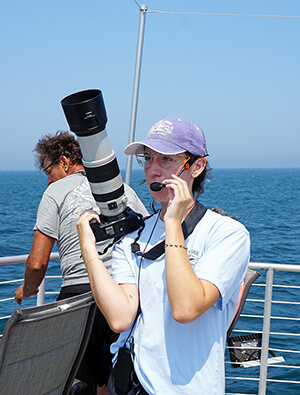
    Brooke van de Sande stands aboard a vessel, speaking through a headset mic while holding a camera.
    Brooke van de Sande

    Brooke van de Sande knows the locations of the cetaceans. With a long-lens camera in one hand and a headset mic in the other, the naturalist on the Jersey Shore Whale Watch vessel Jersey Girl calls out “10 o’clock!” to alert passengers to a humpback whale lunging from the sea in the distance. Multitasking, she shares details about the behaviors and feeding habits of humpbacks over the PA, while trying to capture closeup photos of unique markings on the whale’s tail that can ID individual animals like a massive fingerprint.

    The images and precise location will be shared with the nonprofit Gotham Whale, which is compiling a catalog of all of the whales spotted along the New York and northern New Jersey coasts. They’ve amassed data on hundreds of individual animals since they started in 2011.

    But van de Sande is also determined to learn about the whales she can’t see. The senior marine and environmental biology and policy student at Monmouth University has been conducting research on how effective trace genetic materials floating in the water – called environmental DNA, or “eDNA” – can be for detecting humpbacks in the area.
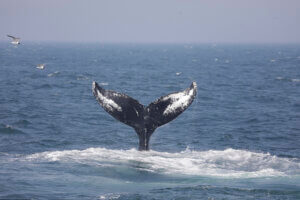
    A humpback tail protruding from the ocean.
    A humpback whale spotted off the coast of Belmar, N.J. (Photo by Brooke van de Sande)

    While interning aboard the Belmar-based vessel in 2023, van de Sande collected a sample of ocean water every time there was a whale spotted within 100 feet. She then filtered out the organic materials from the bottles at a campus lab and tested them for humpback whale DNA. In every case, there was a match.

    “Now we know that there is a strong correlation between DNA samples taken in the water and the visual sightings,” van de Sande said. “If we take a sample and see that there were high numbers of humpback whale DNA, then we can assume that there was a whale in the area, even if we didn’t see one. It’s a really non-invasive technique to monitor whales in the area.”

    She recently presented her work at the Southeast and Mid-Atlantic Marine Mammal Symposium at the Duke University Marine Lab in North Carolina, where she garnered the top prize for undergraduate speed talks. Her work has been guided by faculty mentors Endowed Professor Marine Science Jason Adolf and Environmental DNA/Marine Fisheries Senior Scientist Sam Chin, as well as Gotham Whale Director of Marine Mammal Research Danielle Brown. Her work and conference travel were supported with a grant from the Urban Coast Institute’s Heidi Lynn Sculthorpe Scholars program.
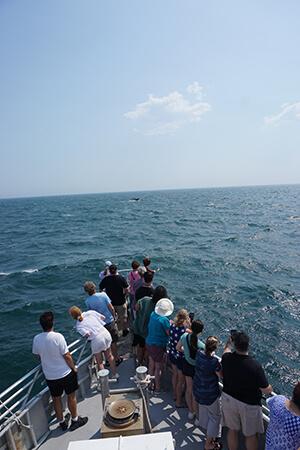
    Spectators on the vessel Jersey Girl watch a humpback whale in the distance.
    Spectators on the vessel Jersey Girl watch a humpback whale in the distance.

    Her class studies on coastal zone management and policy issues have given her added perspective on the importance of the research. She said waters that the Jersey Girl tours are busy with human activities such as cargo ship traffic and recreational boating, and it all needs to co-exist safely with the whales.

    “Ocean urbanization and ocean planning is a big thing right now, especially in New Jersey, with all of the whales that have been showing up here over the past few decades,” she said. “It’s really important that we’re learning about all of the speed restrictions and laws going into place to protect the whales and we’re planning for the future of the ocean in New Jersey and New York.”
  • LISTEN: MacDonald, Herrington Discuss Coastal Resilience on ‘America Adapts’ Podcast

    Urban Coast Institute (UCI) Director Tony MacDonald and Associate Director Tom Herrington appeared on a special episode of the “America Adapts” podcast dedicated to the New Jersey Coastal & Climate Resilience Conference, held at Monmouth University in the spring. In the two-hour episode, host Doug Parsons interviewed 13 attendees about the conference proceedings, their work in the field, and observations on how climate change is impacting New Jersey communities.

    MacDonald appears at the 25:40 mark and Herrington at the 1:03:05 mark. Visit the episode page for the full lineup of speakers and links to listen on your favorite podcast platform.

    The three-day event was hosted jointly by the New Jersey Coastal Resilience Collaborative and the New Jersey Department of Environmental Protection.

  • Amanda Boddy Expands Urban Coast Institute’s Coastal Resilience, Oyster Research Capacity

    Amanda Boddy

    Amanda Boddy, an expert with a decade of experience conducting ecological restoration and coastal resilience projects on New Jersey and New York waterfronts, has joined the Monmouth University Urban Coast Institute (UCI) as its marine biology technician. In this role, Boddy will contribute to the portfolio of projects that fall under the umbrella of the UCI’s Coastal Community Resilience Initiative (CCRI), including the installation and monitoring of artificial reefs along Naval Weapons Station Earle’s shores and an investigation of how fouling on oyster castles impacts their capability to recruit larvae.

    Boddy worked on these projects and other efforts to restore oyster populations in the region’s waters in her previous position as manager of the Coastal Restoration Program for NY/NJ Baykeeper, where she collaborated for several years with UCI Coastal Resilience and Restoration Practitioner Meredith Comi. Through a 2023 agreement, that program’s management was transitioned to Monmouth University, where it has continued to expand. Boddy’s work will be funded through a combination of external grants.

    Boddy first got involved with the Naval Weapons Station Earle project as an intern and marine science student at Rutgers University in 2015. Initially, her work focused on studying the types of structures and materials that were most effective for retaining oyster larvae, a line of research she said is an excellent gateway for students to get started in the field. Later, her work transitioned to studying the sedimentation patterns around the oyster castles to determine whether certain arrangements are better than others for accumulating sand.

    “We looked at erosion versus accretion, because even if the castles didn’t produce oysters, they were still meant to dampen wave energy and hold sand that had been pulled away from shore by waves,” she said.

    Boddy traces her passion for marine science back to her childhood days summering at her grandparents’ home in Manahawkin. There she spent long days on the beach and the bay, earning her boater’s license at age 13.

    However, her career nearly went in a much different direction. Boddy recalled that she was initially a psychology major and intended to pursue a master’s in hospital social work, but the classes never resonated with her. An elective introduction to oceanography class she took as a first-year student would change that trajectory.

    “I remember thinking, I’m actually really good at this, I like it, and everything makes sense because I know how water and marine life work,” she recalled. “I was tutoring a lot of my friends in that class who found it difficult.”

    Today she looks forward to working with Monmouth students and feels her projects present excellent opportunities for experiential learning.

    “As someone who started off as an intern, I really like helping interns out, because marine science can be a difficult field to get your start in,” she said.

  • UCI Director to Chair MCF Educational Outreach Committee

    Urban Coast Institute (UCI) Director Tony MacDonald, who serves as a member of the Monmouth Conservation Foundation (MCF) Board of Trustees, has been appointed as the chair of the organization’s Educational Outreach (EO) Committee. In this role, MacDonald will work with the EO Committee members and MCF staff to help guide the development of an education and outreach plan to reach Monmouth County residents of all ages, focused on environmental sustainability and quality of life related to MCF’s mission.

    The Middletown-based MCF’s core mission is to acquire and preserve open space and farmland and conserve natural habitats throughout Monmouth County in support of outdoor recreation, agriculture, clean water, and wildlife for long-term sustainability. Founded in 1977, the MCF is an independent nonprofit land trust that has preserved more than 9,400 acres of green space in Monmouth County.

  • Four from UCI Named to N.J. Coastal Resilience Collaborative Leadership

    New Jersey Coastal Resilience Collaborative logo

    The New Jersey Coastal Resilience Collaborative (NJCRC) recently reorganized with a new leadership structure that includes four members of the Monmouth University Urban Coast Institute (UCI). As its co-managing director, UCI Associate Director Tom Herrington will help oversee the consortium’s day-to-day activities. UCI Director Tony MacDonald, who had previously served for several years as the organization’s co-chair, will sit on its newly formed Board of Directors.

    Under the new structure, the leaders of the NJCRC’s various workgroups are also automatic members of the board. UCI Coastal Resilience and Restoration Practitioner Meredith Comi serves as the NJCRC’s Ecological Restoration and Science Workgroup lead while UCI Communications Director Karl Vilacoba is its Communications Workgroup lead.

    The NJCRC is a network established to foster sustainable and resilient coastal communities and ecosystems by generating informed action. Its partnership includes over 80 academic institutions, businesses, NGOs, advocacy groups, state agencies, municipalities and regional planning groups.

    Click here to read the announcement summarizing the NJCRC’s full leadership roster.

  • Research Seeks to Learn Why Oysters Aren’t Sticking Around Reef Blocks

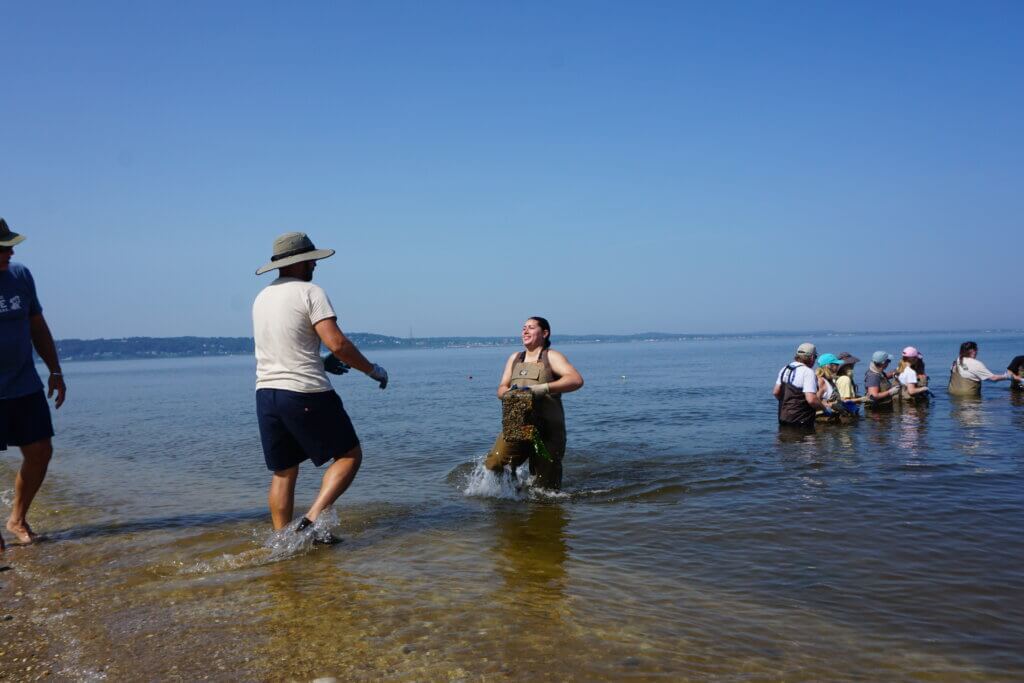
    A line of people in the water passing a block down to a man waiting on the beach

    When oysters are in the market for a home, do they prefer new construction or resales? An experimental research project at Sandy Hook aims to find out.

    On July 16, a team of community volunteers, students and scientists from the Monmouth University Urban Coast Institute (UCI), New Jersey City University (NJCU), the National Oceanic and Atmospheric Administration (NOAA), and the New Jersey Sea Grant Consortium recovered a formation of concrete blocks called oyster castles that had been submerged along a secluded beach on Sandy Hook Bay for a year. The project is being led by NJCU Associate Professor Allison Fitzgerald with co-principal investigator and UCI Coastal Resilience and Restoration Practitioner Meredith Comi.

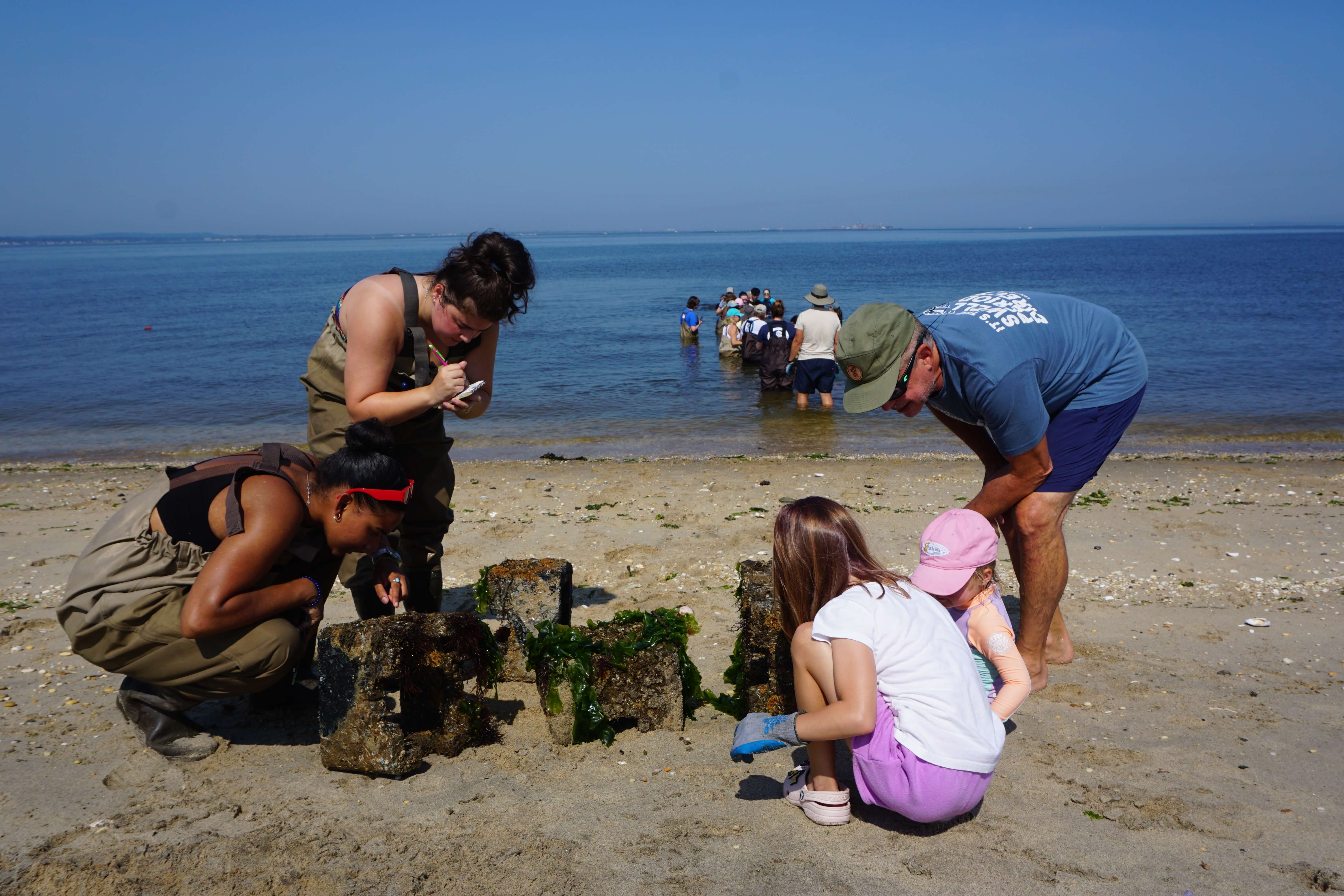
    Four people inspecting an oyster castle block on the beach

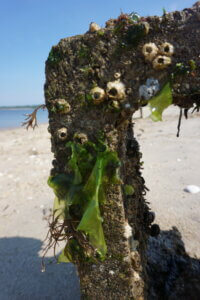
    The group formed a line to the installation and passed each block down to the shore, where the growth on them was inspected and catalogued. Each piece was covered with organisms like mussels, barnacles, sponges, tube worms, and algae.

    The blocks were transported to the nearby NOAA James J. Howard Marine Sciences Laboratory at Sandy Hook and placed in tanks, where oyster larvae will be introduced to the waters and monitored for several weeks. Alongside clean, bare castles, researchers will study whether or not all those other animals (‘fouling organisms’) are detrimental to oyster larvae looking to recruit back to the reef.

    The project was initiated because researchers have observed that as reef structures have been deployed in the wild, oysters will colonize initially, but less and less each year thereafter. The team hopes to determine whether and why oysters lose interest or have trouble attaching to the blocks once they’ve been fouled.

    “Is that level of growth inhibiting the larvae from growing? And if so, what does that mean for these restoration projects?” Comi asked. “There’s no data on it. These projects are all in their infancy, and three, five years out, people are noticing these things.”

    “This project not only allows us to investigate more into the longevity of restoration practices, but also to get a recent biodiversity estimate of animals living near shore on submerged substrate,” Fitzgerald added.

    An unexpected finding was that the blocks on the bottom of the stacks were almost entirely covered by sand. This raised the question of whether they sunk in place or naturally accumulated sediments, which would have implications for oyster castles’ effectiveness as coastal resilience measures. UCI Associate Director Tom Herrington believes it is more likely the latter, because had they sunk, the depths of the blocks would not likely have been as uniform.

    Comi said the team plans to monitor the tanks daily through the early fall, and the results may open new scientific questions.

  • Environmental Justice and Social Work Researcher Rachel Forbes Joins Urban Coast Institute

    Rachel Forbes, an environmental justice scholar and 2011 graduate of the Monmouth University School of Social Work’s Master of Social Work program, has joined the Urban Coast Institute (UCI) as its community engagement and outreach specialist. In this role, Forbes will support the UCI’s National Oceanic and Atmospheric Administration (NOAA) grant-funded work to provide coastal resilience planning support for environmental justice communities in New Jersey.

    Forbes is a professor of the practice of social work at the University of Denver Graduate School of Social Work where she has led the integration of environmental justice into social work curricula and programming. She is also a social work doctoral student at the School of Social Work at Sacred Heart University where her research explores the impacts of environmental justice and climate change on mental health outcomes. Forbes has also supported the development of a bachelor’s degree program in sustainability studies at Colorado Mountain College in Western Colorado. She is co-editor of the recently published book “Ecosocial Work: Environmental Practice and Advocacy,” which delves into the intersection of environmental concerns and social work practice and calls upon social work professionals to engage in ecosocial work practice.

    Environmental justice, or EJ, focuses on addressing disproportionate impacts that people including communities of color, persons with disabilities, women, aging populations, and those who don’t speak English are more likely to face from environmental problems. A society striving to build more resilient communities has an ethical and moral responsibility to consider the needs of those who face inequities as a result of having less social and economic capital at their disposal, she said.

    “Environmental harms and environmental privileges are not equally distributed across populations and we know that certain populations bear the brunt of environmental harms,” Forbes said. “These are also often the communities that are least likely to actually be contributing to those harms.”

    Through the NOAA project, Forbes and the UCI will partner with local leaders and residents, as well as planning and resource experts, to produce climate adaptation plans that foster equitable community resilience. The project will pilot methods for engaging stakeholders in socially vulnerable communities, who are often difficult to reach in planning processes. The community-centric engagement and planning process will develop resilience and adaptation plans that can serve as a model for disadvantaged and environmental justice communities throughout the state.

    “You can’t really talk about the environment without talking about climate change,” Forbes said. “We know that these are communities that are going to be hit harder by the challenges that they face, whether it’s an acute weather event like a hurricane, or other issues like toxic dumping, air pollution, food security and water contamination.”

    Forbes, a longtime resident of Belmar, was first drawn to EJ issues while a MSW student at Monmouth, where she concentrated in international and community development. At the time, she interned for the International Federation of Social Workers at the United Nations headquarters in New York City, and also spent time in Guatemala studying issues surrounding youth homelessness.

    Forbes is an appointed member of the Council on Social Work Education (CSWE) Commission on Educational Policy, the inaugural cochair of the CSWE Committee on Environmental Justice, and a former member of CSWE’s Council on Global, Learning and Practice. She was the taskforce cochair for the CSWE Curricular Guide for Environmental Justice (2020) and was an elected member of the Colorado Chapter of the National Association of Social Workers Board of Directors. She has taught coursework on sustainability, ecological justice, culture and place-based equity, and fostering sustainable behavior across undergraduate and graduate programs for over 10 years. Her work has been published in “Environmental Justice” and has been funded by the CSWE Katherine A. Kendall Institute for International Social Work. She is co-author of the book: “The Intersection of Environmental Justice, Climate Change, Community and the Ecology of Life” (Springer Press, 2020).

  • Watch: Learn to Use the Mid-Atlantic Ocean Data Portal

    Monmouth University Urban Coast Institute Communications Director Karl Vilacoba provided a beginner’s tour of the Mid-Atlantic Ocean Data Portal in a June 25 edition of the Mid-Atlantic Regional Council on the Ocean’s “How Tuesday” webinar series. The webinar demonstrated how to use the Portal’s tools and collection of thousands of interactive maps depicting marine life distributions, fishing grounds, vessel traffic patterns, offshore wind proposals and much more.

    Vilacoba serves as the Portal’s project manager. For additional information about the Portal, email kvilacob@monmouth.edu.

  • Watch: Monmouth Student Researchers Present Posters at Mid-Atlantic Ocean Forum

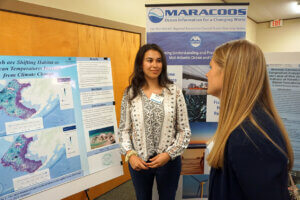
    Three Monmouth University student researchers presented posters at the Sixth Annual Mid-Atlantic Ocean Forum, held May 13-15 in Lewes, Delaware. Hosted by the Mid-Atlantic Regional Council on the Ocean (MARCO), the Forum is the region’s premier annual event dedicated to ocean planning, gathering ocean professionals and stakeholders representing federal and state agencies, Tribal entities, marine industries, nonprofit research and advocacy organizations, and the public. The poster session was organized in partnership with the Mid-Atlantic Regional Association Coastal Ocean Observing System (MARACOOS).

    Presenting were Diederik Boonman Morales, a rising senior in the Marine and Environmental Biology and Policy (MEBP) program; and May graduates Marie Mauro and Ivy Norton, who were also MEBP students. Watch their presentations below.

    Microbial Community Composition Analysis in Coastal Lakes of New Jersey as an Indicator of Harmful Algal Bloom Formations

    Student Researcher and Major: Diederik Boonman Morales, Marine and Environmental Biology and Policy

    Faculty Mentor: Endowed Professor of Marine Science Jason Adolf, Department of Biology

    Abstract: Coastal lakes are unique and important ecosystems, providing numerous benefits ecologically, and to the local communities. However, the health of these ecosystems is threatened and facing gradual degradation due to human activities, polluted water runoff, and Harmful Algal Bloom formations. HABs are complex phenomena that impact waterbodies and can have ecological and anthropogenic impacts. Genomics approaches of microbial community composition can improve our ability to monitor and understand HAB dynamics. Here, environmental DNA (eDNA) samples collected from three coastal lakes in 2021 and 2022 were analyzed by 16s meta-barcoding to examine the spatial and temporal distribution of microbial community composition. Through NMDS (Non-parametric Multi-Dimensional Scaling) ordinations and K-means clustering, the composition can be reduced to a single variable that can more easily be analyzed and spatially represented. A pipeline was created to seamlessly run the same process to analyze future samples. This study will contribute to the conservation and management of these critical ecosystems, providing a better understanding of the roles of microbial communities in coastal lake ecology.

    Assessing Policy Measures for Managing Climate Induced Fish Habitat Shifts

    Student Researcher and Major: Marie Mauro, Marine and Environmental Biology and Policy

    Faculty Mentor: Rechnitz Family/Urban Coast Institute Endowed Chair in Marine and Environmental Biology and Policy Peter Jacques, Department of Political Science and Sociology

    Abstract: Marine fisheries play a crucial role for both nutrition and economic prosperity in the United States. Anthropogenic climate change has been pressuring critical fish species to shift their habitats due to rising ocean temperatures. As a result, fisheries have to adapt which include relocating to alternative locations. The Magnuson-Stevens Act is the primary federal law that governs fisheries in the United States. The goal of this research was to analyze if the federal policies of the United States are adapted to accommodate the shifting habitat of fish which is necessary for maintaining the integrity of fisheries. A policy analysis method was employed to identify if federal policies have taken the shifting habitats of marine fish due to climate change into account with the most recent editions. Results indicate that climate change has not been directly addressed in most federal policies regarding fisheries management. The impacts of climate change already have induced changes in fisheries which is why it is necessary for federal policies to be updated.

    Current Paradigm Affecting the World’s Fisheries

    Student Researcher and Major: Ivy Norton, Marine and Environmental Biology and Policy

    Faculty Mentor: Rechnitz Family/Urban Coast Institute Endowed Chair in Marine and Environmental Biology and Policy Peter Jacques, Department of Political Science and Sociology

    Abstract: In the contemporary world, the status of our fisheries emerges as a paramount concern, besieged by overfishing, pollution, and dwindling biodiversity. This poster confronts the critical issue of fisheries mismanagement by investigating its core values. To answer the question, “What are the dominant values that manage world fisheries?” I use a quantitative content analysis of one of the more important international fisheries documents published every two years by the United Nations Food and Agriculture Organization, The State of the World’s Fisheries and Aquaculture (SOFIA Reports), using a proven dictionary from prior publications on this very issue in (Lobo and Jacques 2017 & Jacques and Lobo 2018. The publication’s data ended in the 2016 SOFIA report, and this work extends to the 2022 report to measure changing values across time. In particular, I analyze whether the economistic paradigm those prior papers found is still dominant, or if other paradigms have displaced the drive for economic growth. Thus, central to our inquiry is the exploration of alternative frameworks that challenge the economistic paradigm, emphasizing principles of sustainability, equity, and ecological resilience. By investigating and analyzing values in these documents, I can theorize the root causes of overfishing and environmental degradation. Early indications are that economism has not been displaced, indicating a need for a shift in policies and decision-making pertaining to fisheries management. Ideally one day we will have access to fisheries that are healthy and abundant while still being able to rely on them as a source of food around the world.

  • ‘We’re All Plastic People Now’ Screening at Monmouth U. May 16

    A free screening of the documentary “We’re All Plastic People Now” will be held at 6:30 p.m. on May 16 at Monmouth University’s Young Auditorium. Introduced by actor and environmentalist Ted Danson and directed by Rory Fielding, “We’re All Plastic People Now” investigates the hidden story of plastic and its effects on human health. A panel discussion with New Jersey experts on plastics will follow the hourlong film.

    The event is being hosted by Oceana, the Sierra Club New Jersey Chapter, Surfrider Foundation Jersey Shore Chapter, Save Barnegat Bay, Clean Water Action, Save Coastal Wildlife, Clean Ocean Action, Beyond Plastics, and the Monmouth University Urban Coast Institute.

    The Young Auditorium is located in Monmouth University’s Leon Hess Business School (Samuel E. and Mollie Bey Hall). Visitors can park in Monmouth’s main campus lot, accessible via the Larchwood Avenue entrance.