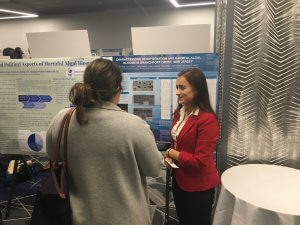
 A poster co-led by Monmouth University students Erin Conlon and Skyler Post earned the top prize for work presented by undergraduates at the 10th U.S. Harmful Algal Bloom (HAB) Symposium, held in November in Orange Beach, Alabama. The poster highlighted the students’ ongoing research on low-oxygen conditions and toxic organisms in Branchport Creek, a Shrewsbury River tributary located in Oceanport and Long Branch, New Jersey.
Post and Conlon attended the symposium with fellow Monmouth University Phytoplankton and Harmful Algal Bloom Lab (PHAB Lab) student researchers Maria Riley and Ariel Zavala, and Endowed Associate Professor of Marine Science Jason Adolf. All four students presented at the poster session and Post (seen in photo at the conference), who represented the Branchport Creek project, won Best Undergraduate Poster for her presentation of the work at the meeting. The trip and research was supported with grants through the UCI Scholars Program.
According to Adolf, the symposium’s focus has shifted over the years from a near total focus on saltwater environments to a now 50/50 split between saltwater and freshwater HABs.
“In 2014 in the U.S., more than 400,000 people living around Lake Erie had toxic water coming out of their tap as a result of a harmful algal bloom,” Adolf said. “The fact that many drinking water plants were not built to remove algal toxins speaks to the recent emergence of the problem.”
New Jersey recently experienced what may be remembered as a summer of HABs, with blooms causing use restrictions and closures in the summer tourist destinations of Lake Hopatcong and Greenwood Lake, and the Manasquan Reservoir, a drinking water source for several Jersey Shore towns. This year the PHAB Lab has focused on monitoring water quality issues in Monmouth County coastal lakes, surfing beaches and local river systems and estuaries.
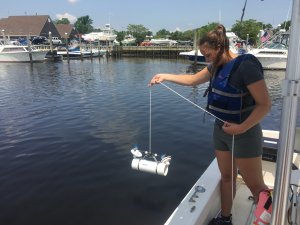 “Last year over the summer we were researching Sandy Hook Bay, the Navesink River and the Shrewsbury River, and every time we went out there was a hot spot of chlorophyll in Branchport Creek,” said Conlon (seen in photo sampling the creek). “We didn’t really have any stations set up there and we wanted to look at that more.”
What they found were phytoplankton biomass levels 10 to 100 times higher than anywhere else in the system. Adolf also said that they observed phytoplankton stratified in a “super-concentrated layer” at the top of the water, while the layer below was had little or no plankton or oxygen at all.
Warning signs were posted around the creek over a decade ago when it was determined that stormwater runoff from the Monmouth Park horse racing track had caused high fecal coliform levels. The problem was later addressed as part of a settlement between the Department of Environmental Protection and the track’s former operators.
“Even though there are signs up saying things like ‘Polluted: Don’t Touch,’ we saw people there who were fishing and crabbing in that water. They definitely should not be,” Post said. “You can almost always count on seeing dead fish or fish hopping out of the water there.”
Adolf said the students’ work could offer new insight on fish kills that have occurred in the creek in recent years. A decade ago, the UCI and School of Science conducted real-time monitoring of water conditions in the creek to study the impact of low-oxygen conditions on menhaden kills. The PHAB Lab work is focused both on water conditions and the microscopic plankton and bacteria living in the water. Organisms they found are known to make toxins that can irritate or kill wildlife.
“What [Conlon and Post] did was elucidate the fact that there’s also a toxic dinoflagellate bloom – a massive bloom, with very high levels of biomass in that creek at the same time,” Adolf said. “It fills out the story of the fish kills in the creek.”

 Speakers
 This event is intended to educate the state’s legal and policy communities and the public on local climate impacts and associated costs now facing communities and taxpayers, and to initiate a dialogue on the growing trend of climate damages litigation in the U.S. Panelists will discuss the extent of climate harms in New Jersey as well as the scientific basis for holding the fossil fuel industry accountable for them. Panelists will also offer legal and community perspectives on damages litigation as a means to shift some of the burden from taxpayers to polluters.
 The Urban Coast Institute (UCI) will welcome one of the nation’s leading scholars at the intersection of animal and environmental law to Monmouth University on March 25 to deliver the guest lecture “Fish Suffering, Climate Change, and the Public Trust Doctrine.” Pace University Professor David Cassuto’s lecture, the latest installment in the UCI’s Marine Science and Policy Series, will be held from noon to 1 p.m. in Bey Hall’s Turrell Boardroom (201).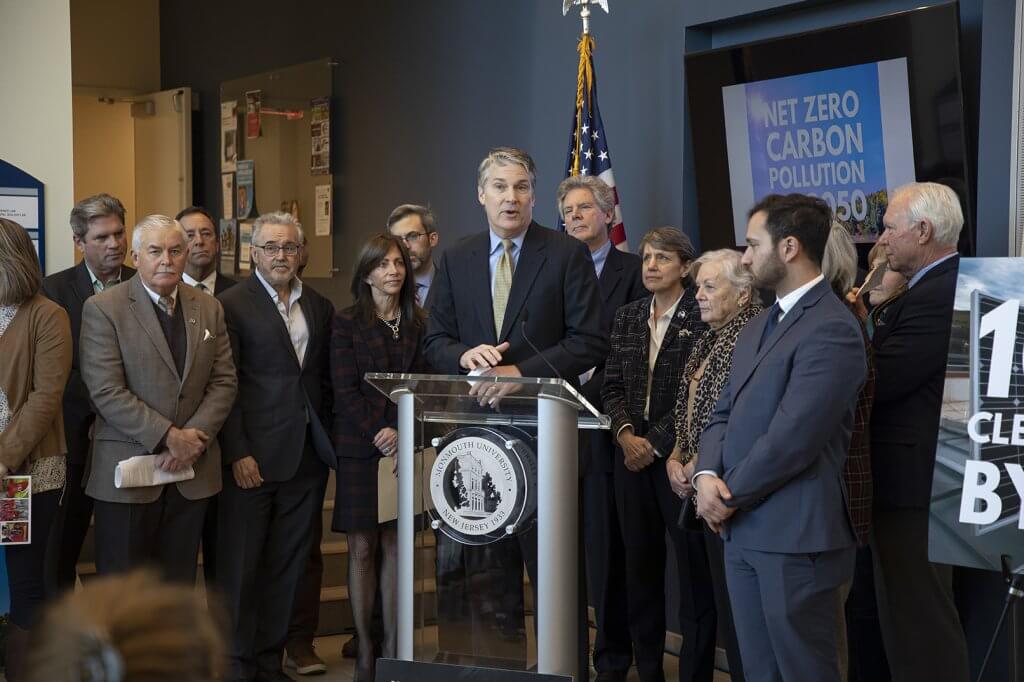
 “I need to thank [Congressman Pallone] on behalf of the ocean because people are increasingly recognizing the climate-ocean nexus,” MacDonald said. “This is a real issue. Twenty-five percent of carbon that is emitted goes into the ocean. Ninety percent of the excess heat that comes from greenhouse gases goes into the ocean, and we can’t handle much more of it.”
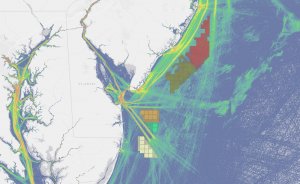 Take a state-by-state tour of active federal offshore wind energy leases from New York through Virginia in
 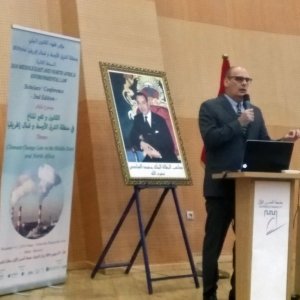 Abate, the only invited speaker from the U.S., delivered his presentation, “Climate Change and the Voiceless: Protecting Future Generations, Wildlife, and Natural Resources,” to an audience of more than 75 attendees, which included climate change law and policy scholars from the MENA region and Moroccan law students.
 The Kislak Real Estate Institute and Department of Economics, Finance and Real Estate at Monmouth University are seeking applications for an open rank Professor in Economics. This position is for the 2020-2021 academic year and is tenure-track.