2026 Summer Research Program Symposium Abstracts
Thursday, August 6, 2026
Erlanger Garden
Rain Location: Edison Science Building, Room E 201
Message from the Dean
Dear Friends and Colleagues,
I would like to take this opportunity to thank the supporters and university partners who contributed to the success of the 2026 Monmouth University School of Science Summer Research Program (SRP). Your contributions allow us to provide impactful research experiences for undergraduate students by funding their summer salaries as research assistants, acquisition of the supplies and equipment necessary to complete their research projects, and providing opportunities for students to travel to conferences and professional meetings to present their research. Without your collective philanthropy and support, the Summer Research Program would not be possible.
I would also like to acknowledge the faculty from the School of Science who dedicated their time and offered their expertise to mentor participating students this year. We aim to provide meaningful experiences outside traditional classroom settings, and this event is crucial in reaching this goal.
Lastly, I offer congratulations to the student research assistants for their efforts and enthusiasm in completing their projects that are highlighted at today’s Summer Research Program Symposium.
Joe Coyle,
Dean, School of Science
2026 Summer Research Program University Partners
The School of Science Summer Research Program (SRP) would not be possible without the support of the Departments of Biology, Chemistry and Physics, Computer Science and Software Engineering, and Mathematics as well as a number of other University offices, programs, and supporters including the following:
Monmouth University Office of the Provost
Monmouth University’s Office of the Provost provides the chief academic leadership, responsibility and support to all of the University’s schools and centers of distinction.
The Provost Office provides stipends to faculty that participate as mentors to our Summer Research Program student research assistants.
Monmouth University School of Science Dean’s Advisory Council
The School of Science Dean’s Advisory Council provides key input to the School’s strategic planning process and annual support for the Summer Research Program.
- Joseph Chung, Ph.D.
- Rebekah Y. Chung ’05M
- Joseph F. Coyle, Ph.D.
- Karen F. Coyle
- Pedram P. Daneshgar, Ph.D.
- Daniel D. Gerdon ’21 ’23M
- William Hammind
- Kurt M. Kovach ’85
- Mari C. Kovach ’82 ’86M
- Bruce Kratz ’89
- Lynn A. Kratz ’94M
- Anne Marie Lavin
- Sharon C. Lehrer
- Michael S. Maiden Jr. ’07M ’14M
- Madelyn I. Mauterer ’15, Ph.D.
- David Minton
- Koorleen M. Minton ’11
- Sossie Najarian
- Tavit O. Najarian, Sc.D.
- Daniel M. Santarsiero
- Elizabeth A. Santarsiero
- Edward C. Thomas
- Patricia A. Thomas
- Ellie Tiedemann
- John Tiedemann
- Jiacun Wang, Ph.D.
- Kevin W. Young ’89
Symposium Agenda
| Time | Event |
|---|---|
| 10–10:15 a.m. | Welcome and Opening Remarks Associate Dean Tsana Tongesayi |
| 10:15 a.m.–12:00 p.m. | Poster Session |
| 11:15 a.m. | Lunch Available |
| 12–12:15 p.m. | Closing Remarks Dean Joe Coyle |
| 12:15 p.m. | Networking and Photos |
| 12:30 p.m. | Adjourn |
The symposium features poster presentations highlighting research projects conducted by School of Science students who participated in the School of Science Summer Research Program.
Project Abstracts
Department of Biology
SRP-1: Comparing Post-Rainfall Enterococcus faecalis Concentrations Between Bayside and Ocean-Side Waters at Sandy Hook, New Jersey
Tyler Pylarinos (Department of Biology)
Faculty Mentors: Jason Adolf, Ph.D.; Elizabeth Clark (Department of Biology)
Funding Sources: Monmouth University Urban Coast Institute; The Surfrider Foundation; Monmouth University School of Science
Read the Abstract—SRP-1: Comparing Post-Rainfall Enterococcus faecalis Concentrations Between Bayside and Ocean-Side Waters at Sandy Hook, New Jersey
Enterococcus spp. are highly resilient enteric bacteria that are routinely used as environmental indicators of fecal contamination in coastal waters, rivers, and lakes. Fecal contamination is a concern for public safety, prompting the monitoring of Enterococcus to protect public health. Elevated concentrations may indicate the presence of waterborne pathogens. Rainfall can increase the concentration of fecal indicator bacteria in recreational waters by carrying stormwater runoff, animal waste, and other contaminants into coastal environments. This study will compare Enterococcus concentrations between bayside and oceanside sampling locations at Sandy Hook, New Jersey, approximately twelve hours after rainfall. This comparison is important because bayside and oceanside waters differ in circulation and mixing, which may influence how long fecal contamination remains concentrated after rainfall. Identifying these differences can help determine whether certain recreational areas may experience greater contamination and potential public-health risks. Water samples were collected from three bayside stations and three oceanside stations. The water samples will be tested using two different laboratory methods to detect and measure Enterococcus bacteria, the IDEXX Enterolert assay and a qPCR assay, allowing the results from each method to be compared. We hypothesize that bayside locations will contain higher Enterococcus concentrations than oceanside locations because the bay has less wave action and water circulation, potentially allowing bacteria introduced by runoff to remain concentrated for longer periods. The results will be compared between the two environments to determine whether sampling location is associated with Enterococcus concentration following rainfall. This research may help identify areas with a greater risk of fecal contamination and improve understanding of how rainfall affects recreational water quality at Sandy Hook.
SRP-2: Exploring Vertebrate Diversity of Monmouth County Coastal Lakes Using Environmental DNA
Ava Gronberg (Monmouth University Department of Biology; University of St. Andrews School of Chemistry)
Mentors: Ms. Elizabeth Clark, Ms. Erin Conlon, Mr. Richard Kane & Dr. Jason Adolf (Monmouth University Department of Biology)
Funding Sources: Monmouth University Urban Coast Institute; Monmouth University School of Science
Read the Abstract—SRP-2: Exploring Vertebrate Diversity of Monmouth County Coastal Lakes Using Environmental DNA
Environmental DNA (eDNA) is a useful tool for studying biodiversity in aquatic ecosystems without needing to capture organisms directly. In this project, water samples were collected from coastal lakes in Monmouth County, including Lake Como, Deal Lake (Sites 1, 2, 3, and 5), Fletcher Lake, Silver Lake, Spring Lake, Sunset Lake, Sylvan Lake, Lake Takanassee, Wesley Lake, and Wreck Pond.
The goal of this study was to identify and compare the vertebrate species present in each lake using eDNA metabarcoding. After collecting the water samples, DNA was extracted and analyzed using vertebrate-specific 12S markers. Although the focus of this project was on fish diversity, the vertebrate eDNA detected also included DNA from other animals that spend time in or around the lakes, such as birds, deer, and small rodents.
The results showed that vertebrate diversity varied among the different lakes, with some lakes containing a greater number of detected species than others. Differences in vertebrate biodiversity among the lakes are likely influenced by variations in environmental conditions such as salinity, water temperature, pH, water quality, and the amount of pollution and stormwater runoff each lake receives, creating unique habitats that support different communities of species.
This study demonstrates how eDNA metabarcoding can provide a broad picture of vertebrate biodiversity in and around coastal lake ecosystems and highlights its value as a non-invasive method for ecological monitoring. Overall, this project helped improve our understanding of the vertebrate communities present in lakes throughout Monmouth County and demonstrate the value of eDNA as a tool for conservation.
SRP-3: Spatial Variation in Enterococcus spp. Concentrations Across High and Low Recreational-Use Waters at Sandy Hook, New Jersey
Emma Owendoff Najarian (Monmouth University Department of Biology; Lehigh University College of Health)
Faculty Mentors: Ms. Elizabeth Clark, Dr. Jason Adolf (Monmouth University Department of Biology)
Funding Sources: Monmouth University Urban Coast Institute; The Surfrider Foundation; Monmouth University School of Science
Read the Abstract—SRP-3: Spatial Variation in Enterococcus spp. Concentrations Across High and Low Recreational-Use Waters at Sandy Hook, New Jersey
Enterococcus spp. are fecal indicator bacteria routinely monitored to assess recreational water quality and protect public health. Elevated concentrations are associated with an increased risk of exposure to fecal contamination and can prompt beach advisories and closures. While routine monitoring is conducted throughout New Jersey, less is known about how Enterococcus concentrations vary across coastal environments with differing levels of recreational use. This study investigates the relationship between recreational activity and Enterococcus concentrations at coastal sites with varying levels of recreational activity at Sandy Hook, New Jersey.
Water samples were collected from six sampling locations representing both Atlantic-facing beaches and bay-side coastal waters with varying levels of recreational activity approximately 12 hours after a significant rainfall event. Samples were analyzed using IDEXX Enterolert, the U.S. Environmental Protection Agency–approved method used by the New Jersey Department of Environmental Protection for recreational water monitoring, and quantitative polymerase chain reaction (qPCR), a complementary molecular method that quantifies Enterococcus DNA. Environmental metadata, including GPS coordinates, water quality parameters, weather, tide stage, and estimates of swimmer and bird abundance, were recorded.
Statistical analyses will evaluate differences in Enterococcus concentrations across sites with varying recreational use while considering environmental conditions. This study will provide preliminary insight into the relationship between recreational activity and Enterococcus concentrations to inform future recreational water monitoring and public health protection along the New Jersey coastline.
SRP-4: Nourished But Delayed: Evaluating Recruitment Pulses of the Atlantic Mole Crab and Sediment Gradients on an Engineered Beach
Jessica Kipnis, Zoe Thompson, and Nevo Ein-Dor Truong (Department of Biology)
Faculty Mentor: Dr. Jason Adolf (Monmouth University Department of Biology)
Funding Sources: Monmouth University School of Science; Department of Biology
Read the Abstract—SRP-4: Nourished But Delayed: Evaluating Recruitment Pulses of the Atlantic Mole Crab and Sediment Gradients on an Engineered Beach
Beach nourishment is a widespread engineering strategy used to combat shoreline erosion, yet its ecological ramifications on sandy beach macrofauna remain poorly understood. This study evaluates the impacts of coastal engineering by comparing population dynamics of the Atlantic mole crab (Emerita talpoida) and environmental context between an engineered beach (Deal) and a natural baseline control (Sandy Hook). Sampling took place during a structured seasonal window of summer 2026, where we measured and quantified sediment samples and crab abundance. Using a multivariate statistical framework, we tracked abundance across three ontogenetic cohorts, alongside sediment moisture and grain size class sorting. Granulometric analysis revealed a stark physical contrast between sites, with Deal having a significantly higher relative proportion of fine sand (< 0.25 mm) and higher sediment moisture, while Sandy Hook had a much higher proportion of coarser sand (0.5–8 mm) correlating with less moisture retention. While mole crab abundance did not differ significantly between sites, generalized linear mixed modeling (GLMM) found littoral microhabitat and size class as primary structural drivers, alongside significant lunar phase synchronization. Temporal tracking revealed a diverging shift between the two sites rather than a permanent population suppression. The natural baseline experienced a localized recruitment pulse in mid-June, while the engineered system showed a delayed intermediate pulse in mid-July. These findings suggest that engineered beach modifications can disrupt macrofaunal settlement timelines by altering grain size sorting which in turn disrupts microhabitat hydrology, emphasizing the need for temporal coordination in coastal management frameworks.
SRP-5: Impact of a Heavy Rainfall Event on Phytoplankton and Zooplankton in Deal Lake, NJ
Nevo Ein-Dor Truong, Zoe Thompson, and Jessica Kipnis (Department of Biology)
Faculty Mentor: Dr. Jason Adolf (Department of Biology)
Funding Sources: Monmouth University School of Science; Monmouth University Urban Coast Institute
Read the Abstract—SRP-5: Impact of a Heavy Rainfall Event on Phytoplankton and Zooplankton in Deal Lake, NJ
Coastal lakes such as Deal Lake in New Jersey are important habitats for wildlife and support a range of recreational activities, including fishing, boating, and birdwatching. These shallow, often brackish or freshwater systems sit close to the ocean and are shaped by both marine and terrestrial influences, making them ecologically distinct and sensitive to change. In this study, we observed the water quality in these lakes to see a shift following heavy rainfall. Storms increase surface runoff from surrounding urban and suburban areas, carrying nutrients like nitrogen and phosphorus directly into the lake, which also flushes into the ocean. This nutrient intake, combined with sediment, road salt, and other pollutants, can trigger changes in water chemistry, including drops in salinity, turbidity, fluorescence, and dissolved oxygen. These changes directly affect the microorganisms on how they interact with one another and changes in abundance on certain species from zooplankton like rotifers, and crustacean larvae, to phytoplankton like Dolichospermum and Desmodesmus. By collecting samples in Deal Lake from three different streets called Norwood Avenue, Sunset Avenue, and Main Street, we were able to observe changes in three distinct spots of the lake. Measurements such as water temperature, dissolved oxygen, conductivity, and cyanofluorescence were all recorded. Samples that were taken were preserved with Lugol’s iodine and was then studied under the microscope for identification of different species of cyanobacteria and zooplankton. By using the Shannon Indices Method, cells were counted within 1×1 mm squares (Sedgewick-Rafter Chamber) to determine prominent taxa. Throughout this study, a decrease in cyanofluorescence and a change in taxa was observed following the heavy rainfall event. Zooplankton decreased as other plankton like Desmodesmus, and Dolichospermum, and zygospores were more abundant. These results help us understand better how this microscopic ecosystem is ever changing so rapidly with the sudden occurrence of a single storm in Deal Lake.
SRP-6: Weekly Changes in Plankton Communities and Watercolor in Deal Lake, New Jersey
Zoe Thompson, Nevo Ein-Dor Truong and Jessica Kipnis (Department of Biology)
Faculty Mentor: Dr. Jason Adolf (Department of Biology)
Funding Sources: Monmouth University School of Science; Monmouth University Urban Coast Institute
Read the Abstract—SRP-6: Weekly Changes in Plankton Communities and Watercolor in Deal Lake, New Jersey
Coastal lakes are valuable for both wildlife and recreation, but their water quality can change when plankton communities shift, especially if harmful cyanobacteria are present. In this study, we tracked weekly changes in plankton at three sites in Deal Lake, New Jersey: Norwood Avenue, State Street, and Sunset Avenue. We also examined whether the color of water could help predict which cyanobacteria were most common. Each week during summer 2026, we collected samples and measured water temperature, conductivity, dissolved oxygen, cyanofluorescence, and water color. We preserved the samples with Lugol’s iodine and used a microscope to identify the plankton and estimate the abundance of each genus. To analyze water color, we used the CIELAB system, which measures lightness (L*), green-to-red (a*), and blue-to-yellow (b*) values of water collected in white buckets. Our results showed that plankton communities changed over time and between locations. Based on microscopic counts, zooplankton made up about 47% of the community during the first two weeks. Following a major rainstorm, phytoplankton increased to about 65% on July 7. We also found significant relationships between water color and dominant cyanobacteria. Dolichospermum was negatively related to bucket L* (r = −0.47) and bucket a* (r = −0.70). Chroococcus was negatively related to surface L* (r = −0.48) but positively related to surface a* (r = 0.54). Woronichinia was positively related to bucket a* (r = 0.46). The phytoplankton increase following the rainstorm may have resulted from nutrients carried into the lake by runoff. These findings show that Deal Lake’s plankton community can shift quickly after weather events. They also suggest that characterizing water color could provide a simple, low-cost method for detecting changes in cyanobacteria and monitoring possible blooms.
SRP-7: Impacts of Salt Intrusion and Marsh Transgression on Coastal Forests
Maggie E. Raymond, Molly R. Frascella, Lillian G. Cole (Marine and Environmental Biology and Policy Program)
Faculty Mentor: Dr. Pedram Daneshgar (Department of Biology)
Funding Sources: Monmouth University School of Science, Plant Ecology Research Lab Fund, Bonnie Muir, Carol Fornwald
Read the Abstract—SRP-7: Impacts of Salt Intrusion and Marsh Transgression on Coastal Forests
Due to sea level rise, extreme storms associated with climate change, and saltmarsh intrusion, the coverage of maritime forests has been reduced to 1% of their historical range, creating highly salinized “ghost forests” of dead, sun-bleached timber. To assess these impacts, three plots were analyzed along an environmental gradient: the marsh, the transitional area between the marsh and maritime forest, and the maritime forest itself. At each plot, data collection included species composition, percent coverage, canopy type, and a soil sample. The soil sample was used to record pH and salinity of each location. Finally, the Shannon-Weiner diversity index was used to calculate the diversity of each plot. As expected, soil salinity was found to decrease inland. Preliminary analysis indicates that on average, the transition and maritime ecosystems have similar levels of diversity, with the marsh ecosystems having a significantly lower level of diversity. Further sampling is expected to show the highest levels of diversity occur within transition ecosystems, due to the encroachment of marsh species into the declining maritime forest. In addition, we documented each site we sampled with video in order to create educational outreach videos.
SRP-8: Impacts of Drought and Elevated Temperature on Juvenile Coffee (Coffea arabica) Plants
Lillian G. Cole, Molly R. Frascella, Maggie E. Raymond (Marine and Environmental Biology and Policy Program)
Faculty Mentor: Dr. Pedram P. Daneshgar (Department of Biology)
Funding Sources: Monmouth University School of Science, Provost Summer Scholar Program
Read the Abstract—SRP-8: Impacts of Drought and Elevated Temperature on Juvenile Coffee (Coffea arabica) Plants
The future of the coffee industry is in danger. Climate change, primarily through rising temperatures and unpredictable rainfall is proving to be detrimental in the regions where coffee is grown. Projections indicate that in the coming decades sed areas will be uninhabitable for coffee growth. In this study, drought conditions were replicated with Coffea arabica, the most dominant coffee species. There are 100 coffee plants around 6 months of age used for this study. The plants are grown in two distinct environments: the greenhouse where temperatures range greatly and the lab where temperature is constant. Within the two environments each of the plants were randomly assigned one of the five treatments: high (simulating a rare event–excessive water), base (simulating current precipitation patterns), 2060 (simulating the predicted precipitation patterns of the year 2060–slight drought), 2080 (simulating the predicted precipitation patterns of the year 2080–moderate drought), 2100 (simulating the predicted precipitation patterns of the year 2100–extreme drought). This experiment is set up and being conducted through a randomized block design. The plants undergo watering twice a week and measurements once a week. During each watering they receive half of their water allotment for the week: high (125 mL), base (100mL), 2060 (85 mL), 2080 (70 mL), and 2100 (50 mL). Treatments began on June 23, 2026 with no set end date. At current a difference has not been noted amongst treatment types but has been noticed between environments with the greenhouse plants trending smaller than the lab plants.
SRP-9: MKP-2 Expression Is Correlated With JNK Activation in Cypress Essential Oil Treated Fibrosarcoma Cells
Warda Chowdhury, Hermoine Kissoon, and Mariam Samaan (Monmouth University Biology Department)
Carmen Lobo (St John Vianney High School)
Faculty Mentors: Dr. Dorothy Lobo and Dr. James Mack (Monmouth University Department of Biology)
Funding Sources: Monmouth University School of Science, Mr. Kevin W. Young ’89
Read the Abstract—SRP-9: MKP-2 Expression Is Correlated With JNK Activation in Cypress Essential Oil Treated Fibrosarcoma Cells
Cypress oil is an essential oil derived from evergreen coniferous trees native to Southern Europe and Western Asia. Cypress essential oil is composed of a total of 20 constituents which represent 98.1% of the oil. These include: α-pinene (48.6%), δ-3-carene (22.1%), limonene (4.6%) and α-terpinolene (4.5%) which are the main components comprising 79.8% of the oil. Some of these components have demonstrated anti-cancer properties, but little is known about their effects in fibroblasts. Previous work in our laboratory demonstrated that both HT-1080 fibrosarcoma cells and CUA-4 normal human fibroblasts displayed reduced proliferation and viability after treatment with cypress essential oil. It was found that the JNK protein, a stress-regulated mitogen-activated protein (MAP) kinase, was activated upon treatment. This treatment could lead to changes in downstream gene expression which could result in apoptosis. Proteins were extracted from fibrosarcoma cells treated with cypress essential oil and used for western blot analysis to determine whether apoptosis was triggered. Apoptosis was measured by quantifying PARP cleavage. Activation of JNK may also result in the upregulation of MKP-2, which is involved in the negative feedback of JNK. MKP-2 expression was found to be increased in cypress-treated cells, reflecting the potential need to modulate JNK activity in treated cells. For further research, it may be possible to impede the activity of JNK with the help of chemical inhibitors or overexpression of phosphatases in order to test whether apoptosis could be reduced.
SRP-10: A Drosophila Model of Human ATXN2.117Q-Induced Aggression
Vinicius Dias de Oliveira, Julia M. Eck, Eqrah Qadiri, Sarah A. Henry, Saheli Sengupta* (Monmouth University)
Siyuan Yang, Caroline B. Palavicino-Maggio (McLean Hospital, Harvard Medical School, Belmont, MA)
Lily Eyvazzadeh (Emory University, Atlanta, GA)
Faculty Mentor: Dr. Saheli Sengupta (Monmouth University Department of Biology)
Funding Sources: Monmouth University School of Science
*Note: Saheli Sengupta served as a corresponding author
Read the Abstract—SRP-10: A Drosophila Model of Human ATXN2.117Q-Induced Aggression
Dysregulated aggression is a clinically significant feature of several neuropsychiatric and neurodegenerative disorders, yet the molecular and neural-circuit mechanisms that drive pathological increases in aggression remain poorly understood. Polyglutamine-expanded proteins disrupt neuronal homeostasis and circuit function, but their effects on the neural systems that regulate aggression have not been systematically examined. We therefore used Drosophila melanogaster, which combines quantitative social-behavior assays, precise genetic targeting, and a comprehensively mapped adult brain connectome, to investigate whether neuronal expression of a pathogenic polyglutamine-expanded protein alters aggression. We generated a fly model in which full-length human ATXN2.117Q is chronically expressed in a defined subset of brain neurons targeted by R10B06-GAL4. Seven-day-old males expressing ATXN2.117Q displayed heightened aggression relative to genetic controls. Preliminary negative-geotaxis assays did not reveal an overt climbing deficit, suggesting that the behavioral phenotype is not readily explained by gross motor impairment, although additional biological replicates are underway. Courtship assays are also in progress to distinguish whether ATXN2.117Q produces a generalized increase in social arousal or a more selective enhancement of aggression. GFP reporter mapping revealed R10B06-labeled neurons in multiple brain regions, including the mushroom bodies, subesophageal zone, and lateral horn region. Future studies will determine the age dependence, cellular correlates, and circuit basis of ATXN2.117Q-induced aggression. Together, these findings establish a model linking polyglutamine-expanded human ATXN2 expression in a defined neuronal population to heightened aggression and provide a framework for determining how pathogenic protein dysfunction disrupts aggression-regulating neural circuits.
Support: Institutional funds from Monmouth University to Saheli Sengupta and 1R35GM157195-01 awarded to Caroline B. Palavicino-Maggio.
SRP-11: Effects of Traffic Noise on Northern Cardinal Song Frequency
Zoe R. Glavan (Department of Biology)
Faculty Mentor: Dr. Sean C. Sterrett (Department of Biology)
Funding Sources: Monmouth University School of Science and Department of Biology
Read the Abstract—SRP-11: Effects of Traffic Noise on Northern Cardinal Song Frequency
Urbanization, which encroaches upon natural habitat, can impact how songbirds communicate through increases in noise pollution. Northern Cardinals (Cardinalis cardinalis) use sound to defend territories, attract mates, maintain pair bonds, and signal alarm. Increased background noise can mask these vocalizations, reducing communication and potentially affecting reproductive success and survival. The objective of this study was to determine whether noise pollution influences the song frequency of Northern Cardinals (Cardinalis cardinalis). This study was conducted at Huber Woods during June and July 2026 using Wildlife Acoustics Song Meter SM4 recorders to collect bird songs from three treatment sites: a forest interior (I), a busy road (BR), and a quiet road (QR). Recordings were analyzed in Raven Lite to identify species and compare song frequencies among treatments. While the interior forests is meant to act as a true control, the quiet road served also a control to determine if song frequencies were associated with traffic noise or due to edge effects. To collect data, recording devices were placed at each site for five consecutive days and recorded from 4:30 a.m. to 9 a.m., when songbirds habitually sing their morning chorus. The recordings were analyzed in Raven Lite, and Northern Cardinal songs were selected for comparison among treatments. From this study, we learned the difficulties of finding a true interior forest, as well as the complexity of bird song identification. However, Northern Cardinal was prominent at all sites and future analyses will focus on this species. Overall, this project aims to understand how Northern Cardinals may respond to increasing noise pollution and how they adjust to increasingly urbanized environments. As development continues to expand into natural habitats, understanding the effects of noise pollution on bird communication can help inform future conservation and habitat management efforts.
SRP-12: How Do Mutations in Histone Chaperones and the Replisome Affect the Overall Health of Drosophila melanogaster?
Stella Saad (Swarthmore College Department of Engineering)
Cibella Tvrdik (University of Massachusetts Amherst Department of Microbiology)
Faculty Mentor: Dr. Jennifer Urban (Monmouth University Department of Biology)
Funding Sources: Monmouth University School of Science and Department of Biology
Read the Abstract—SRP-12: How Do Mutations in Histone Chaperones and the Replisome Affect the Overall Health of Drosophila melanogaster?
Drosophila melanogaster, most known as fruit flies, is a multicellular organism. It is composed of many different cells with distinct functions and specific structures that support their function. Every different cell that makes up Drosophila has the same DNA. What guides the cells through differentiation? These things are nucleosomes. Nucleosomes are a unit of chromatin that consists of DNA wrapped around a histone unit. As an organism develops, the many cells undergo cell division. During DNA replication, both the cells and the chromatin state is doubled. In DNA replication, the replication fork removes nucleosomes to unwind the double stranded DNA into single stranded DNA. The nucleosomes that are on the double stranded DNA disassemble from the chromatin when the replication fork comes by and reassembles onto a single DNA strand. Studies have shown when histone chaperones are mutated, they disrupt how the histones are distributed behind the replication fork. The replisome, which is DNA replicating machinery, is composed of many components. Mutations have been found in two components of the replisome, MCM21 and Polα12 genes. However, all experiments regarding these genes have been done in vitro. The aim of this project is to place these mutations in vivo and study their biological role and effect in the multicellular organism Drosophila. After confirming the presence of the mutation in vivo by sequencing, we tested the effect of this mutation by assessing the Mendelian ratio of progeny and fertility of male flies. In the future, we will create a vector expressing the mutated proteins to test if their interaction with histones is impaired.
Department of Chemistry and Physics
SRP-13: Investigating the Impact of Base Pair Mismatches on the B-to-A Conformational Transition of Duplex DNA
Zach Brewer, John Hebron (Department of Chemistry and Physics)
Faculty Mentor: Dr. Davis Jose (Department of Chemistry and Physics)
Funding Sources: School of Science, Department of Chemistry and Physics
Read the Abstract—SRP-13: Investigating the Impact of Base Pair Mismatches on the B-to-A Conformational Transition of Duplex DNA
The reversible transition between the standard B-form DNA double helix and the A-form was first identified via X-ray diffraction of DNA fibers in 1953. Physiologically, this conformational shift is driven by changes in local hydration or specific protein interactions and involves a highly cooperative structural rearrangement, including alterations in sugar pucker and helix dimensions. The B-to-A transition is essential for numerous biological functions and is frequently observed in vital protein-DNA complexes. Recently, it was hypothesized that the shorter length of A-form DNA compared to B-form plays a critical role in bacteriophage genome packaging, with the conformational shift itself potentially serving as the mechanical force generator for DNA packing motors.
Despite the biological significance of this transition, its fundamental biophysical specifics, such as the site of nucleation, propagation mechanisms, and the influence of structural defects like base mismatches or abasic sites, remain largely unresolved. To address this knowledge gap, we investigated the conformational dynamics of the B-to-A transition using three distinct nucleic acid models: a fully base-paired strand, a single-mismatch strand, and a double-mismatch strand. Our results reveal that mismatches in short DNA duplexes acts as a structural roadblock, significantly hindering the B-to-A transition. These findings underscore the critical requirement of sequence continuity and base-stacking integrity for cooperative structural shifts. Understanding these dynamics provides fundamental insights into nucleic acid mechanics. Furthermore, because sequence integrity is required for this transition, our findings suggest that naturally occurring mismatches could disrupt critical biological processes like viral packaging and protein-DNA recognition, potentially revealing novel vulnerabilities for antiviral therapies and informing the design of nucleic acid-based diagnostics. Building on these findings, future work will incorporate abasic sites and site-specific fluorescent base-analog substitutions to resolve local, position-specific conformational dynamics during the transition.
SRP-14: Cytotoxicity and Mechanistic Aspects of Rhenium(I) Complexes Supported by a Chelating Bidentate Ligand
Juliana Ramos-Filewicz (Department of Chemistry and Physics)
Faculty Mentor: Dr. Gregory A. Moehring (Department of Chemistry and Physics)
Funding Sources: Monmouth University School of Science; Department of Chemistry and Physics
Read the Abstract—SRP-14: Cytotoxicity and Mechanistic Aspects of Rhenium(I) Complexes Supported by a Chelating Bidentate Ligand
Rhenium complexes that are stabilized by three carbonyl (CO) ligands can be specifically cytotoxic to cancer cells compared to normal cells. Earlier work in our group synthesized rhenium bromotricarbonyl complexes supported by bidentate ligands. The complexes were prepared through thermal reactions between rhenium bromopentacarbonyl and 8-substituted quinolines. The 8-substituent on the quinoline includes an oxygen containing functional group (aldehyde or ketone in this study) and binds to rhenium at the nitrogen and oxygen atoms. Bidentate ligands which are bound to a single metal center are generally not easily displaced from that metal center (the chelate effect). The goal of this study is to understand how these complexes behave in solution in order to better understand the mechanism of their cytotoxicity. These complexes are selectively cytotoxic to oral cancer cell lines. An NMR kinetics study found two separate activation parameters for the displacement of the substituted quinolines by either dimethyl sulfoxide or by acetonitrile. Rupture of the weaker rhenium-oxygen bond is disfavored by entropy while rupture of the stronger rhenium-nitrogen bond is favored by entropy.
SRP-15: Investigating Baby Spinach RNA Aptamer Fluorescence With DFHBI to Measure G-Quadruplex Stability
Samantha Baldwin (Department of Chemistry and Physics)
Faculty Mentor: Dr. Jonathan Ouellet (Department of Chemistry and Physics)
Funding Sources: School of Science and Department of Chemistry and Physics
Read the Abstract—SRP-15: Investigating Baby Spinach RNA Aptamer Fluorescence With DFHBI to Measure G-Quadruplex Stability
This project characterized the Baby Spinach RNA aptamer, which fluoresces upon binding to the small molecule DFHBI. The resulting fluorescence served as a reporter of the aptamer’s structural integrity and functional folding, particularly the formation of its G-quadruplex conformation.
To assess proper folding and fluorescence activation, DFHBI was added to the RNA at a 100:1 molar ratio. In its unbound state, DFHBI is essentially non-fluorescent because internal rotation allows absorbed energy to dissipate as heat. Upon binding to the RNA’s G-quadruplex structure, this rotation is restricted, enabling the dye to release absorbed energy as fluorescence at a longer wavelength. Consequently, fluorescence intensity serves as an indicator of the extent of aptamer folding, with higher fluorescence corresponding to a greater proportion of properly folded RNA.
Fluorescence was measured at 503 nm (excitation at 466 nm) using a cuvette-based assay. A temperature scan from 0˚C to 65˚C showed strongest fluorescence at low temperatures, indicating proper and stable G-quadruplex folding. A decrease in signal with increasing temperature reflected RNA unfolding and structural destabilization. From these graphs, melting temperatures (Tm) were determined through a curve fitting using a modified Boltzmann equation in Origin, reinforcing reversed folding behaviors between cycles.
The observed fluorescence confirms that the Baby Spinach RNA aptamer was successfully synthesized, purified, and folded into its functional conformation. These findings also highlight the effectiveness of this aptamer–DFHBI system as a sensitive platform for real-time analysis of RNA folding and structural integrity.
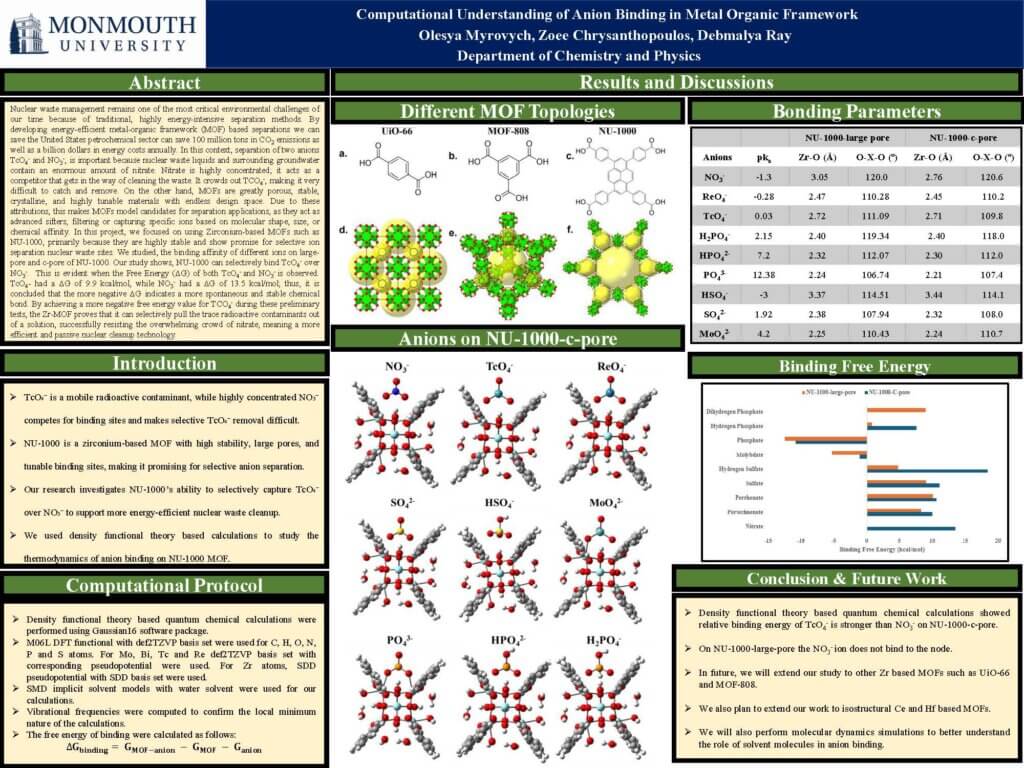
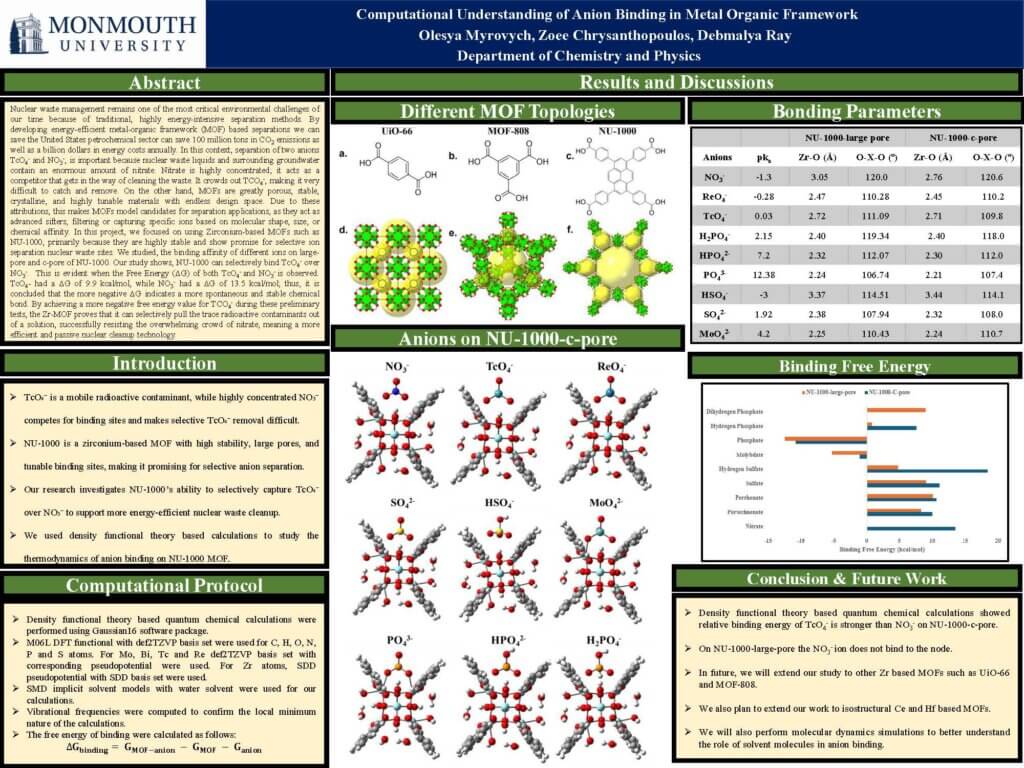
SRP-16: Computational Understanding of Anion Binding in Metal Organic Framework
Olesya Myrovych, Zoee Chrysanthopoulos (Department of Chemistry and Physics)
Faculty Mentor: Dr. Debmalya Ray (Department of Chemistry and Physics)
Funding Sources: Monmouth University School of Science
Read the Abstract—SRP-16: Computational Understanding of Anion Binding in Metal Organic Framework
Nuclear waste management remains one of the most critical environmental challenges of our time because of traditional, highly energy-intensive separation methods. By developing energy-efficient metal-organic framework (MOF) based separations we can save the United States petrochemical sector can save 100 million tons in CO2 emissions as well as a billion dollars in energy costs annually. In this context, separation of two anions TcO4– and NO3–, is important because nuclear waste liquids and surrounding groundwater contain an enormous amount of nitrate. Nitrate is highly concentrated; it acts as a competitor that gets in the way of cleaning the waste. It crowds out TCO4–, making it very difficult to catch and remove. On the other hand, MOFs are greatly porous, stable, crystalline, and highly tunable materials with endless design space. Due to these attributions, this makes MOFs model candidates for separation applications, as they act as advanced sifters, filtering or capturing specific ions based on molecular shape, size, or chemical affinity. In this project, we focused on using Zirconium-based MOFs such as NU-1000, primarily because they are highly stable and show promise for selective ion separation nuclear waste sites. We studied, the binding affinity of different ions on large-pore and c-pore of NU-1000. Our study shows, NU-1000 can selectively bind TcO4– over NO3–. This is evident when the Free Energy (ΔG) of both TcO4–and NO3–is observed. TcO4 had a ΔG of 9.9 kcal/mol, while NO3 hada ΔG of 13.5 kcal/mol; thus, it is concluded that the more negative ΔG indicates a more spontaneous and stable chemical bond. By achieving a more negative free energy value for TCO4– during these preliminary tests, the Zr-MOF proves that it can selectively pull the trace radioactive contaminants out of a solution, successfully resisting the overwhelming crowd of nitrate, meaning a more efficient and passive nuclear cleanup technology.
SRP-17: Photochemical Aging of Microplastics in Mineral–Organic Systems Under Environmentally Relevant pH Conditions
Thomas P. Smith (School of Science)
Faculty Mentor: Dr. Tsana Tongesayi (School of Science/Department of Chemistry and Physics)
Funding Sources: School of Science; Department of Chemistry and Physics
Read the Abstract—SRP-17: Photochemical Aging of Microplastics in Mineral–Organic Systems Under Environmentally Relevant pH Conditions
Microplastics (MPs) undergo chemical and structural transformations in natural environments, yet the specific roles of mineral surfaces and natural organic matter in accelerating MP aging remain poorly understood. This project aimed to investigate how goethite (GT), kaolin (KL), and fulvic acid (FA), individually and in combination, affect the photochemical aging of polyethylene terephthalate (PET) microplastics under ultraviolet (UV) irradiation at environmentally relevant acidic (pH 4) and alkaline (pH 9) conditions. The central hypothesis is that GT, KL, and FA modify MP aging rates by influencing reactive oxygen species (ROS) production, mineral–organic interactions, and polymer surface oxidation, with stronger interactions expected at low pH.
To test this hypothesis, GT, KL, and FA suspensions were first equilibrated separately at pH 4 and pH 9 for at least 48 hours to stabilize surface charge, protonation state, and adsorption behavior. PET MPs were then introduced into each equilibrated system and exposed to controlled UV irradiation in a photochemical reactor. A second phase of the study involved equilibrating GT, KL, and FA together prior to MP addition to assess combined effects. Planned analyses include Fourier-transform infrared spectroscopy (FTIR) to monitor carbonyl formation and changes in surface functional groups, and X-ray photoelectron spectroscopy (XPS) to characterize surface elemental composition, oxidation states, and the development of oxygen-containing functional groups on aged MPs. Measurements of pH drift and mineral–organic interactions will complement these analyses.
Due to time limitations and the need for extended equilibration and irradiation periods, final analytical results are still pending. However, the experimental framework established this summer provides a strong foundation for continued investigation into mineral- and FA-mediated microplastic aging processes in natural systems.
Department of Computer Science and Software Engineering
SRP-18: Quantum Computing for Malware Classification
Allison Aurilio (The College of New Jersey Department of Computer and Electrical Engineering)
Sean Sanpietro (Misericordia University Department of Computer Science)
Faculty Mentor: Dr. Brian Callahan (Department of Computer Science and Software Engineering)
Funding Sources: Monmouth University School of Science; Department of Computer Science and Software Engineering
Read the Abstract—SRP-18: Quantum Computing for Malware Classification
Quantum computing is a new computing paradigm that is beginning to show promise in improving the way data is processed. It offers remarkable potential for processing high-dimensional data, which provides new opportunities to strengthen fields that traditionally use classical computing. With the introduction of quantum computing there are concerns for an increase in cyber threats, but it has promise to make strides in detecting cyber threats as well.
The goal of this research was to evaluate the potential of quantum machine learning for detecting malicious binaries, malware, against traditional classical computing models. Using IBM’s definition of quantum advantage, we sought to determine if quantum was at least one of more accurate, faster, or more energy efficient at classifying unknown software as malware or safe.
We used the IBM Qiskit Aer environment to simulate Quantum Support Vector Machines (QSVM) and quantum kernels to analyze multiple independent malware datasets. Each dataset was first run through a classical Support Vector Machine (SVM) so that a baseline classical accuracy for the model could be determined. Then it was run again through the Qiskit Aer simulator so the accuracy of the two models could be compared. Through these comparisons, we learned that in some cases the Qiskit Aer simulator suggests quantum advantage. However, gains from quantum computing for this particular class of problems may be limited and need to be trialed before switching to a quantum-based approach to malware detection.
SRP-19: Implementing GaREL: Bidirectional Type Checking for Relational Array Analysis
William Judd, Daniel-John Diala, Kevin Yuan (Department of Computer Science and Software Engineering)
Faculty Mentor: Dr. Weihao Qu (Department of Computer Science and Software Engineering)
Funding Sources: NSF CRII grant (#2451348)
Read the Abstract—SRP-19: Implementing GaREL: Bidirectional Type Checking for Relational Array Analysis
This project is built around BiArel, a research tool that performs relational cost analysis. Instead of asking how much a program costs to run individually, it proves how much the cost of two related runs can differ. This matters for questions like whether a small change to the input causes only a small change in work, or whether two runs cost exactly the same so no secret information leaks through timing. As groundwork, we brought the original tool up to date on modern software and got its full set of examples verifying correctly.
The main practical result is the BiArel Playground, a web application that puts this checker in the browser. A user can write or load a program, run it through the verifier, and read a log of the outcome, including clear reasons when a program cannot be proved and a fallback that tries several underlying solvers. This turns a research artifact into something people can try out and learn from.
Our forward-looking contribution is a study of how to remove BiArel’s core performance weakness. Choosing the typing rule for array operations can, in the worst case, branch and backtrack exponentially. On top of this, a solver timeout is currently mistaken for a real failure. We designed two routes to fix this. Route A, the more ambitious research track, reframes every choice as a global unknown solved together by a fixpoint solver. Together these define a clear, staged path for continued research. Route B, contextual typing, carries each operation’s own arguments as context so the rule is decided locally in one pass, turning the worst case from exponential into linear.
Department of Mathematics
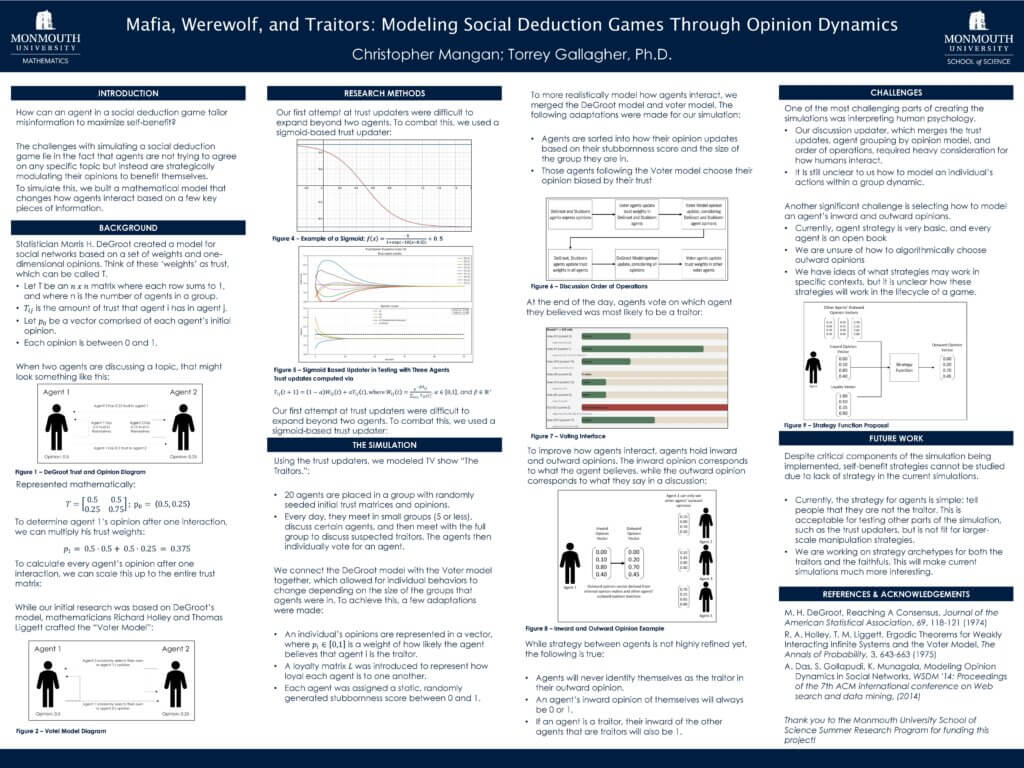
SRP-20: Mafia, Werewolf, and Traitors: Modeling Social Deduction Games Through Opinion Dynamics
Christopher Mangan (Department of Mathematics)
Faculty Mentor: Dr. Torrey Gallagher (Department of Mathematics)
Funding Sources: School of Science; Mathematics Department
Read the Abstract—SRP-20: Mafia, Werewolf, and Traitors: Modeling Social Deduction Games Through Opinion Dynamics
Social deduction games (e.g. Mafia, Werewolf, and the TV show “The Traitors”), where players attempt to uncover hidden truths about other players, introduce nuanced difficulties in mathematical modeling. In particular, misinformation must be used in a strategic manner. This project creates a mathematical model for examining how opinions, trust, and loyalty in different players relates to these games. The project uses a combination of opinion update models, such as DeGroot’s consensus model and Holley and Liggett’s Voter model, as well as custom-written parameter updaters. The simulation dynamically changes how agents interact based on factors such as their trust in each other, the opinions they hold, their loyalty to one another, and the size of the group they are currently in.