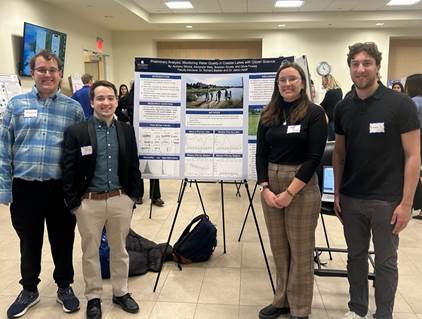
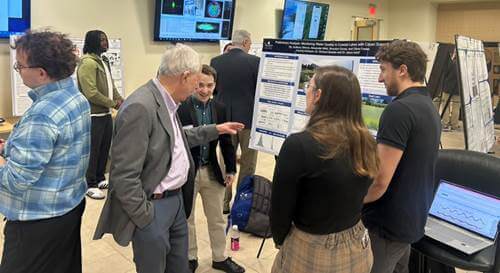
Alexander Metz (Business-Stats Minor), Anthony Stirone (Math/Statistics), Olivia Fowles (Biology), and Brandon Govea (Math/Statistics), and worked with Richard Bastian, Ph.D. (Mathematics), and Jason Adolf, Ph.D. (Biology-MEBP), on a statistical analysis of water quality in coastal lakes in Monmouth County. Their data came from citizen scientists who voluntarily took water samples and remotely entered their measurements. The team found significant differences between seasons and between some of the lakes during those seasons. The team was awarded best Mathematics poster in the School of Science Research Conference in April 2025.
Matt Mueller (MA/Stat), Malea Horn-Attanasio (MA/Stat) and Sarah Henry (Biology-Stat Minor) worked with Dr. Hillary Delprete (History and Anthropology) and Dr. Richard Bastian (Mathematics) on a statistical analysis of skeletal data over time. Titled “Pelvic Morphology Over Time,” their analysis looked for significant differences in a populations’ pelvic measurements before, during and after a period of political turmoil and social stress.
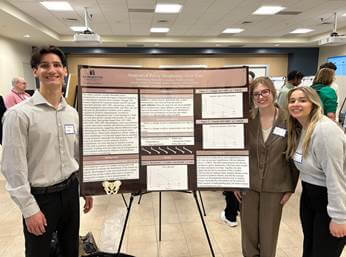
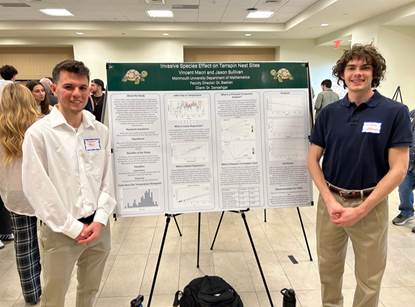
Vincent Macri (MA/CS) and Jason Sullivan (MA) worked with Dr. Pedram Daneshgar (Biology-MEBP) and Dr Richard Bastian (Mathematics) on an analysis of temperature variations due to different ecological conditions at terrapin nesting sites. Since temperature determines the sex of the terrapin, this study could have implications for future terrapin populations.
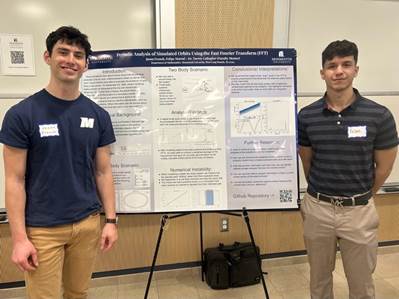
Jason French (MA/SE) and Felipe Marcal (MA) worked with Dr Torrey Gallagher (Mathematics) on using deviations in theoretical orbital data to detect the presence of unknown bodies in a star system. In particular, if you live on a planet that is seemingly alone in its star system, but your planet’s orbit deviates from the Newtonian predicted orbit, can you use that information to solve for the location of the mystery planet which must also be in your star system?
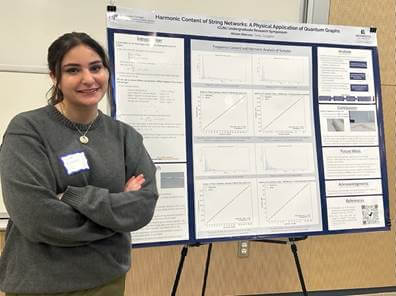
Miriam Abecasis (MA/SE) worked with Dr Torrey Gallagher (Mathematics) on a project related to the field of quantum graphs. With funding from an ICUNJ Undergrad Research Symposium grant, Miriam constructed and tested a physical apparatus to determine how closely the harmonic spectrum of connected string networks aligned with the spectrum predicted by her theoretical quantum graph model of the network.