
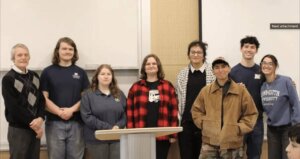
Fifty students from ten high schools across New Jersey came to Monmouth’s campus to participate in the annual High School Hawk Hack this February. Students from each school comprised teams of two or three members who competed in a 90 minute coding competition. The top three teams won prizes ranging from robots to drones to STEAM gift cards.
The annual event, run by the student-led club of the Institute of Electrical and Electronics Engineers/ Association for Computing Machinery, (IEEE/ACM) works with everything from computer science and software engineering (CSSE) to Information Technology (IT). According to Vincent Tuberion, President of IEEE/ACM, the annual Hawk Hack is the club’s biggest event.
Tuberion also addressed concerns surrounding artificial intelligence (AI) use, “One of the big things that I’ve been working on for this year is trying to be very clear with the rules, requirements, and having definite stipulations as far as preventing the use of any AI or large language models. We want to make sure the students aren’t depending on AI. It should be used more as a tool to assist rather than doing it for you, because otherwise you’re not learning anything.”
Specialist Professor Rolf Kamp, IEEE/ ACM Club advisor since January 2022, said, “there are two prongs to our mission: number one of course being selfish, promoting Monmouth University’s Computer Science and Software Engineering department by showing off our resources, and of course, enhancing and promoting STEM awareness.” Kamp touched on how COVID-19 impacted attendance of the event: “I’d say we are back to where we should have been [pre-COVID], largely due to our partnership with Admissions. We are very fortunate to have a good partner with the Admissions department.”
Ling Zheng, Ph.D., chair of the Department of Computer Science and Software Engineering, said, “it’s a great chance to showcase our department to all participating high school students and their teachers. It’s a way to let high school students know that this kind of journey, starting from this competition, can lead to many amazing results.” Zheng added, “I hope that we can have an even bigger event, or a series of such kinds of events so that more students can participate in this kind of contest.”
Joe Coyle, Ph.D., interim dean of the School of Science, added, “One of the things a university should be seen as, from the school’s perspective, is as a resource in the area.
New schools also joined this year including Lodi High School, Saddle River High School, and John P. Stevens High School. In the end, John P. Stevens won first, Saddle River second, and Freehold High School got third.
Saddle River Coding Club, the second-place team noted that this was not their first “Hackathon.” Sri Sheroy, Junior said, “We went to this one Hackathon in NYC but it was really bad, this one was much better. The premise of the game was a lot more interesting and collaborative.”
Nicole Halpin , John P. Stevens supervisor of career and technical education for grades 6-12, concluded, “I love when kids can see outside of the world of Edison, or outside of their own little community. A lot of times, high schoolers don’t know what else goes on around them, so to meet other like-minded kids is always good. For our kids, especially at a high achieving high school, to see that there are other high achieving kids out there, that they’re going to meet in the real world outside.”