Welcome Brian Callahan, Ph.D.
Sept. 10, 2025

We are excited for the start of another successful academic semester. To better support some of our new course offerings, the Department of Computer Science and Software Engineering is excited to welcome Brian Callahan, Ph.D., to our faculty. Callahan joins us from Rensselaer Polytechnic Institute (RPI), where he served as the graduate program director for and senior lecturer in the Information Technology and Web Science program (ITWS), and the director of the Rensselaer Cybersecurity Collaboratory (RCC), and was widely recognized for his innovative work at the intersection of cybersecurity, quantum computing, and generative AI. Callahan brings with him a deep commitment to student mentorship, hands-on learning, and inclusive pedagogy. His research spans topics such as reverse engineering, digital forensics, security education, and the use of BSD Unix systems in computer science instruction; areas in which he has published extensively and continues to contribute actively.
Recently, Callahan lead a team of undergraduates in quantum cybersecurity research, winning the Best Presentation Award special prize at the 28th Colloquium for Information Systems Security Education (CISSE). At RPI, he also spearheaded efforts to integrate real-world, low-level systems work into the curriculum, helping students become more effective, security-conscious engineers. Callahan is a featured speaker at ISC2’s Security Congress in Nashville this October. Most recently, his work on Quantum Kernels for Network Intrusion has been accepted for publication at the First AAAI Symposium on Quantum Information & Machine Learning (QIML).
An advocate for FOSS (Free and Open Source Software), Callahan’s unique blend of academic rigor and applied practice makes him an outstanding addition to our department. We are excited for the energy, expertise, and collaborative spirit he brings to Monmouth University. Please join us in welcoming Callahan to our community!
Introducing Two New Minors
Sept. 10, 2025

The Department of Computer Science and Software Engineering proudly announces two new minors, starting Fall 2025: data science, and cybersecurity. While new course offerings compliment these in-demand minors, the data science minor is designed to attract students across programs. For more information, please contact Office Coordinator Christy Jenkins.
Data Science
The data science minor program will focus on harnessing the power of data, providing a foundation in data science techniques, along with hands-on experience. This minor exposes students from all majors to the growing field of data science, analytics, and artificial intelligence. Students will learn and develop applications across various domains, while fostering a comprehensive understanding of data analytics, machine learning, and ethics, as well as exploring cutting-edge topics and tools.
Cybersecurity
The cybersecurity minor program will introduce students to information and network security and their related issues. By learning the fundamental principles of securing software systems and networks, through the introduction of cryptography, as well as the techniques of hacking and secure cloud computing, students will be able to design secure applications and systems, understand threat assessment using different detection techniques, and countermeasure security threats.
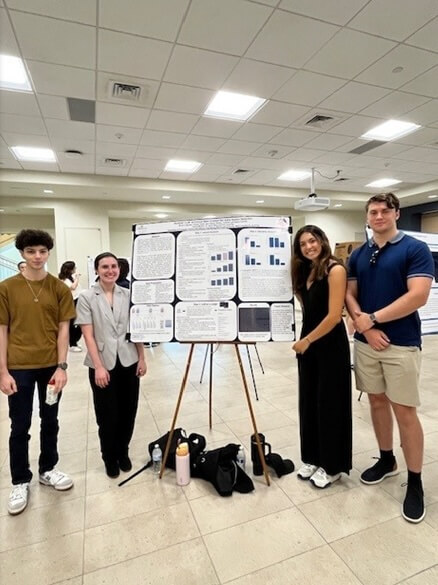
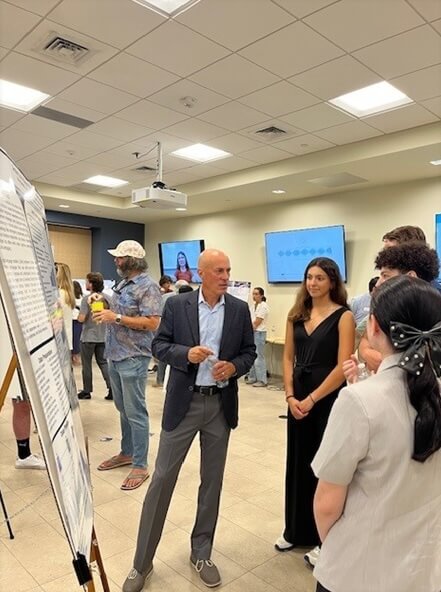
Data and Computer Science Students Present at the SRP Symposium
Aug. 7, 2025
Undergraduates and graduate students had the opportunity to participate in Monmouth’s School of Science Summer Research Program (SRP). This program is a 10-week paid research experience for students to work on collaborative research projects under the supervision of School of Science faculty, culminating in student presentations at the Summer Research Program Symposium on Aug. 7. In addition to the opportunity to present their work to faculty and professional contacts of the School of Science, students gained invaluable research experience that looks attractive to future employers and to graduate and professional school programs.
Project: Formal Verification of Quantitative Properties Supporting Mutable Arrays
Faculty Mentor: Weihao Qu, Ph.D.
William Judd University of Illinois Urbana-Champaign
Software systems often need to handle sensitive data securely, maintain user privacy, and operate efficiently. One way to ensure these qualities is by analyzing how a program behaves when it processes different inputs or runs in different situations. This type of analysis, called relational reasoning, helps uncover important properties like whether a program protects sensitive information or performs tasks consistently. While tools exist for analyzing some programs, they often struggle to handle features like mutable arrays, which are widely used to store and manage data in practical applications. The project’s novelties are creating better tools to analyze programs that use arrays, making the process more precise and broadly applicable. By addressing key challenges in existing techniques, the research bridges gaps in both theoretical understanding and practical implementation.
Project: Predicting Patient Length of Stay in Hospitals Using Machine Learning
Faculty Mentor: Jiacun Wang, Ph.D.
Brooke Tortorelli, Miriam Abecasis, Isaac Sasson, Sophia Velandia, and Thomas Farrell
The primary mission of hospitals is to meet the demand for care by efficiently moving patients through the care pathway while simultaneously improving patient satisfaction and health outcomes. One of the crucial determinants for hospitals to maintain resource efficiency and deliver quality treatment is the patient length of stay (LOS), as it directly impacts bed availability, staffing requirements, and overall operational costs. Reducing LOS without compromising patient care is a significant challenge that hospitals face.
The goal of this project is to develop a machine learning system to predict LOS at the admission phase of patients, using initial diagnosis and test results. By accurately predicting LOS, hospitals can better allocate resources, optimize patient flow, and improve overall patient care. The emphasis of this research is on feature engineering, one-hot encoding, and Synthetic Minority Over-sampling Technique (SMOTE) to handle imbalanced datasets. Feature engineering involves selecting and transforming relevant variables to enhance the predictive power of the model. One-hot encoding is used to convert categorical variables into a format that can be provided to machine learning algorithms. SMOTE is employed to address the issue of imbalanced datasets, which is common in real-world healthcare data. Both regression models and classification models, including deep learning and some most recently developed algorithms such as federated learning, were investigated, implemented, and tested in this study. Regression models predict the exact LOS, while classification models categorize patients into different LOS ranges. Real-world datasets are used for model training and validation to ensure the robustness and generalizability of the developed models. The results of the different models are compared and discussed to identify the most effective approach for predicting LOS. Given that most real-world datasets are significantly imbalanced, the imbalanced nature of the dataset is addressed to improve model performance and reliability.
Symposium Gallery