
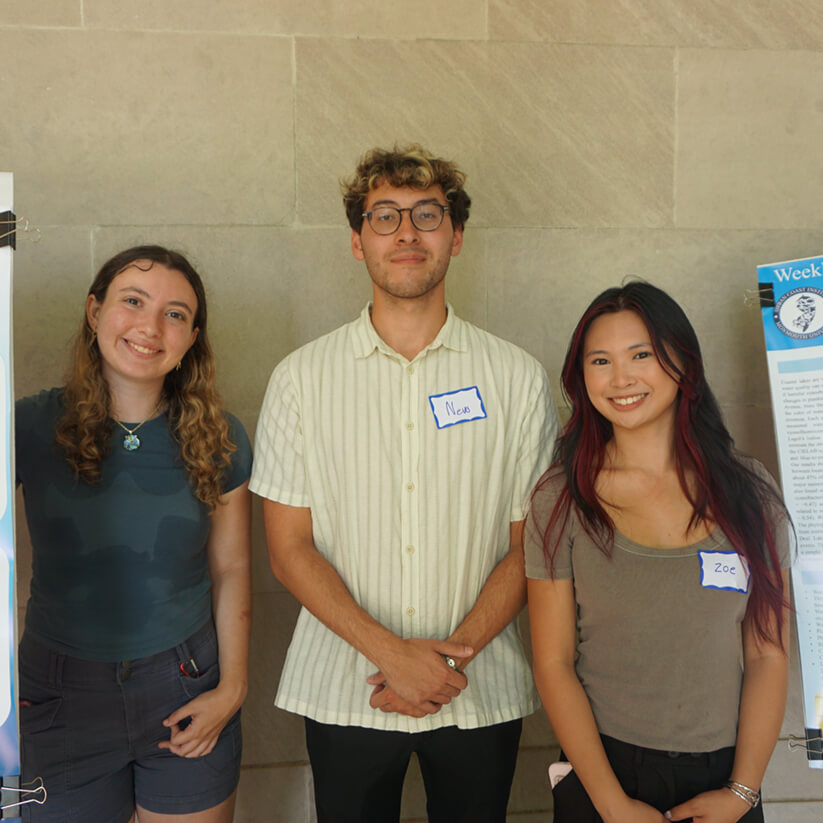
Students shared key takeaways and lessons learned from two dozen projects at the Monmouth University School of Science’s 2026 Summer Research Program Symposium, held Aug. 6 at the University’s Erlanger Garden. The annual poster session caps off a 12-week research experience for School of Science students working with faculty mentors on collaborative research projects.
Scroll below to watch students present some of this year’s Urban Coast Institute-supported projects. Click here to view a list of all of this year’s Summer Research Program projects and their abstracts.
Nourished But Delayed: Evaluating Recruitment Pulses of the Atlantic Mole Crab and Sediment Gradients on an Engineered Beach


Student and Major: Jessica Kipnis, Marine and Environmental Biology and Policy
Faculty Mentor: Endowed Professor of Marine Science Jason Adolf, Department of Biology/Marine and Environmental Biology and Policy Program
Abstract: Beach nourishment is a widespread engineering strategy used to combat shoreline erosion, yet its ecological ramifications on sandy beach macrofauna remain poorly understood. This study evaluates the impacts of coastal engineering by comparing population dynamics of the Atlantic mole crab (Emerita talpoida) and environmental context between an engineered beach (Deal) and a natural baseline control (Sandy Hook). Sampling took place during a structured seasonal window of summer 2026, where we measured and quantified sediment samples and crab abundance. Using a multivariate statistical framework, we tracked abundance across three ontogenetic cohorts, alongside sediment moisture and grain size class sorting. Granulometric analysis revealed a stark physical contrast between sites, with Deal having a significantly higher relative proportion of fine sand (< 0.25 mm) and higher sediment moisture, while Sandy Hook had a much higher proportion of coarser sand (0.5–8 mm) correlating with less moisture retention. While mole crab abundance did not differ significantly between sites, generalized linear mixed modeling (GLMM) found littoral microhabitat and size class as primary structural drivers, alongside significant lunar phase synchronization. Temporal tracking revealed a diverging shift between the two sites rather than a permanent population suppression. The natural baseline experienced a localized recruitment pulse in mid-June, while the engineered system showed a delayed intermediate pulse in mid-July. These findings suggest that engineered beach modifications can disrupt macrofaunal settlement timelines by altering grain size sorting which in turn disrupts microhabitat hydrology, emphasizing the need for temporal coordination in coastal management frameworks.
Weekly Changes in Plankton Communities and Water Color in Deal Lake, New Jersey


Student and Major: Zoe Thompson, Marine and Environmental Biology and Policy
Faculty Mentor: Endowed Professor of Marine Science Jason Adolf, Department of Biology/Marine and Environmental Biology and Policy Program
Abstract: Coastal lakes are valuable for both wildlife and recreation, but their water quality can change when plankton communities shift, especially if harmful cyanobacteria are present. In this study, we tracked weekly changes in plankton at three sites in Deal Lake, New Jersey: Norwood Avenue, State Street, and Sunset Avenue. We also examined whether the color of water could help predict which cyanobacteria were most common. Each week during summer 2026, we collected samples and measured water temperature, conductivity, dissolved oxygen, cyanofluorescence, and water color. We preserved the samples with Lugol’s iodine and used a microscope to identify the plankton and estimate the abundance of each genus. To analyze water color, we used the CIELAB system, which measures lightness (L*), green-to-red (a*), and blue-to-yellow (b*) values of water collected in white buckets. Our results showed that plankton communities changed over time and between locations. Based on microscopic counts, zooplankton made up about 47% of the community during the first two weeks. Following a major rainstorm, phytoplankton increased to about 65% on July 7. We also found significant relationships between water color and dominant cyanobacteria. Dolichospermum was negatively related to bucket L* (r = −0.47) and bucket a* (r = −0.70). Chroococcus was negatively related to surface L* (r = −0.48) but positively related to surface a* (r = 0.54). Woronichinia was positively related to bucket a* (r = 0.46). The phytoplankton increase following the rainstorm may have resulted from nutrients carried into the lake by runoff. These findings show that Deal Lake’s plankton community can shift quickly after weather events. They also suggest that characterizing water color could provide a simple, low-cost method for detecting changes in cyanobacteria and monitoring possible blooms.
Comparing Post-Rainfall Enterococcus faecalis Concentrations Between Bayside and Ocean-Side Waters at Sandy Hook, New Jersey


Student and Major: Tyler Pylarinos, Marine and Environmental Biology and Policy
Faculty Mentors: Endowed Professor of Marine Science Jason Adolf and Elizabeth Clark, Department of Biology/Marine and Environmental Biology and Policy Program
Abstract: Enterococcus spp. are highly resilient enteric bacteria that are routinely used as environmental indicators of fecal contamination in coastal waters, rivers, and lakes. Fecal contamination is a concern for public safety, prompting the monitoring of Enterococcus to protect public health. Elevated concentrations may indicate the presence of waterborne pathogens. Rainfall can increase the concentration of fecal indicator bacteria in recreational waters by carrying stormwater runoff, animal waste, and other contaminants into coastal environments. This study will compare Enterococcus concentrations between bayside and oceanside sampling locations at Sandy Hook, New Jersey, approximately twelve hours after rainfall. This comparison is important because bayside and oceanside waters differ in circulation and mixing, which may influence how long fecal contamination remains concentrated after rainfall. Identifying these differences can help determine whether certain recreational areas may experience greater contamination and potential public-health risks. Water samples were collected from three bayside stations and three oceanside stations. The water samples will be tested using two different laboratory methods to detect and measure Enterococcus bacteria, the IDEXX Enterolert assay and a qPCR assay, allowing the results from each method to be compared. We hypothesize that bayside locations will contain higher Enterococcus concentrations than oceanside locations because the bay has less wave action and water circulation, potentially allowing bacteria introduced by runoff to remain concentrated for longer periods. The results will be compared between the two environments to determine whether sampling location is associated with Enterococcus concentration following rainfall. This research may help identify areas with a greater risk of fecal contamination and improve understanding of how rainfall affects recreational water quality at Sandy Hook.
Impact of a Heavy Rainfall Event on Phytoplankton and Zooplankton in Deal Lake, NJ


Student and Major: Nevo Ein-Dor Truong, Marine and Environmental Biology and Policy
Faculty Mentor: Endowed Professor of Marine Science Jason Adolf, Department of Biology/Marine and Environmental Biology and Policy Program
Abstract: Coastal lakes such as Deal Lake in New Jersey are important habitats for wildlife and support a range of recreational activities, including fishing, boating, and birdwatching. These shallow, often brackish or freshwater systems sit close to the ocean and are shaped by both marine and terrestrial influences, making them ecologically distinct and sensitive to change. In this study, we observed the water quality in these lakes to see a shift following heavy rainfall. Storms increase surface runoff from surrounding urban and suburban areas, carrying nutrients like nitrogen and phosphorus directly into the lake, which also flushes into the ocean. This nutrient intake, combined with sediment, road salt, and other pollutants, can trigger changes in water chemistry, including drops in salinity, turbidity, fluorescence, and dissolved oxygen. These changes directly affect the microorganisms on how they interact with one another and changes in abundance on certain species from zooplankton like rotifers, and crustacean larvae, to phytoplankton like Dolichospermum and Desmodesmus. By collecting samples in Deal Lake from three different streets called Norwood Avenue, Sunset Avenue, and Main Street, we were able to observe changes in three distinct spots of the lake. Measurements such as water temperature, dissolved oxygen, conductivity, and cyanofluorescence were all recorded. Samples that were taken were preserved with Lugol’s iodine and was then studied under the microscope for identification of different species of cyanobacteria and zooplankton. By using the Shannon Indices Method, cells were counted within 1×1 mm squares (Sedgewick-Rafter Chamber) to determine prominent taxa. Throughout this study, a decrease in cyanofluorescence and a change in taxa was observed following the heavy rainfall event. Zooplankton decreased as other plankton like Desmodesmus, and Dolichospermum, and zygospores were more abundant. These results help us understand better how this microscopic ecosystem is ever changing so rapidly with the sudden occurrence of a single storm in Deal Lake.