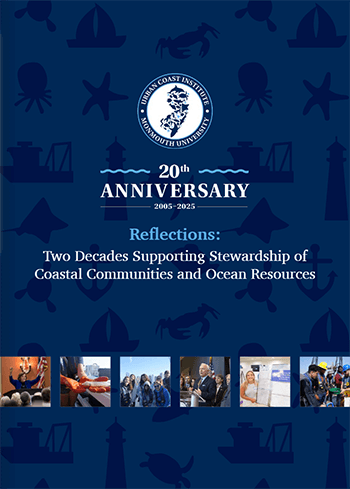
“Reflections: Two Decades Supporting Stewardship of Coastal Communities and Ocean Resources” takes a look back at some of the Monmouth University Urban Coast Institute’s (UCI) major milestones, accomplishments and signature events. In its first 20 years, the UCI has made an indelible impact on the coastal communities it serves, on campus, and has helped inspire the next generation of ocean leaders. The UCI has also grown in influence and capacity, and is well prepared to continue leveraging the expertise of Monmouth’s faculty and the passion of its students to work with other partners who share their love for the ocean and coast.
Among the report’s features are a timeline walking from the UCI’s earliest years to today, a comprehensive list of all of the student and faculty research projects funded through the Heidi Lynn Sculthorpe Scholars program, and a roster of all Champion of the Ocean honorees going back to 2005.
The report is available in digital flipbook and PDF formats:
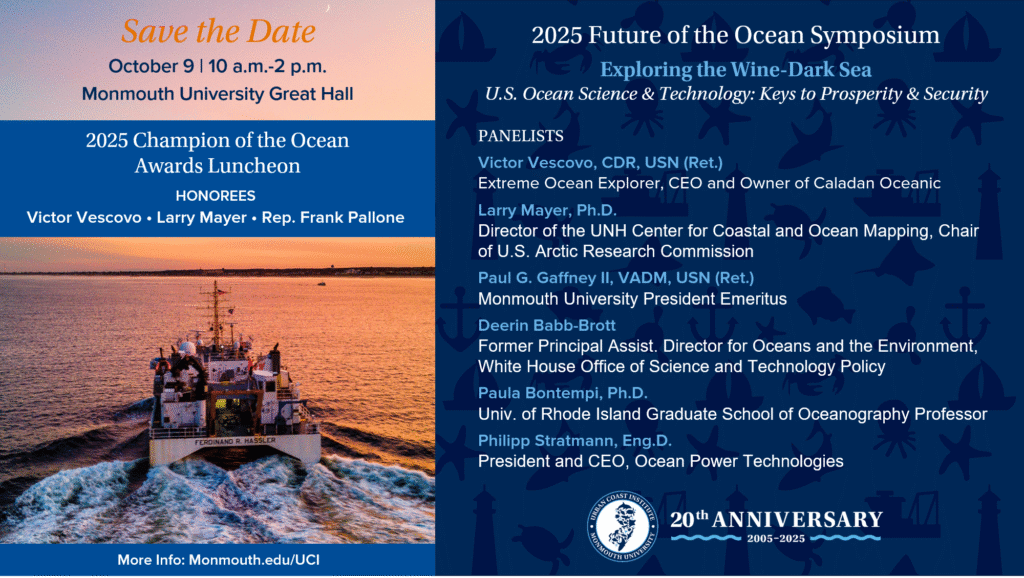
Join the Urban Coast Institute (UCI) on Oct. 9 for its signature annual event, the Champion of the Ocean Awards Luncheon. Purchase your tickets today to celebrate this year’s honorees and the UCI’s 20th anniversary! Tickets are tax deductible, with proceeds supporting the UCI.
If you’re planning to attend the luncheon, don’t miss our 2025 Future of the Ocean Symposium, which will directly precede it in the Great Hall Auditorium from 10-11:45 a.m. This year’s symposium will have a theme of “Under the Wine-Dark Sea – U.S. Ocean Science & Technology: Keys to Prosperity & Security.” It is free and open to the public.
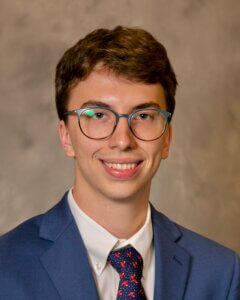
Aidan Bodeo-Lomicky, a 2022 Monmouth University graduate with a degree in marine and environmental biology and policy, recently co-founded the nonprofit wildlife/animal law organization Animal Counsel. While at Monmouth, Bodeo-Lomicky received a grant through the Urban Coast Institute’s (UCI) Heidi Lynn Sculthorpe Scholars Program to research threats to the critically endangered North Atlantic right whale, working under the guidance of former Rechnitz Family/UCI Endowed Chair in Marine and Environmental Law and Policy Randall Abate, the author of multiple books on animal law. Bodeo-Lomicky was also awarded the National Oceanic and Atmospheric Administration’s (NOAA) prestigious Ernest F. Hollings Undergraduate Scholarship.
He has since earned a J.D. from the University of Colorado Law School, where he served as managing editor of the Colorado Environmental Law Journal and published work on how to better protect the world’s rarest and most recently discovered whale species, the Rice’s whale. He recently began a clerkship with Chief Judge Jeffrey Pilkington on Colorado’s First Judicial District Court, to be followed by clerkships on the Colorado Court of Appeals and the U.S. District Court for the Northern District of California.
We caught up with Aidan to learn more about what’s ahead for Animal Counsel.
Congratulations on founding Animal Counsel! What is the mission of the organization and what kind of work do you expect it to do?
Thanks so much! Above all, our mission is to advance the interests of animals through law and policy work. We’re focused on three main areas: wildlife, domestic animals, and rights of nature. For now, we are primarily writing academic and policy papers, and we just brought on two law student interns to help contribute to the mission. We also hope to expand into litigation in the long term, but for now we’re leaning into the think tank model. Animal law is a rapidly developing field, and our goal is to contribute our voices and stay at the leading edge as it continues to evolve.
How did Animal Counsel come to be?
I met my co-founders, Shelby White and Mason Liddell, during our first year of law school. We all shared a deep passion for wildlife/animal issues, but quickly noticed the lack of opportunities available for students in this field. So, we restarted Colorado Law’s Animal Legal Defense Fund chapter and began working on hands-on projects like public comments and pro bono work with existing NGOs. The three of us also worked together on our environmental law journal and clinic, getting lots of valuable legal research and writing experience. After working on so many practical animal law and policy projects together—and because our initial post-grad positions weren’t specific to this field—we decided to create our own NGO as a vessel to continue this work (and help others do the same).
Can you tell us about the need for an organization like Animal Counsel? Is there a shortage of representation around animal law and welfare generally in the U.S.?
There are many groups in the wild and domestic animal spaces doing great work for these causes. However, animals and the environment are under greater threat than ever before, and countless issues need more attention from scientists, lawyers, and policymakers. Specifically, there is a shortage of policy work being done at the intersection of animal and environmental law, as well as in the more cutting-edge areas of animal rights and rights of nature. Beyond this, we’ve noticed that there are far more people interested in doing this work than there are opportunities available. Tens of thousands of law students, undergraduates, and others want to devote their time and skills to protecting wild and domestic animals, but it can be overwhelming deciphering where to even start. Aside from the prestigious and difficult-to-obtain internships with the major NGOs and government agencies, there aren’t many obvious options. So, not only did we want to create new internship opportunities, we also wanted to show that students can simply dive into the work themselves. Of course, having mentors in the field is extremely beneficial when getting started, so we intend to be a resource for any students looking to get their feet wet with public commenting, policy writing, and more on behalf of animals.
How did your time at Monmouth and work with the UCI prepare you for the steps you’re taking today?
As I mentioned, mentorship is the best way to navigate any new field. Right from the time I got to Monmouth, Professor Randall Abate and UCI Director Tony MacDonald were instrumental in guiding me through the world of wildlife law and policy. I had the opportunity to take a handful of incredible law classes and write two independent legal research papers about endangered whales with Professor Abate, and I worked on real-world ocean policy issues for the UCI under Tony’s guidance. I was also connected to outside opportunities with organizations like the Earth Law Center and NOAA, which gave me invaluable insight into the field and a big leg up when applying to and starting law school. I was able to figure out my exact interests and path thanks to my time at Monmouth and the UCI, and I hope to be able to provide similar mentorship to others as I progress through my career.
What are the ways people can support or get involved with Animal Counsel?
We’d love to hear from anybody interested in working with or supporting us! We have some exciting projects in the works and are very interested in ideas for more. Our website has more information, as well as a contact form (or you can simply email us at contact@animalcounsel.org). We’re also on LinkedIn and Instagram if you’d like to stay up-to-date. And of course, as a 501(c)(3) nonprofit organization, we’re fully funded by people’s generous (and tax-deductible) donations. We’re grateful for any amount, and it will go a long way in helping us develop and expand our work for wild and domestic animals: https://www.animalcounsel.org/donate. Thank you!
Endowed Professor of Marine Science Jason Adolf delivered a presentation on Monmouth University’s research on the use of environmental DNA (eDNA) for surveying fish populations at the 2025 Mid-Atlantic Ocean Forum on May 7 in Baltimore. Adolf’s presentation highlighted how the technique of analyzing materials filtered from water samples can be paired with traditional techniques to improve fisheries monitoring plans.
As fish swim through the waters, they leave behind dandruff-like cells and bodily fluids that can be analyzed and matched to the genetic barcodes of others to determine their species. This crime scene investigation-style approach to marine detection has emerged as a more humane and less expensive means of studying fish populations than traditional methods that require their capture.
The session, “eDNA in Marine Systems: Applications for the Mid-Atlantic,” focused on the potential application of eDNA to marine and coastal natural resource management and how it can contribute to monitoring and decision-making processes. The session also included presentations by Jan McDowell, Ph.D., and Angelina Dichiera, Ph.D., of the Virginia Institute of Marine Science; and Kesley Leonard, Ph.D., of the Shinnecock Nation.
Hosted by the Mid-Atlantic Regional Council on the Ocean, the forum is the region’s premier annual event dedicated to ocean planning. UCI Director Tony MacDonald and Fisheries and Ocean Conservation Fellow Jay Odell moderated sessions at the event. View additional videos from the Forum.
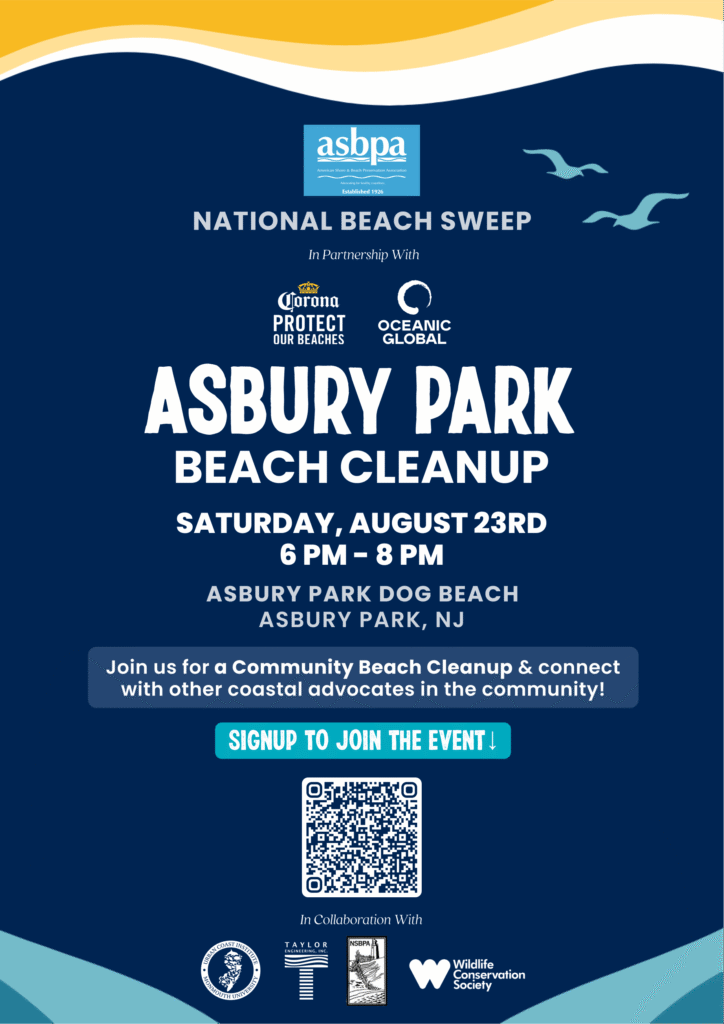
Join the Urban Coast Institute for a beach sweep in Asbury Park on Saturday, Aug. 23, from 6-8 p.m. Help us prevent plastics and litter from entering our ocean while connecting with our partners the American Shore and Beach Preservation Association and fellow beach lovers at the Jersey Shore! Click here for full details and registration.
Monmouth University marine and environmental biology and policy student Christopher Reigel was one of the dozens of students who presented posters at the School of Science’s 2025 Summer Research Program Symposium on Aug. 8. Watch above as Reigel discusses his summer research on improving the detection of the endangered Atlantic sturgeon in near-shore ocean environments with environmental DNA (eDNA).
Reigel’s project was supported by the School of Science and the Urban Coast Institute through a federal grant secured by Congressman Frank Pallone. Read the abstract below to learn more about his work.
Project Title: Development and Testing of a Novel oPCR Assay for Endangered Atlantic Sturgeon Environmental DNA (eDNA) In Continental Shelf Waters
Student & Major: Christopher Reigel, marine and environmental biology and policy
Faculty Mentors: Jason Adolf, Ph.D. and Elizabeth Clark, Department of Biology
Funding Sources: Monmouth University School of Science, Urban Coast Institute, National Oceanic and Atmospheric Administration (NOAA) National Marine Fisheries Service-Northeast Fisheries Science Center 2024 Earmark Ecological Resilience in the Hudson-Raritan (Principal investigators: Jason Adolf and Tony MacDonald)
Abstract: The Atlantic sturgeon, Acipenser oxyrinchus oxyrinchus, is an endangered anadromous fish of historic ecological and commercial importance. Atlantic sturgeon are currently monitored using traditional surveying methods such as gillnetting and acoustic telemetry, which can be costly and logistically challenging to undertake, making it difficult to effectively monitor this species across their broad range. Environmental DNA (eDNA) has emerged as a useful complementary tool to traditional surveying for many aquatic species. A qPCR probe-based assay for the monitoring of Atlantic sturgeon has been published, but the authors concluded that the assay was not designed for use in low population density areas, making it less suitable for monitoring sturgeon during the time they are migrating through continental shelf waters. The objective of our study is to develop an optimized probe-based qPCR assay for Atlantic sturgeon that can successfully detect their presence in ocean water samples. Optimization measures included making the assay amplicon length shorter and modifying qPCR protocols. We have validated this assay in silico and are further validating it against DNA extracts from Atlantic sturgeon and closely related/cohabitating species (e.g. shortnosed sturgeon, menhaden, river herring, gizzard shad), as well as field samples where Atlantic sturgeon have been verified by capture or metabarcoding methods. Development of a more sensitive qPCR assay for Atlantic sturgeon will better allow tracking of this important species throughout its natural range.
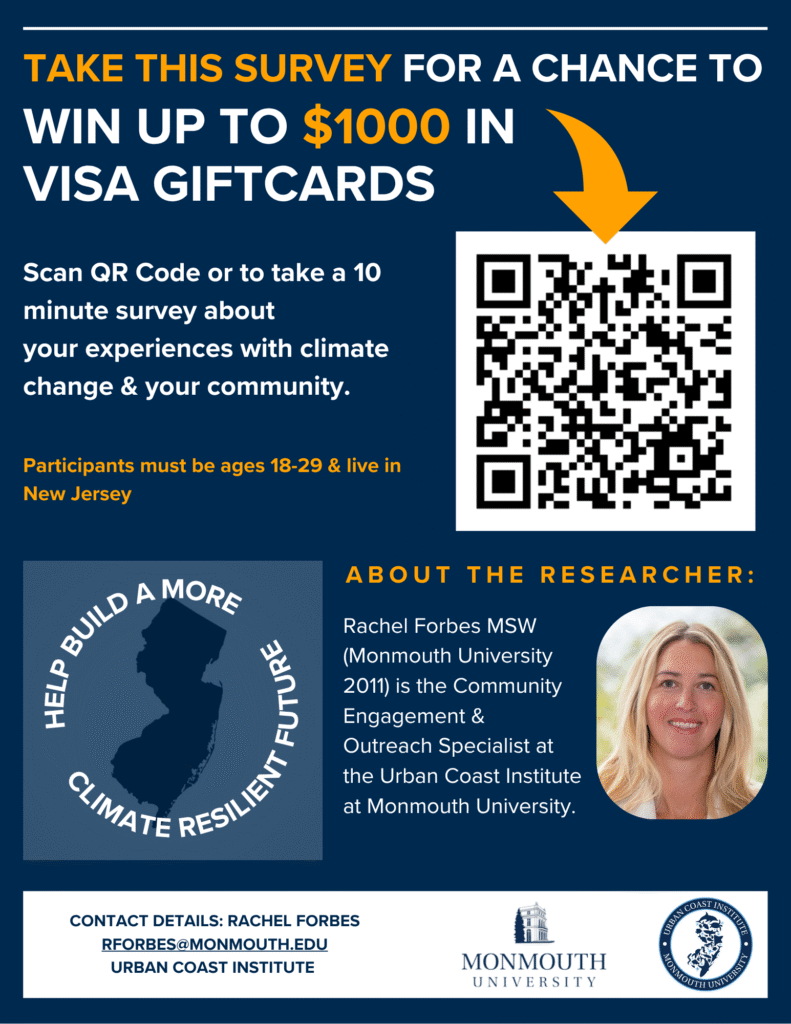
You are invited to take part in a research study about how climate change is affecting the mental health and wellbeing of young adults in New Jersey. As you know, climate change is not only a global environmental crisis—it also impacts people on a deeply personal and emotional level, especially those living in communities that experience environmental injustice or climate-related disasters.
This study is being conducted as part of a doctoral dissertation in social work. It explores how feeling connected to your community might help buffer or protect against the stress and anxiety many young people feel about climate change. We are especially interested in how these experiences differ across neighborhoods and identities in New Jersey.
Your voice matters. By completing this survey, you’ll be helping researchers, policymakers, and community leaders better understand how to promote mental health and climate resilience—especially in communities that are most impacted by environmental and social injustices.
The survey includes questions about your thoughts and feelings related to climate change, your sense of connection to your community, and some background questions about you and where you live. It will take about 10 minutes to complete.
As a thank you, after completing the survey, you will have the option to enter a raffle to win up to $1,000 in Visa gift cards. To protect your privacy, your email will be collected separately and will not be connected to your survey responses in any way.
For questions about the survey, contact Urban Coast Institute Community Engagement and Outreach Specialist Rachel Forbes at rforbes@monmouth.edu.
The UCI’s signature annual event returns to Monmouth University’s historic Great Hall on Oct. 9. The theme of this year’s Future of the Ocean Symposium is “Exploring the Wine-Dark Sea – U.S. Ocean Science and Technology: Keys to Prosperity and Security.” Our 2025 Champion of the Ocean Awards Luncheon will directly follow.
This year we’ll also be celebrating the UCI’s 20th anniversary. Come and help us set sail to serve the University and our communities for the next two decades.
Visit our event page to view the current lineup of confirmed speakers and honorees and more information.
UCI Director Tony MacDonald (fifth from l) and fellow panelists in Nice, France.
Monmouth University Urban Coast Institute (UCI) Director Tony MacDonald attended the 2025 United Nations Ocean Conference (UNOC) in Nice, France, from June 9-13. UNOC 2025 brought together over 15,000 diverse stakeholders from governments, UN agencies, international NGOs, civil society and the private sector to discuss ways to accelerate action to conserve and sustainably use the ocean. In addition to representing the UCI, MacDonald attended in his role as chair of the National Academy of Science Ocean Studies Board’s U.S. Decade Committee for Ocean Science for Sustainable Development and as a Global Ocean Forum (GOF) board member.
The panel was moderated by María José González-Bernat, Ph.D., co-director of the Interamerican Association for Environmental Defense (AIDA) Ecosystems Program, and Peter Ricketts, Ph.D., former president and vice-chancellor of Acadia University (Canada) and GOF Board member. Other panelists included:
H.E Ambassador Julio Cordano, director of environment, climate change and oceans, Ministry of Foreign Affairs of Chile
H.E. Ambassador Viliami Va’inga Tone, permanent representative of the Kingdom of Tonga to the U.N.
Professor Robbert Dijkgraaf, former minister of education, culture and science of the Netherlands
Peter Haugan, policy director at Institute of Marine Research, Norway
Lynne Shannon, principal researcher leading the Marine Sustainability group in the Department of Biological Sciences, University of Cape Town
Professor Jean-Christophe Martin, University Cote d’Azur
Professor María Fernanda Morales Camacho, Universidad Nacional de Costa Rica
Louise Lieberknecht, senior expert in marine sustainability, GRID-Arendal
Jasmine Nyagah, University of Nairobi, Kenya
Kate Killerlain Morrison (l) and Sylvia Earle of Mission Blue.
Among the many ocean colleagues at UNOC 2025, MacDonald had the privilege of running into 2015 UCI National Champion of the Champion honoree and ocean explorer Sylvia Earle, Ph.D., and Kate Killerlain Morrison, former MARCO executive director and current managing director of Earle’s conservation organization, Mission Blue.
Heather Korzun recently joined the Monmouth University Urban Coast Institute (UCI) as a community engagement fellow supported through the National Oceanic and Atmospheric Administration’s (NOAA) Coastal Resilience Fellowship Program.
In this role, Korzun will support UCI Associate Director Tom Herrington in coordinating project pipeline work for the Building a Climate Ready NJ initiative, which is funded by NOAA and led by the New Jersey Department of Environmental Protection. In 2024, the UCI was named a partner in the initiative, which aims to harness statewide expertise to advance resilience planning, project design, construction, and education across New Jersey’s 16 coastal counties.
Korzun will work to ensure that multiple education, engagement, and training activities are planned and implemented in conjunction with Building a Climate Ready NJ core activities. She will work closely with Herrington and UCI Community Engagement Specialist Rachel Forbes to gather knowledge from residents, community leaders, and other stakeholders that will help identify resilience projects that are most needed and would be the most impactful. The recommendations will then be entered into the project pipeline for further study and eventual implementation.
Korzun most recently served as a planning fellow at the Land Conservancy of New Jersey, assisting municipalities across the state with developing open space and recreation plans and helping target lands that would be valuable for conservation. The communities she worked with ranged from rural towns with rolling hills of bucolic farmlands to some of the state’s most densely populated neighborhoods.
“What excites me most about this role is the opportunity to deepen my work in community engagement,” she said. “Working on Camden’s Coastal Resilience Plan helped me understand the community dynamics that impact planning efforts. I am grateful for the chance to learn from New Jersey’s coastal communities and help connect them with resources that strengthen their long-term resilience.”
A native of the Virginia Beach area, Korzun recalls first being drawn to environmental policy work as an undergraduate taking a sustainability in business course. She felt a sense of climate anxiety while delving into lessons about the ways climate change was disrupting ordinary people’s lives and felt a calling to act.
“I was really stressed about that for a while, but I realized that the only way to alleviate some of that anxiety was to do work that was directly part of the solutions,” she said.
Korzun graduated from Mary Baldwin University with a bachelor’s degree in sustainable business before completing her master of public administration at the University of Pennsylvania. As a student, she led community engagement projects and educational events about sustainability and has supported research projects on emerging contaminants and climate resilience.