
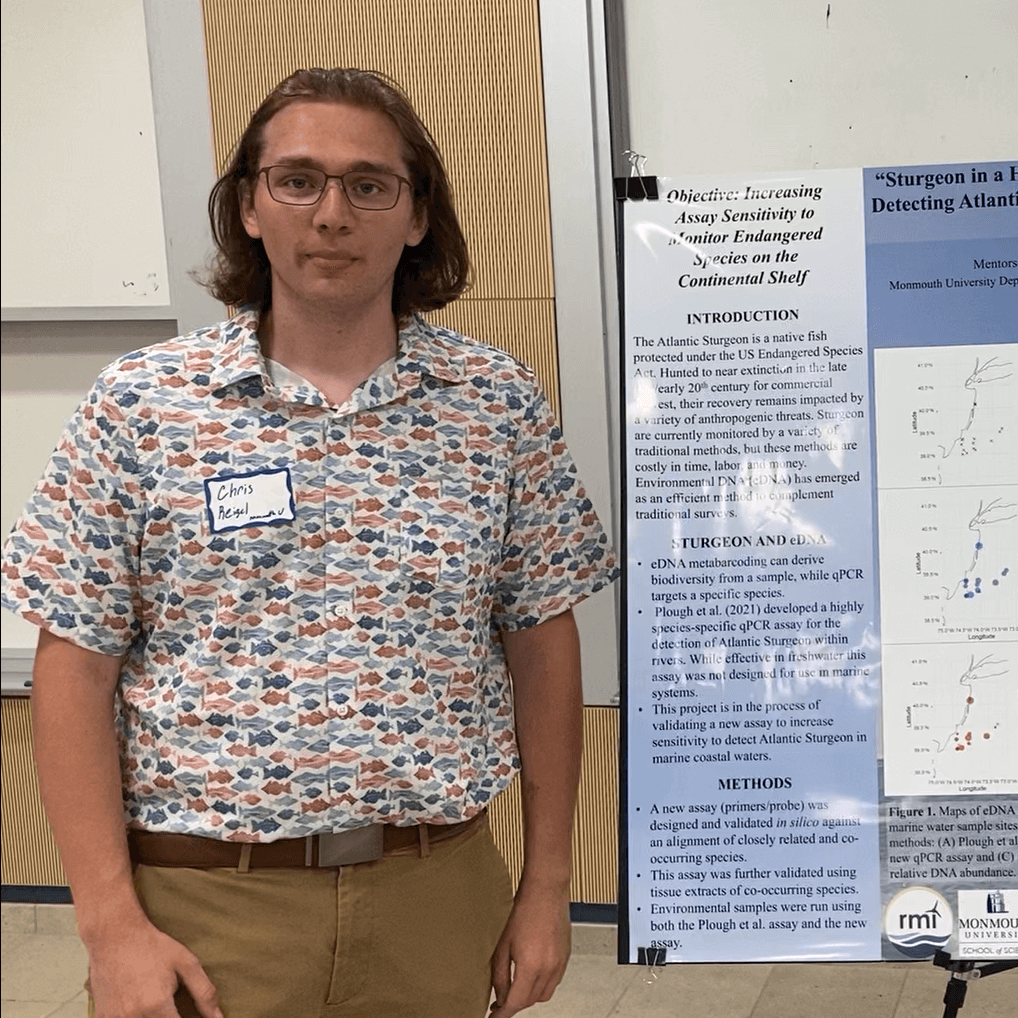


Monmouth University marine and environmental biology and policy student Christopher Reigel was one of the dozens of students who presented posters at the School of Science’s 2025 Summer Research Program Symposium on Aug. 8. Watch above as Reigel discusses his summer research on improving the detection of the endangered Atlantic sturgeon in near-shore ocean environments with environmental DNA (eDNA).
Reigel’s project was supported by the School of Science and the Urban Coast Institute through a federal grant secured by Congressman Frank Pallone. Read the abstract below to learn more about his work.
Project Title: Development and Testing of a Novel oPCR Assay for Endangered Atlantic Sturgeon Environmental DNA (eDNA) In Continental Shelf Waters
Student & Major: Christopher Reigel, marine and environmental biology and policy
Faculty Mentors: Jason Adolf, Ph.D. and Elizabeth Clark, Department of Biology
Funding Sources: Monmouth University School of Science, Urban Coast Institute, National Oceanic and Atmospheric Administration (NOAA) National Marine Fisheries Service-Northeast Fisheries Science Center 2024 Earmark Ecological Resilience in the Hudson-Raritan (Principal investigators: Jason Adolf and Tony MacDonald)
Abstract: The Atlantic sturgeon, Acipenser oxyrinchus oxyrinchus, is an endangered anadromous fish of historic ecological and commercial importance. Atlantic sturgeon are currently monitored using traditional surveying methods such as gillnetting and acoustic telemetry, which can be costly and logistically challenging to undertake, making it difficult to effectively monitor this species across their broad range. Environmental DNA (eDNA) has emerged as a useful complementary tool to traditional surveying for many aquatic species. A qPCR probe-based assay for the monitoring of Atlantic sturgeon has been published, but the authors concluded that the assay was not designed for use in low population density areas, making it less suitable for monitoring sturgeon during the time they are migrating through continental shelf waters. The objective of our study is to develop an optimized probe-based qPCR assay for Atlantic sturgeon that can successfully detect their presence in ocean water samples. Optimization measures included making the assay amplicon length shorter and modifying qPCR protocols. We have validated this assay in silico and are further validating it against DNA extracts from Atlantic sturgeon and closely related/cohabitating species (e.g. shortnosed sturgeon, menhaden, river herring, gizzard shad), as well as field samples where Atlantic sturgeon have been verified by capture or metabarcoding methods. Development of a more sensitive qPCR assay for Atlantic sturgeon will better allow tracking of this important species throughout its natural range.