• Community Scientists Set the Bar(code) for Future Fish Surveys in Monmouth County Waters

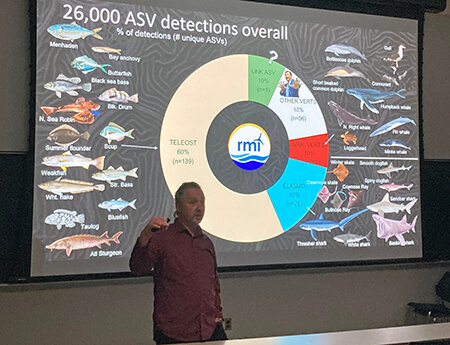
    The swirling gene pool that is Monmouth County’s ocean and estuarine waters was home to at least 68 species of fish this fall. That was one of the findings of an analysis of environmental DNA (eDNA) extracted from water samples taken at local beaches, bays and tidal rivers by community scientists partnering with the Monmouth University Urban Coast Institute (UCI).

    A presenter standing in front of a slide showing a pie chart
    Endowed Professor of Marine Science Jason Adolf shares findings from the eDNA analysis.

    Beginning in September, Monmouth researchers provided equipment and instruction to the volunteers to collect and return the samples, which were lab analyzed for eDNA – trace genetic materials floating in the water can indicate the presence of marine life. On Nov. 20, the volunteers gathered on campus for a meeting to learn about the study method and what their jars of water contained.

    Endowed Professor of Marine Science Jason Adolf explained that the eDNA shed into the water by marine organisms carries signatures, called metabarcodes, that can indicate what species it’s from. Since these materials tend to break down in the water in about a day, a detection indicates that it was likely in the area over the last few hours, if not at that moment.

    “It’s like barcoding at the supermarket, where instead of the person having to find the price tag for each item, you just scan it and the computer knows what it is,” Adolf said. “We have a database for all of the barcode sequences of fish, marine mammals, turtles and humans, and when we detect it in the natural sample, we can tell that a fish was there, and to some extent, how many of the fish were there.”

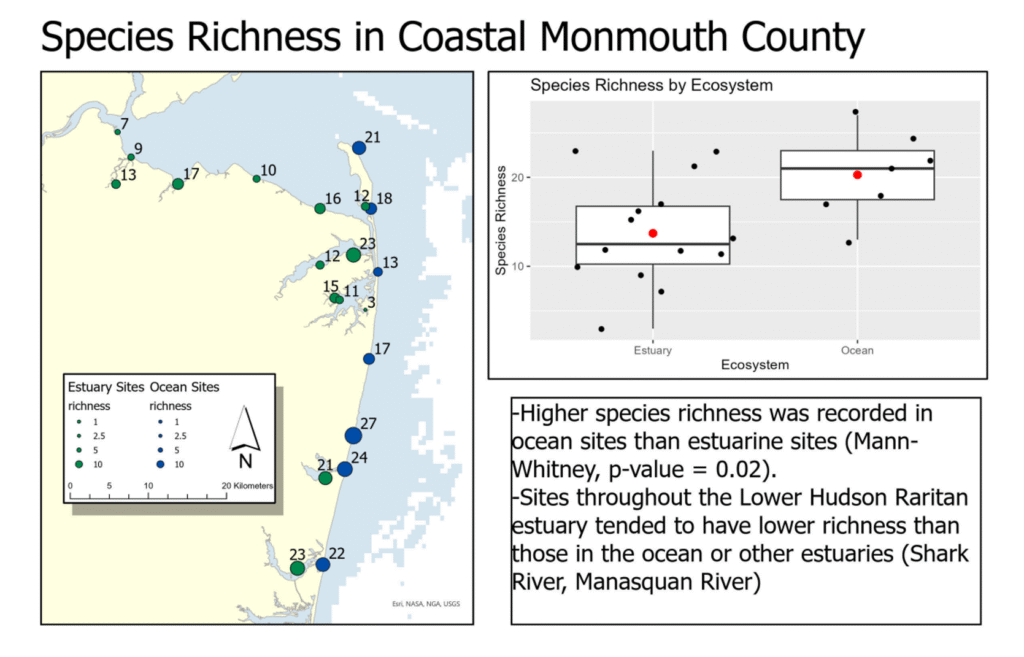
    The volunteers collected samples at 22 stations from the Manasquan Inlet to the Raritan Bay. The following are some of the results:

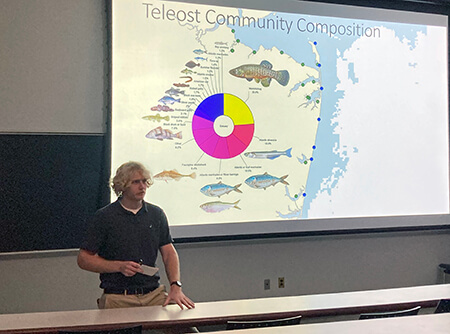
    • In the estuaries, the most common fish was mummichog, followed by Atlantic silverside and Atlantic or Gulf menhaden, with a caveat. Since river herring’s metabarcode is difficult to distinguish from Atlantic menhaden (commonly called bunker), they were paired together. If the possible river herring detections were actually menhaden, it would be the second most-detected fish.
    • In the ocean, the most detected fish was tautog, followed by menhaden, black drum or spot, and river herring or menhaden.
    • Elasmobranch species (sharks and rays) were counted separately. In the estuaries, the most common detection was for the sand tiger shark, while in the ocean it was the clearnose skate and smooth dogfish.
    • The highest number of fish species detected was at an Asbury Park beach with 27, followed by 24 at a beach near the Shark River Inlet in Belmar. The Raritan Bay locations tended to show lower species richness than the estuaries to the south. A site in Manahassett Creek, a branch of the Shrewsbury River in Long Branch, showed the fewest fish species (3).
    A presenter standing before a slide showing a map and a pie chart.
    UCI Resilience and Outreach Project Lead Richard Kane shares which fish were detected in local estuaries.

    The data will be used to help develop a baseline understanding of what species eDNA shows to be living in Monmouth area waters that can be compared to future results.

    “Each species plays a very important role in the function of their ecosystem, and as biodiversity decreases, ecosystem function decreases,” UCI Resilience and Outreach Project Lead Richard Kane said. “It’s important that we monitor biodiversity because ecosystem function – the working of the planet – is reliant on there being biodiversity and allowing these functions to continue.”

    Kane said a second round of sampling will be conducted in the summer. Those interested in participating can email rkane@monmouth.edu

  • UCI Receives NJDEP Grant to Expand Naval Weapons Station Earle Oyster Reef

    The Monmouth University Urban Coast Institute (UCI) has been awarded a $991,655 grant from the New Jersey Department of Environmental Protection (NJDEP) to expand and monitor its oyster reef installation off the shore of Naval Weapons Station Earle in Middletown. The grant will enable UCI and student researchers to add 600 oyster castles to the reef to enhance resilience, reduce shoreline erosion, and create habitats that support a diverse range of marine species.

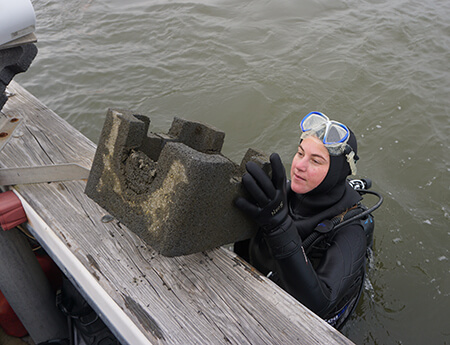
    UCI Marine Biology Technician Amanda Boddy adds an oyster castle to the reef at Naval Weapons Station Earle.

    The funding was provided through an $8 million round of Water Quality Restoration grants from the Murphy Administration to municipalities, nonprofit groups and academic institutions for projects that help reduce the impacts of nonpoint source pollution, address harmful algal blooms, develop watershed-based planning efforts, address emerging contaminants and improve climate resilience. The New Jersey Sea Grant Consortium will serve as an administrative partner on the project.

    Under the direction of Coastal Resilience Practitioner Meredith Comi, the UCI has been developing the reef in a 0.9-acre area of the Raritan Bay that is off limits to the public. Earle provides a unique testing ground for a reef project in that it is protected from disturbance but located along one of the most densely populated estuaries in the country. Comi first began work on the site a decade as director of the NY/NJ Baykeeper’s Coastal Restoration Program, until the project transitioned to the UCI’s management in 2023.

    The UCI maintains an aquaculture facility on the Earle grounds with tanks where the oyster castles – cement block-like structures that can stack underwater and resist waves and currents – and other experimental materials can be seeded with oyster larvae. The funding will support upgrades to the facility’s tanks and equipment.

    The continued placement of oyster castles at Earle will reduce the risks posed by extreme weather events to Earle by blunting the force of waves and helping accumulate and hold sand in the area. Oysters are also widely known for their ecosystem services, including their capacity to filter water and construct habitat for other marine organisms. 

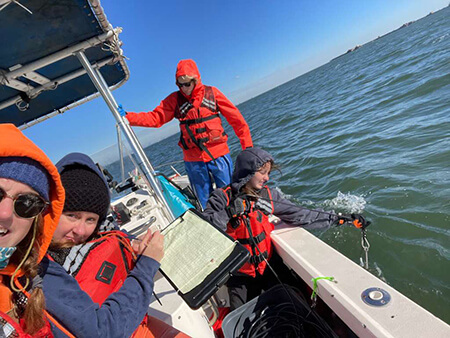
    Monmouth senior Grace Schleiden collects an eDNA sample near the reef aboard the R/V Little Hawk with (l-r) the UCI’s Amanda Boddy, Meredith Comi, and Richard Kane.

    “Oysters are natural engineers. They create hard, stationary structures that provide cover and substrate for organisms in what would otherwise be a barren bay bottom,” Comi said. “The reef is now home to a wide variety of crabs, sponges, snails, fish and other organisms.”

    The researchers will monitor the species richness and abundance on and around the reef using fish traps, settlement plates, and environmental DNA (eDNA) samples. Sonar, wave and current meters, water quality sondes, pressure sensors and other technologies will be used to survey the reef area and quantify its resilience impacts.

    “The project is providing important data on the benefits that nature-based solutions can offer for shoreline stabilization and coastal protection in a dynamic urban environment,” said UCI Acting Director Tom Herrington. “It will also offer students an opportunity to gain valuable field experience working alongside Naval personnel and other partner institutions while making an important contribution to the health of our waters.”

    Work to deploy the oyster castles is expected to commence in the spring. For more information on the project, email Meredith Comi at mcomi@monmouth.edu

  • Watch: Monmouth’s Siena Zisa Interviews Chilean Marine Biologist for COP30 Virtual Ocean Pavilion

    Monmouth University senior Siena Zisa, a joint research assistant with the Urban Coast Institute (UCI) and Global Ocean Forum, interviewed Professor Carlos F. Gaymer, director of the Center for Ecology and Sustainable Management of Oceanic Islands (ESMOI) at the Universidad Católica del Norte, as part of the COP30 Virtual Ocean Pavilion Youth-led Interview Series.

    Youth leaders from the CO30 Virtual Ocean Pavilion Team (Global Ocean Forum, Plymouth Marine Laboratory, and Ocean Generation), and the Citizen of the Ocean youth-led world forum coordinated by Nausicaá, Peace Boat US, and the Kenyan Youth Biodiversity Network, were matched with ocean and climate experts from around the world. The goal of the interviews was to provide a deeper understanding of complex topics addressed at the COP30 United Nations Climate Conference, held Nov. 10-21 in Brazil.

    The UCI was a partner in organizing a COP30 Virtual Ocean Pavilion that opened on Nov. 3. The free online platform features exhibits and activities dedicated to raising the visibility of the ocean and showcasing why it matters in climate negotiations and to all life on our planet. Its content will remain accessible through Dec. 22.

  • Nov. 20 Meeting to Share Results of eDNA Sampling at Monmouth County Beaches

    The Monmouth University Urban Coast Institute (UCI) will host a meeting on Nov. 20 to reveal the findings of a fall community science project designed to learn more about the marine organisms living along our coast through environmental DNA (eDNA) sampling. Members of the public are invited to attend the workshop, which will be held on campus from 6-9 p.m. at the Bey Hall Auditorium.

    Dinner and refreshments will be provided. Registration is requested by Thursday, Nov. 13, for the free event.

    Beginning in September, local volunteers worked with Monmouth researchers to collect samples of ocean waters, bays, and brackish areas of rivers from the Manasquan Inlet to the Raritan Bayshore in Monmouth County. The samples have since been lab analyzed for trace genetic materials floating in the water, known as eDNA, which can indicate the recent presence of marine life. The data will be used to help develop a baseline understanding of the species living in Monmouth area waters that can be compared to future results. 

    Endowed Professor of Marine Science Jason Adolf and UCI Resilience and Outreach Project Lead Richard Kane will provide an overview of the sampling, analysis process, results, and next steps in the research. The project is being supported through a federal grant secured by Congressman Frank Pallone.

    Those with questions about the event may email rkane@monmouth.edu.

  • UCI Ecopsychologist in Residence Delaney to Help Students ‘Restore at the Shore’

    Monmouth University Associate Professor Megan Delaney, Ph.D., LPC, has joined the Urban Coast Institute (UCI) as its ecopsychologist in residence. In this first-of-its-kind role, Delaney will deliver “Restore at the Shore” programming designed to help students reduce stress and revive their attention and energy for classwork through direct engagement with nature, including ocean and coastal environments.

    Delaney, of the Department of Psychology, has created courses at Monmouth and conducted research with UCI grant support on ecotherapy, which focuses on contact with the natural world as a method or element of counseling. According to Delaney, studies have indicated that regular exposure to the environment can reduce stress, obesity, attention-deficit/hyperactivity disorder, childhood anxiety, and carry other mental and physical health benefits. Monmouth is one of the few universities in the U.S. to offer an ecotherapy specialization, which Delaney designed and oversees.

    “I created the specialty in the graduate professional counseling program because I am an ecotherapist in my private practice. I see my clients all in natural spaces and do a lot of work on their connection with the natural world and how that impacts their mental health, but also how that can help them heal, and how nature is a co-therapist in the whole process,” Delaney said. “The UCI has been unbelievably supportive all these years in my research, looking both at the outcomes of ecotherapy with clients and students’ experiences in it.”

    The residency seeks to present students practical tools for stress relief, concentration restoration, and mental renewal through encounters with water and green spaces. In the near term, Delaney will meet with student clubs with science and nature focuses to offer lessons on ways students can utilize the campus and natural spaces at the shore to reinvigorate themselves when they’re feeling stressed. She said this is especially important for students whose work regularly confronts them with ecological problems that can weight them down emotionally.

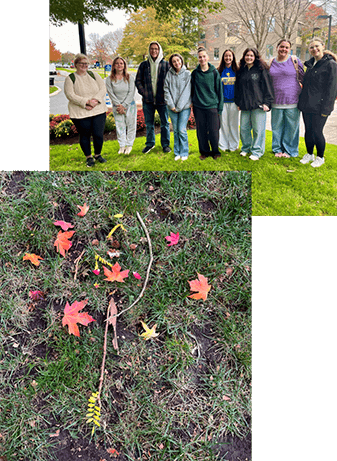
    Delaney spoke with the MEBP Club on Oct. 29 about how nature can help with study and rest. After, the group ventured outside to assemble a fall leave mandala.

    “People very much resonate with their connection to the natural world, or where they feel peace, or where they feel calm, and also where they feel sadness,” Delaney said. “I want to have conversations with as many people as I can that help them identify those feelings and have a plan to cope with them.”

    In the coming semester, she hopes to organize activities such as nature study breaks, goat yoga, paddleboarding trips, campfires, beach meditation and guided shoreline walks. Delaney will be assisted in organizing the programming by Ian Bley, Sean McCann, and Haley Roberts, all graduate students in the Professional Mental Health Counseling Program.

    Delaney is the author of “Nature is nurture: Counseling and the natural world,” which combines research and practical application for mental health professionals to infuse nature as a therapeutic partner. She teaches applied and adventure-based ecopsychology courses at the graduate and undergraduate level. Dr. Delaney has a private ecotherapy practice, Therapy Without Walls, LLC, and has been a featured contributor to Psychology Today. Her research agenda focuses on clinical outcomes in ecotherapy as well as student experiences in nature-based curriculum.

    To inquire about collaborating with Dr. Delaney on a Restore at the Shore activity for your club, class or campus activity, email mdelaney@monmouth.edu.

  • MacDonald, Herrington Guests on Monmouth Matters Podcast

    Monmouth University President Patrick Leahy and Matt Harmon welcomed Urban Coast Institute (UCI) Director Tony MacDonald and Associate Director Tom Herrington as guests on the Monmouth Matters podcast on Oct. 21. MacDonald and Herrington shared their thoughts on the UCI’s 20th anniversary, the recent Future of the Ocean Symposium, MacDonald’s forthcoming transition to a new role as a fellow at the UCI, and the ongoing environmental work ahead. Leahy and Harmon also touched on recent campus events, including the career fair and homecoming, within the context of Monmouth’s steady rise in external rankings.

    Download file | Play in new window | Duration: 48:20 | Download transcript

    Subscribe: Apple Podcasts Google Podcasts PocketCasts

  • Oct. 22: ‘Marine Carbon Dioxide Removal and its Potential Role in U.S. Climate Policy’

    Wil Burns, Ph.D., co-director of the Institute for Responsible Carbon Removal at American University, will deliver the presentation “Marine Carbon Dioxide Removal and its Potential Role in U.S. Climate Policy” on Oct. 22 at 1 p.m. in 201 Edison Hall. The talk is free to attend and light refreshments will be served.

    The event is jointly sponsored by the Monmouth University Department of Political Science and Sociology and the Urban Coast Institute (UCI). For questions or more information, contact Rechnitz Family/UCI Endowed Chair in Marine and Environmental Law and Policy Peter Jacques at pjacques@monmouth.edu

    Presentation Abstract

    In the ensuing years after the entry into force of the Paris Agreement, it has become increasingly apparent that achievement of its temperature objectives will require both aggressive emissions reduction initiatives and large-scale deployment of carbon dioxide removal/negative emissions technologies to either avoid passing critical climatic thresholds or address temperature “overshoot” scenarios. While much of the early research on carbon dioxide removal methods focused on terrestrial approaches, there has been increasing attention to the potential role of the world’s oceans, given both sustainability considerations and the fact that oceans already serve as a huge carbon sink, with substantial additional potential for storing carbon. These “marine carbon dioxide removal” (mCDR) options include ocean iron fertilization, ocean alkalinity enhancement, ocean upwelling/downwelling, and ocean biomass sinking. This presentation will provide an overview of mCDR approaches and developments in the U.S., including the emerging regulatory framework for deployment of mCDR.

    Speaker Bio

    Wil Burns, Ph.D., is the co-founding director of the Institute for Responsible Carbon Removal at American University, a research center that focuses on social science aspects of carbon dioxide removal, including law and governance, ethics and justice and the role of public engagement and deliberation. Previously, he served as the associate director of the Environmental Policy & Culture program at Northwestern University and the founding director of the Energy Policy & Climate program at Johns Hopkins University. He also taught at the University of Chicago, Stanford University, and the University of California-Berkeley. Prior to entering academia, he served as assistant secretary of state for policy for the state of Wisconsin and worked in the environmental non-profit sector for more than 20 years.

    His community service includes having served as co-chair of the International Environmental Law Section of the American Branch of the International Law Association, and president of the Association of Environmental Studies & Sciences (AESS). He was the 2019 recipient of AESS’s Lifetime Achievement Award for Scholarship and Service in the field. He received his Ph.D. in International Law from the University of Wales-Cardiff School of Law and is the author of more than 90 publications.

  • Watch: Tony MacDonald Reflects on Urban Coast Institute’s First 20 Years

    The Monmouth University Urban Coast Institute (UCI) turned 20 this year and Tony MacDonald has been its director from the start. Watch above as Tony looks back on some of the UCI achievements he’s most proud of.

    UCI 20th anniversary, 2005-25

    You can celebrate this anniversary with the UCI at the 2025 Future of the Ocean Symposium on Thursday in Monmouth’s Great Hall Auditorium. You can also browse these resources to learn more about the UCI’s history:

  • Watch: Herrington Joins Roundtable on Beach Replenishment Funding Challenges

    Monmouth University Urban Coast Institute (UCI) Associate Director Tom Herrington was a panelist on an Oct. 1 online discussion hosted by South Jersey Forward about funding challenges New Jersey faces for its future beach replenishment needs. The panel was moderated by South Jersey Forward founder Michael Suleiman and also included Jersey Shore Partnership Executive Director Grace Hanlon and Stevens Institute of Technology Research Professor Jon Miller. The following is a synopsis of the discussion topic from South Jersey Forward:

    For the first time in decades, 2025 saw no federal dollars allocated for beach replenishment. Without these critical funds, South Jersey’s shoreline faces unprecedented risk, especially for the homes, businesses, and ecosystems it protects. Early appropriations for the next fiscal year suggest even deeper cuts ahead.

    That’s why we’ve partnered with the Jersey Shore Partnership, the state’s leading authority on coastal restoration, for a virtual roundtable on Wednesday, October 1 to discuss:

    • The implications of zero federal funding for beach replenishment
    • Economic, environmental, and community impacts of reduced beach replenishment
    • Strategies for local and state advocacy to secure future funding
  • Monmouth University Urban Coast Institute to Host Future of the Ocean Symposium Oct. 9

    A new wave of marine technologies such as artificial intelligence, autonomous underwater gliders, environmental DNA, and acoustic telemetry is rapidly changing how we study and what we know about our oceans. On Oct. 9, a panel of leading voices in ocean science and exploration will convene at Monmouth University for a conversation on actions the U.S. must take to harness these innovations to ensure its economic prosperity and national security.

    The 2025 Future of the Ocean Symposium will be hosted by the Monmouth University Urban Coast Institute (UCI) from 10-11:45 a.m. at Monmouth’s historic Great Hall. The symposium is free and open to the public and will have a theme of “Exploring the Wine-Dark Sea – U.S. Ocean Science and Technology: Keys to Prosperity and Security.” The event will also commemorate the 20th anniversary of UCI, which was established in 2005.

    An image of a ship sailing forward at sunset with text reading "2025 Future of the Ocean Symposium and Champion of the Ocean Awards." Exploring the Wine-Dark Sea, U.S. Ocean Science and Technology: Keys to Prosperity and Security. October 9, Monmouth University Great Hall. UCI 20th Anniversary 2005-2025

    Among the panelists will be two UCI 2025 Champion of the Ocean honorees: Caladan Oceanic CEO Victor Vescovo, an entrepreneur and extreme ocean explorer who was the first person to visit the deepest point in all five of the world’s oceans; and ocean mapping pioneer Larry Mayer, who serves as chair of the U.S. Arctic Research Commission and director of the University of New Hampshire Center for Coastal and Ocean Mapping. The panel will also include VADM (Ret.) Paul Gaffney, Monmouth University president emeritus and former chief of naval research; Deerin Babb-Brott, formerWhite House Office of Science and Technology Policy principal assistant director for oceans and the environment; Paula Bontempi, University of Rhode Island Graduate School of Oceanography professor and president of the Oceanography Society; and Ocean Power Technologies President and CEO Philipp Stratmann. The panel will be moderated by UCI Director Tony MacDonald.

    The transformational promise and potential of these technologies is being realized at a moment when the longstanding model for funding universities to conduct ocean research is being disrupted, and proposed cuts to staff and programs at the National Oceanic and Atmospheric Administration, National Science Foundation and other federal agencies is creating additional uncertainty. At the same time, the administration has directed the agencies to “prioritize new and emerging technologies and collaborative approaches to efficiently map, explore, and characterize the resources of the United States exclusive economic zone and sea beds under international waters … [and] focus on increasing their capacity to effectively and efficiently manage large volumes of ocean observation and research data.”

    “The uncertainty and seemingly contradictory actions raise many questions of critical importance, including, what will the new normal of ocean science and exploration look like?  What will the roles of government, academia and the private sector be moving forward, and how can rapidly changing technology advance their work?” MacDonald said. “There is little public awareness of the major role the ocean plays in regulating climate, supporting economic development and national security, and it all depends on our ability to observe and understand the ocean environment. Yet federal investment in ocean science remains disproportionately small, accounting for less than 0.2 percent of federal discretionary spending.”

    Immediately following the symposium at noon, the UCI will host its Champion of the Ocean Awards Luncheon, also in the Great Hall. This year’s National Champion of the Ocean honorees are Vescovo, Mayer, and Congressman Frank Pallone. Tickets are required to attend the reception, with proceeds supporting the UCI.

    The awards were established in 2005 to honor individuals who have undertaken actions and demonstrated sustained leadership that ensures coasts and oceans are clean, safe, sustainably managed, and preserved for the benefit and enjoyment of future generations. Previous honorees include ocean explorer Robert Ballard, marine biologist and explorer Sylvia Earle, ocean scientist and advocate Jean-Michael Cousteau, and former CIA Director and Secretary of Defense Leon Panetta.

    This event is made possible thanks to the generosity of the Leslie Hitchner Family. For more information, email uci@monmouth.edu or visit the event website.