
Lindsay Mehrkam, Ph.D., associate professor of psychology, was recently named an honorary Fellow of the Eastern Psychological Association (EPA).
Founded in 1896, the EPA is the oldest regional psychological association in the country; its mission is to advance the science and profession of psychology. The Fellow designation is a level of membership within the association to honor long-standing achievement and is awarded in recognition of meritorious contributions to the field of psychology by EPA’s Members Committee and Board of Directors. Fellows also earn expedited acceptance of first-author submissions and a responsibility to play important leadership roles in the association as well as to nominate colleagues for committee elections.
“I’m honored to be a lifetime member of an association that is so welcoming of undergraduate students, inclusive of faculty-student scholarship, and provides a space for researchers and professionals across all areas of psychology to come together to share ideas,” Mehrkam said. “I look forward to helping support EPA’s long-standing history of studying animals in psychology in innovative ways that increase the visibility our students’ accomplishments with animal learners here in their classes and research at Monmouth. We are seeing how the science of behavior can be applied in ways that not only extends the long-standing tradition of using animals as models to understand human behavior—but also in doing so, help advance animal welfare and student learning outcomes.”
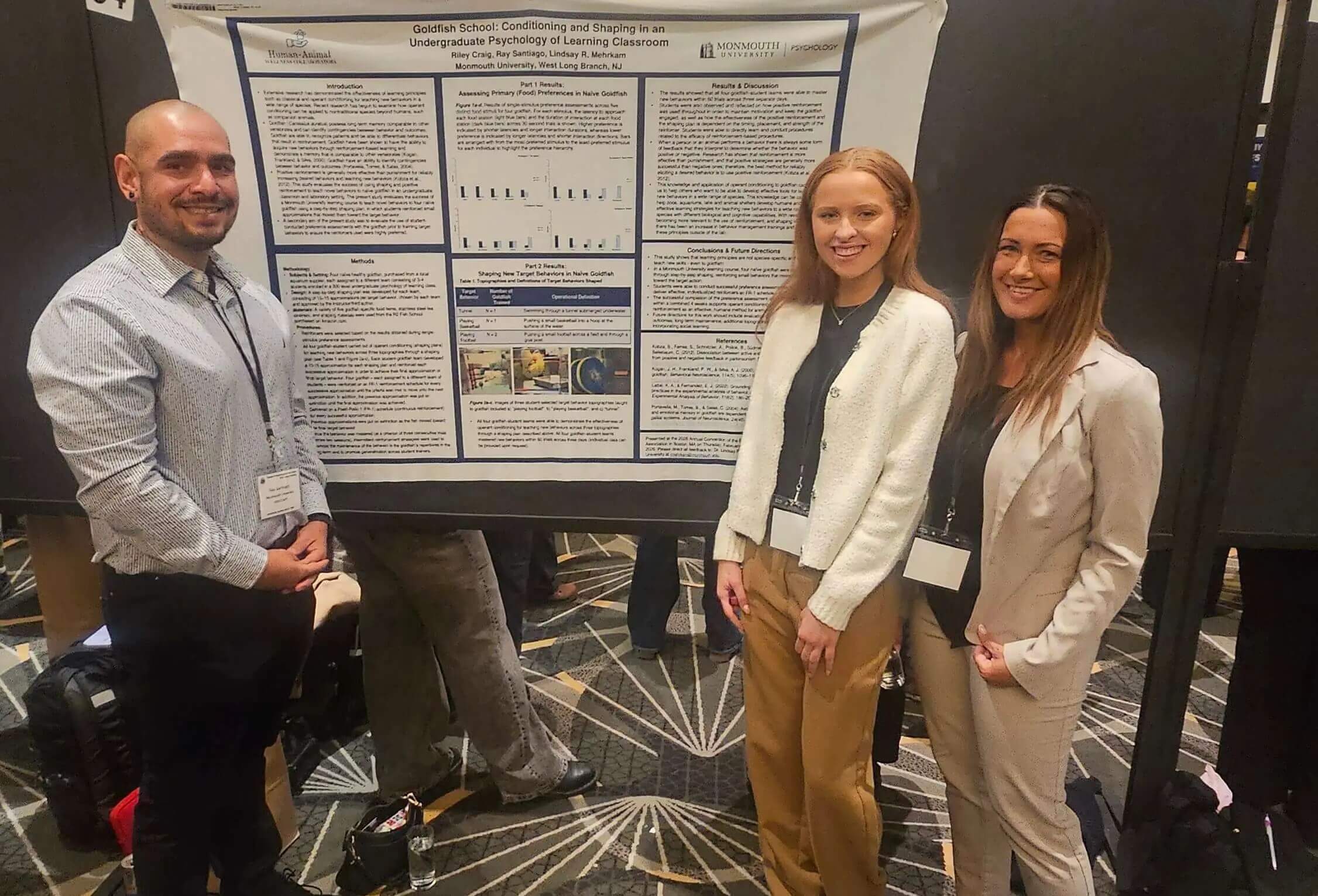
At the EPA’s 97th Annual Meeting in Boston earlier this year, Mehrkam co-presented with two undergraduate psychology students, Riley Craig and Raymond Santiago, on a poster presentation titled “Goldfish School: Conditioning and Shaping in an Undergraduate Psychology of Learning Classroom.” In their presentation, Craig and Santiago demonstrated how their Psychology of Learning class developed and conducted mini-labs adapted from traditional animal models (such as rats and pigeons) to naive goldfish. By reinforcing behaviors on a fixed schedule, student research teams successfully taught their goldfish new target behaviors within 60 trials across three days. During the process, students maintained strict animal welfare guidelines and collected ongoing behavioral data to ensure the physical and psychological well-being of their team goldfish throughout all procedures in the class.
“What these students accomplish with their goldfish in a 14-week semester through this Goldfish Learning Laboratory is truly remarkable,” Mehrkam said. “Their findings speak to the power of positive reinforcement and how an understanding of learning principles can lead to humane behavior change. In the process, our students are challenging stereotypes about animal intelligence, gaining employable skills (such as following laboratory safety procedures and conducting animal wellness checks), all while providing better standards of welfare and care for fish compared to what they typically receive.”
Mehrkam is the principal investigator of the Human-Animal Wellness Collaboratory, a community-based research lab centered on student-faculty collaborations to understand human-animal interactions across diverse animal settings. She also serves as the Chair of the Institutional Animal Care and Use Committee, which provides oversight for animals used in teaching and research at the University.