
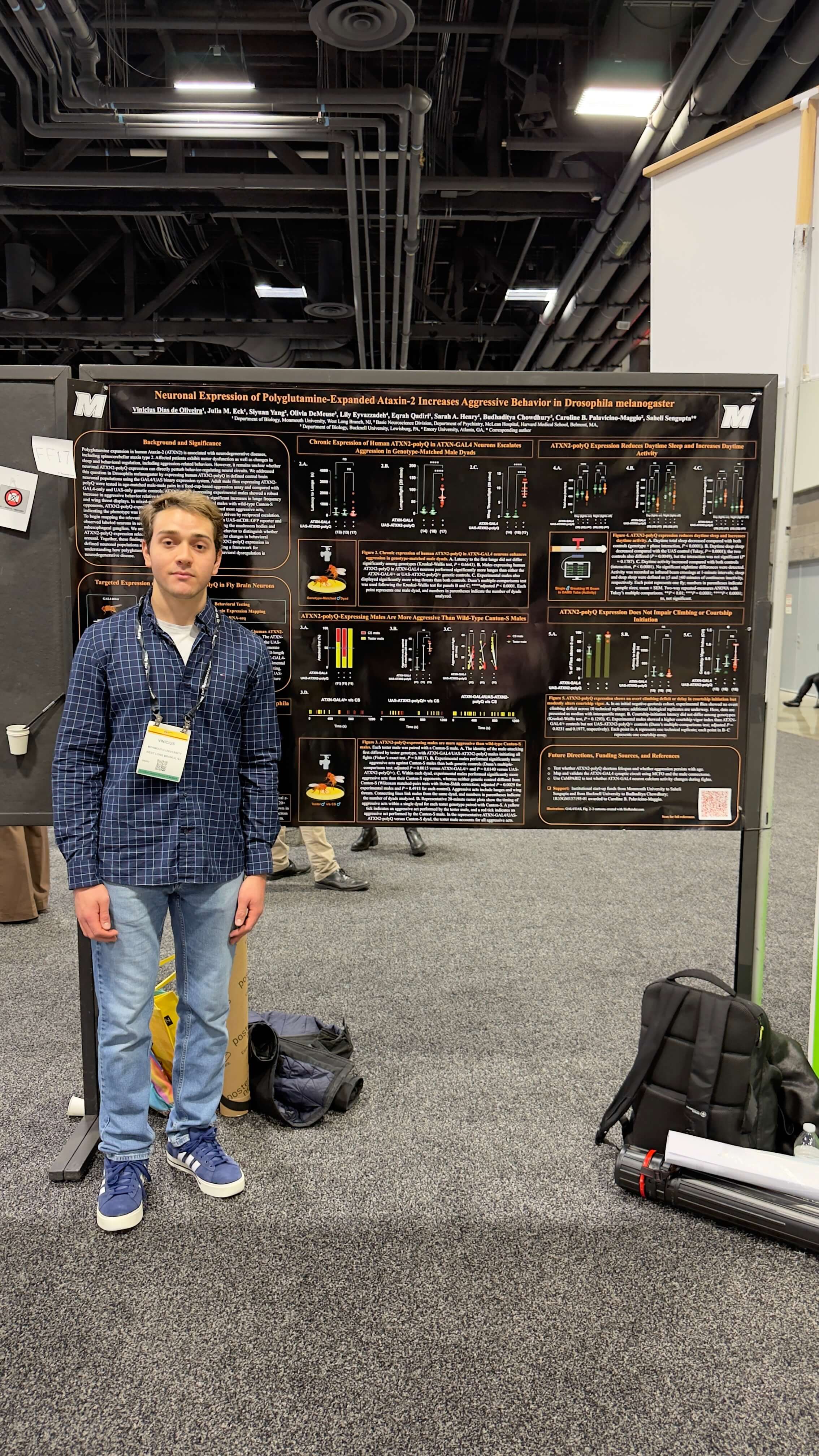
Undergraduate biology student Vinicius Dias de Oliveira recently presented research at the 2026 Society for Neuroscience (SfN) Annual Meeting, held Nov. 14–18 in Washington, D.C. One of the world’s largest gatherings of neuroscientists, the annual meeting brings together thousands of researchers from across the globe to share discoveries and advances in neuroscience.
Dias de Oliveira’s research abstract was accepted for presentation at the conference, where he served as the first and presenting author of the study, titled “Neuronal Expression of Polyglutamine-Expanded Ataxin-2 Increases Aggressive Behavior in Drosophila Melanogaster.”
The research, conducted in the laboratory of Saheli Sengupta, Ph.D., assistant professor of biology, investigates how a neurodegenerative disease-linked form of the human Ataxin-2 protein influences aggression and other behaviors. Using the fruit fly (Drosophila melanogaster) as a model organism, the team examines how expressing polyglutamine-expanded Ataxin-2 in specific brain neurons affects behavior.
The findings reveal that male fruit flies expressing this disease-linked form of Ataxin-2 exhibit significantly elevated aggression, displaying more frequent lunges and threatening wing movements than control flies. When paired with wild-type fruit flies, the experimental males initiated all observed fights and performed most of the aggressive actions. The researchers also observed reduced daytime sleep and increased daytime activity, suggesting that the protein may influence broader neural mechanisms involved in behavioral regulation.
Dias de Oliveira plays a leading role in this research in Sengupta’s laboratory, colloquially called the “Fruit Fly Fight Club.” He continues to advance the project, investigating how these behavioral changes arise and working toward completing the study. The ongoing research aims to better understand how neurodegenerative disease-associated proteins alter neural circuits and behavior.
His presentation at SfN 2026 highlights the opportunities for Monmouth University undergraduates to participate in original neuroscience research and contribute to scientific conversations at major international research conferences.