
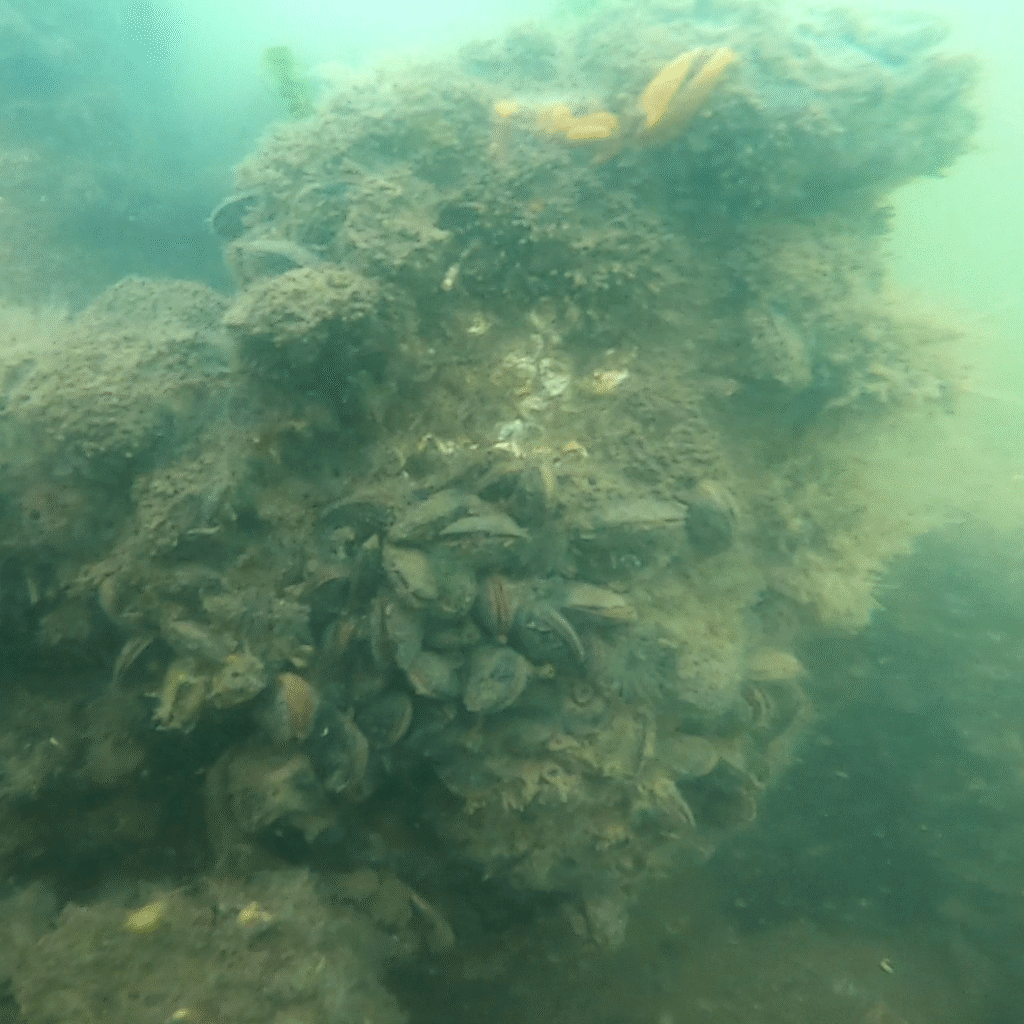
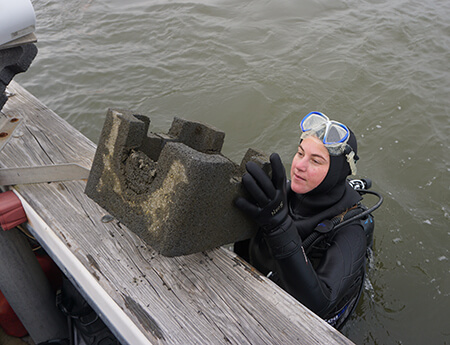
The Monmouth University Urban Coast Institute (UCI) has been awarded a $991,655 grant from the New Jersey Department of Environmental Protection (NJDEP) to expand and monitor its oyster reef installation off the shore of Naval Weapons Station Earle in Middletown. The grant will enable UCI and student researchers to add 600 oyster castles to the reef to enhance resilience, reduce shoreline erosion, and create habitats that support a diverse range of marine species.
The funding was provided through an $8 million round of Water Quality Restoration grants from the Murphy Administration to municipalities, nonprofit groups and academic institutions for projects that help reduce the impacts of nonpoint source pollution, address harmful algal blooms, develop watershed-based planning efforts, address emerging contaminants and improve climate resilience. The New Jersey Sea Grant Consortium will serve as an administrative partner on the project.
Under the direction of Coastal Resilience Practitioner Meredith Comi, the UCI has been developing the reef in a 0.9-acre area of the Raritan Bay that is off limits to the public. Earle provides a unique testing ground for a reef project in that it is protected from disturbance but located along one of the most densely populated estuaries in the country. Comi first began work on the site a decade as director of the NY/NJ Baykeeper’s Coastal Restoration Program, until the project transitioned to the UCI’s management in 2023.
The UCI maintains an aquaculture facility on the Earle grounds with tanks where the oyster castles – cement block-like structures that can stack underwater and resist waves and currents – and other experimental materials can be seeded with oyster larvae. The funding will support upgrades to the facility’s tanks and equipment.
The continued placement of oyster castles at Earle will reduce the risks posed by extreme weather events to Earle by blunting the force of waves and helping accumulate and hold sand in the area. Oysters are also widely known for their ecosystem services, including their capacity to filter water and construct habitat for other marine organisms.
“Oysters are natural engineers. They create hard, stationary structures that provide cover and substrate for organisms in what would otherwise be a barren bay bottom,” Comi said. “The reef is now home to a wide variety of crabs, sponges, snails, fish and other organisms.”
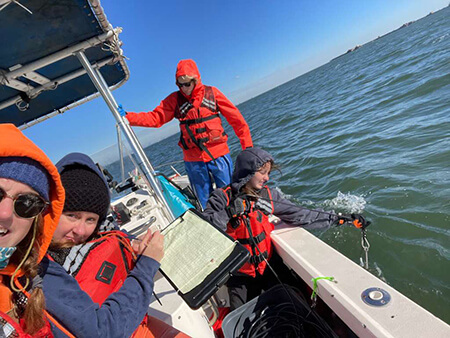
The researchers will monitor the species richness and abundance on and around the reef using fish traps, settlement plates, and environmental DNA (eDNA) samples. Sonar, wave and current meters, water quality sondes, pressure sensors and other technologies will be used to survey the reef area and quantify its resilience impacts.
“The project is providing important data on the benefits that nature-based solutions can offer for shoreline stabilization and coastal protection in a dynamic urban environment,” said UCI Acting Director Tom Herrington. “It will also offer students an opportunity to gain valuable field experience working alongside Naval personnel and other partner institutions while making an important contribution to the health of our waters.”
Work to deploy the oyster castles is expected to commence in the spring. For more information on the project, email Meredith Comi at mcomi@monmouth.edu.