
March 26–27, 2026
This symposium provides a space for generative conversations on what we know about Native American boarding schools and what that knowledge means. Join us in exploring the 20th-century history of North American Indian boarding schools in this two-day symposium, featuring speakers, workshops, and film.
About the Symposium
In the late-19th and early-20th century, throughout the United States and Canada, federal governments created boarding schools for Native American youth. Student experiences at each school varied, depending on living conditions, curriculum, and who oversaw the school (churches, federal employees, trained teachers, etc.). The boarding schools tried to strip children of their Indigenous culture, agency, and family. The white administrators forcibly cut children’s hair, sacred to many, and required that they only wear western clothing instead of their traditional clothing. In many schools, students were expected to adhere to strict rules that helped repress the expression of Indigenous culture. In most schools, for example, children could only speak English, a language completely unfamiliar to them. Failure to adhere to rules and complete assigned work could result in severe punishment. The schools subjected the children to inadequate diets, rampant disease, overwork, and overcrowding, which along with the poor building and living conditions resulted in poor health and even death.
The governments of Canada and the United States left the history of Native American boarding schools unacknowledged until relatively recently. Stephen Harper, the prime minister of Canada, made a formal apology for the implementation of boarding school systems and the trauma they produced in 2008, with President Joe Biden making the United States’ national apology in 2024.
This symposium brings together scholars who have worked with the history of Native American Boarding Schools in North America. The goal of this symposium is to spark conversation on what is known about Native American boarding schools and what this knowledge means. The Native American Boarding School Symposium will be hosted March 26–27 on Monmouth University’s campus.
The Native American Boarding School Symposium would not be possible without the generous help of the Diversity Innovation Grant from the Intercultural Center at Monmouth University. We are grateful for this grant and thank all of the co-sponsors of this event: the Bruce Springsteen Center for American Music, the Office of the Provost, the School of Humanities and Social Sciences, the School of Education, the School of Business, the Department of English, the Department of Criminal Justice, the Department of Curriculum and Instruction, the Intercultural Center, the Department of History and Anthropology, African Diaspora Studies, and the Program in Gender and Intersectionality Studies.
Meet the Keynotes

Brenda J. Child, Ph.D., Ojibwe
Northrop Professor of American Studies at University of Minnesota
Keynote Title: “Boarding Schools and American Indian Dispossession”
Brenda J. Child is Northrop professor and former chair of the Departments of American Studies and American Indian Studies at the University of Minnesota, where she received the President’s Engaged Scholar Award in 2021. She was Guggenheim Fellow in 2022–23. She was a nonfiction judge for the National Book Awards for 2024.
Child is the author of several books in American Indian history including “Boarding School Seasons: American Indian Families, 1900-1940” (Nebraska, 1998), which won the North American Indian Prose Award; and “Holding Our World Together: Ojibwe Women and the Survival of Community” (Penguin, 2012). Her 2014 book “My Grandfather’s Knocking Sticks: Ojibwe Family Life and Labor on the Reservation” (MHS Press, 2014) won the American Indian Book Award and Best Book in Midwestern History. She edited a book, “Ojibwe and Ocheti Sakowin Artists and Knowledge Keepers” (Minnesota, 2024) with Howard Oransky that was a finalist for a Minnesota Book Award. She curated an exhibit of the same title that was at the Katherine E. Nash Gallery at the University of Minnesota in January–March 2024. The exhibit marked the opening of the new George Morrison Center for Indigenous Arts in the College of Liberal Arts at the University of Minnesota, and Child is the founding director. Her current book project, for which she received a Guggenheim Fellowship is “The Marriage Blanket: Love, Violence, and the Law in Indian Country”. Child is the author of a best-selling bi-lingual book for children, “Bowwow Powwow” (2018), and the forthcoming “BlueBearies”.
She was a member of the Board of Trustees of the National Museum of the American Indian-Smithsonian (2013–18) and was president of the Native American & Indigenous Studies Association (2017–18). She was consultant to a major exhibit, “Away from Home: American Indian Boarding School Stories” at the Heard Museum. She has a popular documentary, “Jingle Dress Dancers in the Modern World”.
Child was born on the Red Lake Ojibwe Reservation in northern Minnesota. She continues as part of a committee developing a new constitution for the 15,000-member nation. She lives with her husband, the Mille Lacs Ojibwe artist Steven Premo, and family in St. Paul and Bemidji, Minnesota.

Preston McBride, Ph.D.
Assistant Professor of History at Pomona College
Keynote Title: “Life and Death in Federal Custody: The Educational Apparatus for Native American Peoples and the Geographies of Removal and Return”
Preston McBride lives and works on Tongva lands where he is an assistant professor of history at Pomona College. There he teaches courses on United States, Native American, and environmental history. After receiving his A.B. and M.A at Dartmouth College, Preston earned an M.A. and Ph.D. in history from the University of California, Los Angeles.
He has been awarded fellowships and grants from the National Endowment for the Humanities, UCLA, University of Southern California, the School for Advanced Research, the University of California Humanities Research Institute, and Dartmouth College. His work has been featured in several PBS documentaries, a play at the Oregon Shakespeare Festival, and dozens of newspapers. He has also co-curated an exhibit on photography and submitted a joint petition to the United Nations Working Group on Enforced or Involuntary Disappearances. Preston is currently finishing his first book, “A Lethal Education”, that investigates student health, environmental conditions, and infectious diseases at federal boarding schools for Native Americans.

Jessica Fremland, Ph.D., Sisseton Wahpeton Dakota
Postdoctoral Research Associate in American Studies at Brown University
Keynote Title: “Epistolary Kinship: Love, Sabotage, and Refusal in the Wahpeton Indian School”
Jessica Fremland (she/her/hers; Sisseton-Wahpeton Dakota) obtained her B.A. from the University of Minnesota Twin Cities, an M.Sc. in sociology from the London School of Economics, and her Ph.D. in gender studies from UCLA.
Her research examines the ways Dakota women critique the violence of the settler state and create anti-colonial geographies through aesthetic expressions of relationality, and sensorial insurgence. Fremland analyzes the gendered forms of settler colonial carcerality that surround Native women in boarding schools, activist spaces, and everyday geographies. Her research highlights methods by which Native women refuse carceral structures by harnessing Indigenous aesthetic practices such as dance, music, sound, crafting, letter-writing and everyday expressions of joy. Jessica draws especially on the fields of Black and Indigenous feminisms to not only document and map these moments of refusal through critical archival and ethnographic research, but to imagine and cultivate alternative possibilities in her own writing and aesthetic engagements.
Speakers and Panelists

Farina King, Ph.D., Citizen of the Navajo Nation
Full Professor and Horizon Chair of Native American Ecology and Culture Department of Native American Studies, University of Oklahoma
Workshop: “Learning and Teaching Indigenous Truthtelling of Boarding Schools”
Farina King (Diné) is full professor and horizon chair of Native American ecology and culture in the Department of Native American Studies at the University of Oklahoma. Her research centers on Indigenous education, oral history, and memory, especially surrounding Native American experiences in boarding schools. A citizen of the Navajo Nation and daughter of a Diné boarding school survivor, King collaborates with communities and institutions to advance truthtelling and restorative initiatives through teaching, research, and digital humanities projects that focus on Indigenous voices and histories.

Nathan Sowry, Ph.D.
Independent Scholar, Washington D.C
Panel Discussion: “Turning the Power: Indian Boarding Schools, Native American Anthropologists, and the Race to Preserve Indigenous Cultures”
Nathan Sowry is the reference archivist at the Smithsonian Institution’s National Museum of the American Indian, where he has worked since 2016. He regularly collaborates with Native and non-Native researchers, scholars, and community groups interested in utilizing archival collections and visiting their cultural heritage. Sowry received his B.A. in anthropology and religious studies from the University of Pittsburgh, M.A. in history from Washington State University, MLIS in archives and records management from the University of Wisconsin-Madison, and Ph.D. in history from American University.

Elisabeth Davis, Ph.D.
Assistant Professor at Lycoming College
Presentation: “After Carlisle: Voices of Alumni from the Carlisle Indian Industrial School”
Elisabeth Davis works at Lycoming College. Her work has examined the role of Catholicism at the Carlisle Indian Industrial School, as well as assimilation attempts at Catholic run schools. She is the author of “Catholic Sisters, Narratives of Authority, and the Native American Boarding Schools, 1847-1918”.

David B. MacDonald, Ph.D.
Full Professor of Political Science at University of Guelph (Canada)
Presentation: “Canada Confronts its History Wars: Reconciliation, Indigenous Genocide Recognition, and Denialism in Contemporary Politics”
David B. MacDonald is a full professor of political science at the University of Guelph (Canada) and has previously been on faculty at Ōtākou Whakaihu Waka / Otago University, and l’École supérieure de commerce de Paris (ESCP). He has a Ph.D. in international relations from the London School of Economics. His work relates to Indigenous-settler relations and Indigenous-ethnic community relations in CANZUS states, Indigenous rights and self-determination, and comparative genocide studies. He is an honorary academic (2024-2028) at Waipapa Taumata Rau / University of Auckland. Publications include “Myths, History Wars, and Indigenous-Settler Relations in Canada and other Settler States” (Cambridge University Press, 2025), “Populism and World Politics: Exploring Inter- and Transnational Dimensions Second Edition”, co-edited with F.A. Stengel and D. Nabers (forthcoming Palgrave MacMillan, 2025), “On Settler Colonialism in Canada: Lands and Peoples”, co-edited with Emily Grafton (University of Regina Press, 2025), and “The Sleeping Giant Awakens: Genocide, Indian Residential Schools, and the Challenge of Conciliation” (University of Toronto Press, 2019). His research is funded by the Social Sciences and Humanities Research Council of Canada.
National Native American Boarding School Healing Coalition
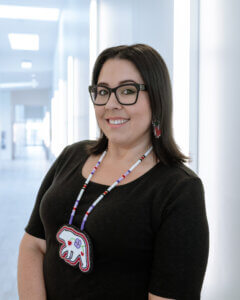
Lacey Kinnart, Sault Ste. Marie Tribe of Chippewa Indians
Co-Director for Oral History Programs
Lacey Kinnart, Mukwa Ode Quay (Bear Hearted Woman), (she/her) is Ojibwe, Potawatomi, and Odawa, and an enrolled citizen of the Sault Ste. Marie Tribe of Chippewa Indians. Kinnart has worked as an office administrator and academic advisor in Indigenous education in Michigan and Wisconsin for the past 15 years. She also worked as an administrator for the Indian Health Service facility in Milwaukee, Wisconsin. She was a member and chairperson for the Milwaukee Indian Education Committee for several years. Kinnart grew up in Anishinaabewaakiing (the land of the Anishishinabeg) in the Upper Peninsula of Michigan. She graduated from Northern Michigan University and Bay College with a degree in business. Kinnart descends from several boarding school survivors, who survived Holy Childhood of Jesus School (Michigan), Mount Pleasant Industrial Indian School (Michigan), Flandreau Indian School (South Dakota), and Carlisle Indian Industrial School (Pennsylvania). Kinnart is extremely passionate about empowering Native youth, advocating for those wrongly convicted, fighting mass incarceration, and strengthening the Native vote.

Charlee Brissette, Sault Ste. Marie Tribe of Chippewa Indians
Co-Director for Oral History Programs
Charlee Brissette, Niimiida Migizii Kwe (Dancing Eagle Woman) (she/her) is an Anishinaabe Ojibwe and Odawa woman. She is an enrolled member of the Sault Ste. Marie Tribe of Chippewa Indians from Bawating (The Place of the Rapids/Sault Ste. Marie), Michigan. Brissette is a descendant of a boarding school survivor who attended Holy Childhood of Jesus in Harbor Springs, Michigan. She graduated from the University of Texas at Austin with a master’s in Health Behavior and Health Education, with a portfolio in Native American and Indigenous Studies. Her master’s thesis was titled: “You heal the spirit: Anishinaabe Adaptations to Historical Loss and Trauma.”
Prior to joining NABS, Brissette worked as a tribal education director and community health educator for the Sault Tribe of Chippewa Indians. She has experience as a health and wellness coach, working with both individuals and small groups. Brissette has done consulting work for local museums, developing permanent and traveling exhibits around the boarding school experience. She also has experience interviewing boarding school survivors and Native American veterans. Her passion centers around bringing about health and well-being to Tribal communities and individuals from an abundance mindset, using education and traditional Indigenous healing practices.
Accompanying Symposium Material
General Resources
Acknowledgments
We are grateful to be funded by a Diversity Innovation Grant and co-sponsored by the Office of the Provost, the Dean’s Distinguished Speaker Series (SHSS), the School of Education, the Leon Hess Business School, the Intercultural Center, the Department of English, the Department of Criminal Justice, the Department of Curriculum & Instruction, the Department of History and Anthropology, the Program for Gender and Intersectionality Studies, and the Bruce Springsteen Center for American Music.
We would also like to thank Claire Garland, Anita Clark, and the Sand Hill Indians for loaning Monmouth University the Christina R. Dickerson Ceremonial Dress and Accessories, as well as other clothing and accessories from their personal collections. We also are grateful to the Shrewsbury Historical Association for the loan of a bandolier bag.
Contact
Katherine Parkin, Ph.D.
Professor;
Jules Plangere, Jr., Endowed Chair in American Social History