
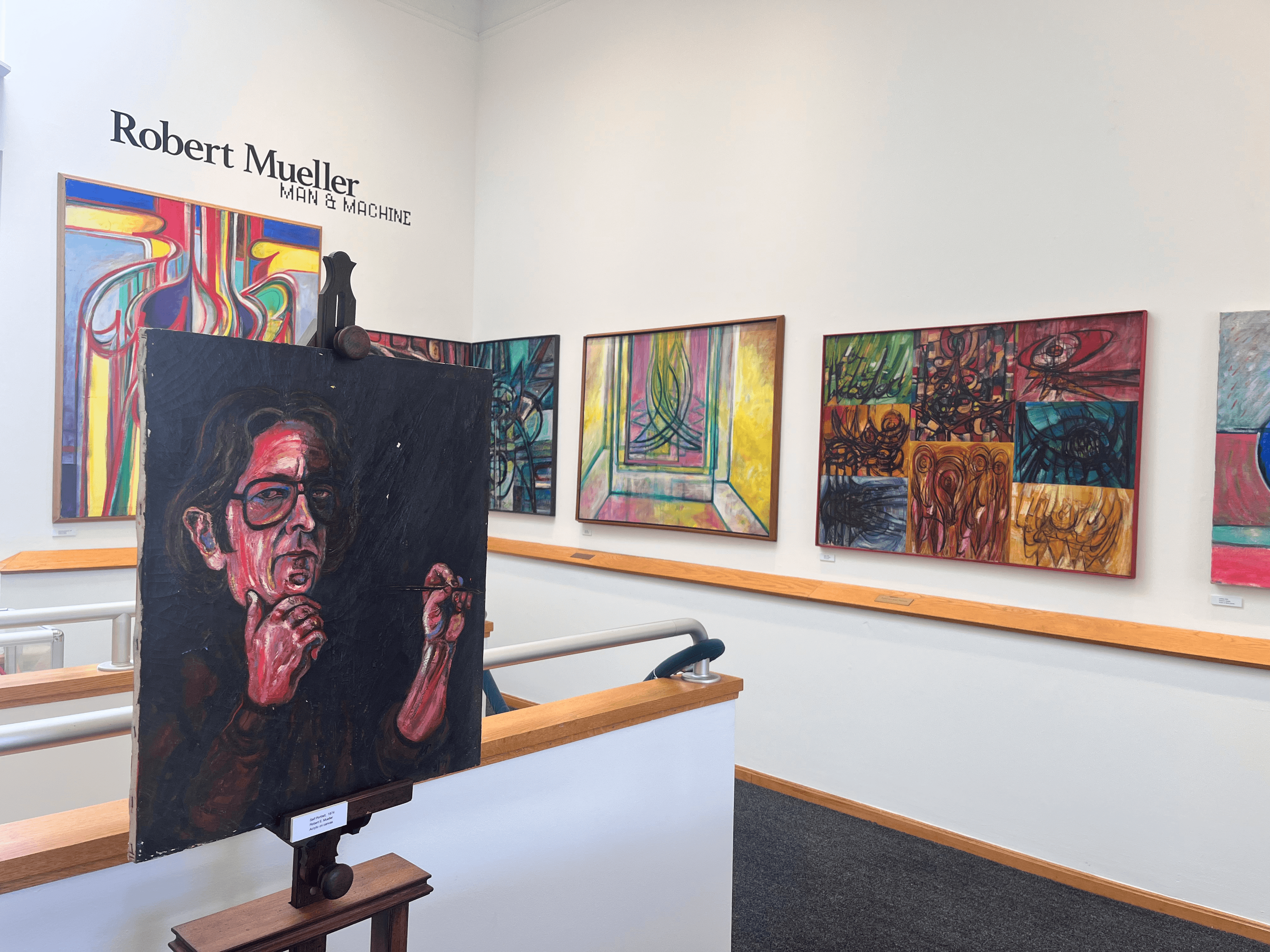
Thea Merritt, senior graphic and interactive design student, with minors in art history and marketing, recently curated the exhibition, “Robert Mueller: Man and Machine” for Monmouth University’s Ice House Gallery. Roosevelt artist Robert Mueller (1925-2017) was a scientist, engineer, inventor, writer, poet, musician, puppet maker, and artist who combined ideas of mathematical models, literary sources, social concepts, scientific constructs, and more in his creations. Every concept to him was interdisciplinary, especially the relationships between art, technology, and human experience, which Merritt selected as the focus of her exhibition.
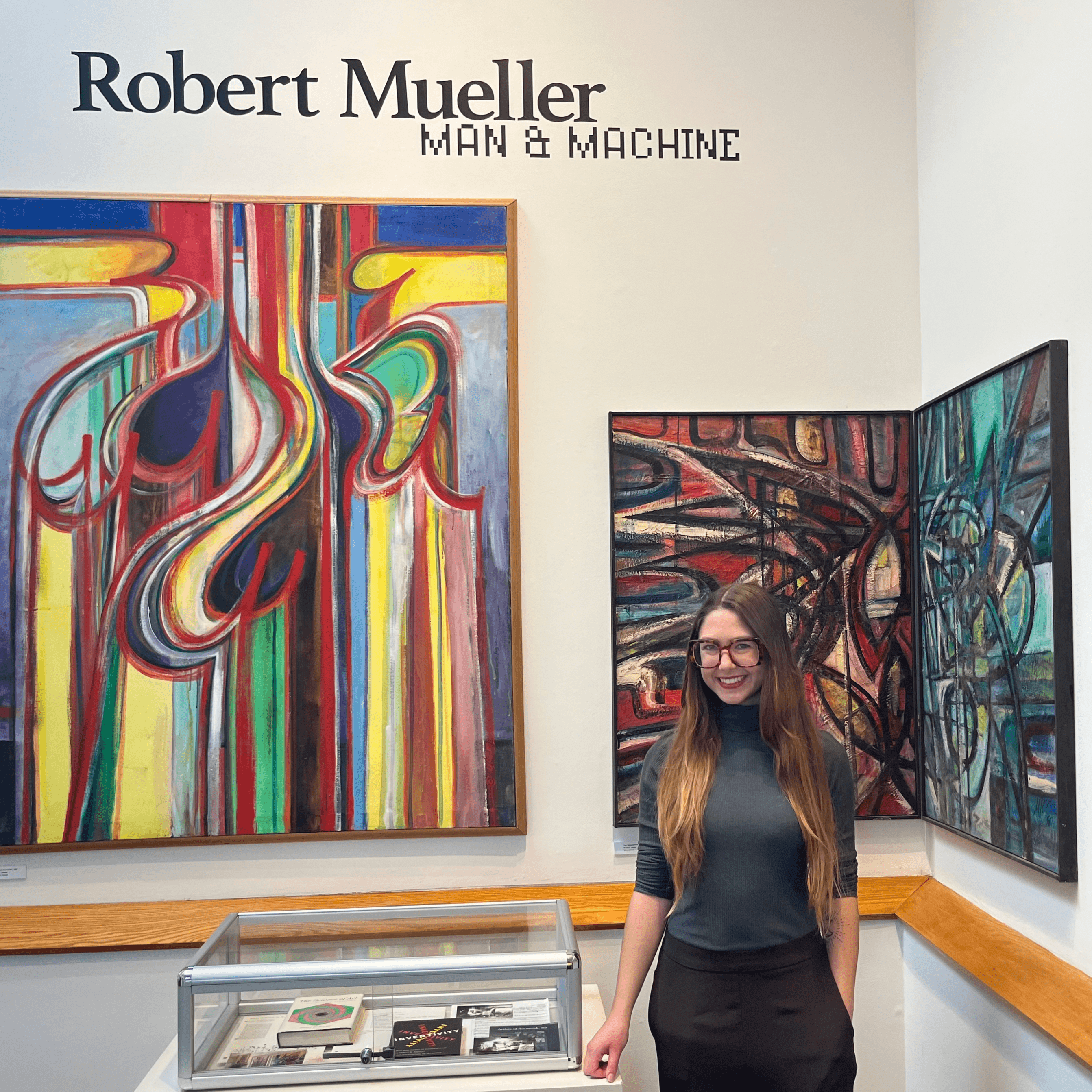
Mueller was born in 1925 and raised in St. Louis, Missouri, where his father was a baker and his mother worked as a seamstress and milliner. He first took an interest in art and science at a young age from the time he spent in his father’s bakery. He served in WWII in the navy as a radar technician. The naval technology he worked with inspired him to pursue a degree in electronic science from the Massachusetts Institute of Technology’s School of Design. He then earned a degree in philosophy and fine arts at New York University, where he continued researching the relationship between art and technology, but now from a more philosophical and artistic point of view. He also worked on his projects at the Brooklyn Museum and New School for Social Research. After college, Mueller moved to the town of Roosevelt, New Jersey, drawn there by the likeminded artists—including Ben Shahn and Gregorio Prestopino—who had formed an artist colony in the New Deal settlement.
In 2014, Mueller’s estate donated about 1,500 objects from the artist to Monmouth University. These objects included an array of artworks in various media and sizes and also ephemera, including books, musical compositions, notebooks, documents, and more. Merritt’s interest in Mueller began in her role as a student employee when she started to catalog the Mueller Collection alongside Scott Knauer, MFA, director of galleries and collections. To date, Merritt has cataloged 223 objects.
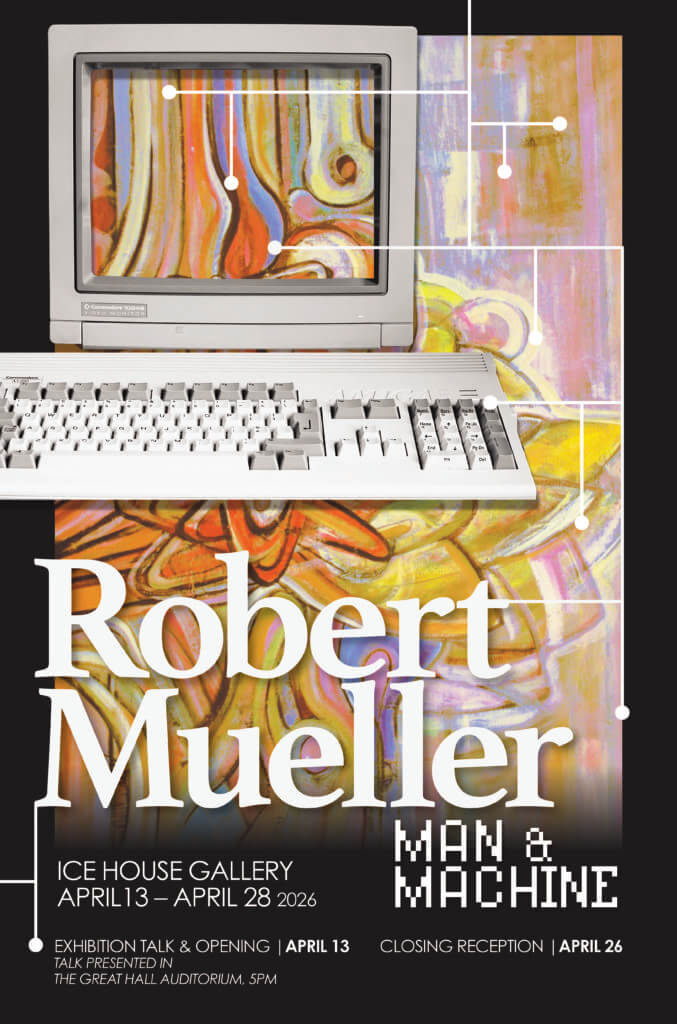
To develop her curatorial project further, Merritt studied recent scholarship on best practices for art curation with Corey Dzenko, Ph.D., associate professor of art history. She then put her research into practice by working with Knauer to curate, design, and install an exhibition about Mueller. As a graphic and interactive design major, Merritt also designed all of the promotional materials for her show.
As Merritt explained, “Researching an artist and documenting their work is somewhat like being a detective. As I documented Mueller’s pieces, I began to offer my interpretation and draw connections between them.” She continued, “If there is anything I have learned in my studies, it is that these works will reveal themselves to you. I learned that a curator’s role is not to force connections between artworks in an exhibition, but to determine and translate ones that are really there for a wider audience.”
Based on Merritt’s interest in continuing to grow her professional practices in the curation of contemporary art, she applied to and received offers from a number of graduate schools in New York City. She will start her graduate studies at Parsons School of Design of The New School in Fall 2026.
“Robert Mueller: Man and Machine” is currently on display along with the Department of Art and Design’s Senior Exhibition until Sunday, April 26, when the galleries will hold a closing reception from 1-4 p.m. Merritt also presented a curator talk as part of Student Scholarship Week on April 13 before she visited the exhibition with her audience.