
This content was automatically translated using machine learning; view original page online
August 28, 2025, 5:10 PM, 21st Century Business Herald, 21 Finance App, Wu Shuang
Wu Shuang, 21st Century Business Herald
On August 16, the “2025 Asset Management Annual Conference” was grandly held in Pudong, Shanghai, under the guidance of Southern Finance Media Group, hosted by 21st Century Business Herald, and co-organized by Shanghai Pudong Development Bank. Richard Roberts, former Director of Credit Risk Management at the Federal Reserve Bank of New York and Distinguished Professor of Economics and Money and Banking at Monmouth University, participated in the conference online. Drawing on his years of experience at the Federal Reserve System, he shared his views on US monetary policy and financial markets, his observations on emerging trends in international capital markets, and his assessment of China’s economic landscape.
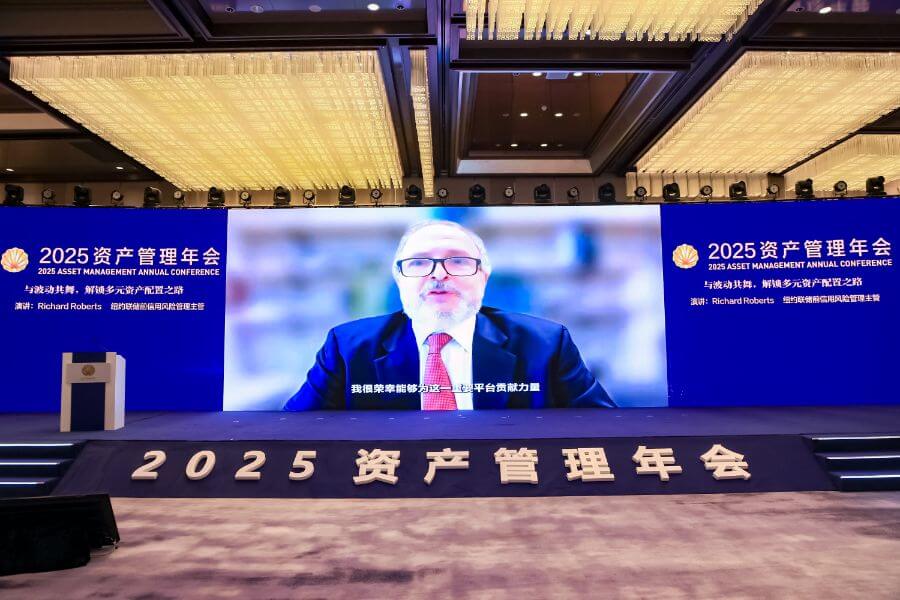
Regarding the Federal Reserve’s current policy direction, Richard Roberts believes that the US economy is showing signs of slowing, even as inflation remains stubbornly persistent. The Fed is holding interest rates steady, with the explicit goal of suppressing inflation and returning it to its 2% target. However, market participants have recently grown increasingly concerned about the risk of an economic slowdown, putting increasing pressure on the Fed to cut interest rates, with action possible as early as its next meeting in late September. Between now and then, decisions will largely depend on incoming data, particularly the Personal Consumption Expenditures (PCE) price index, a closely monitored inflation indicator at the end of August.
In his view, the Fed will keep interest rates unchanged at its September meeting unless the PCE data at the end of August shows that inflationary pressures have weakened significantly. This cautious approach reflects the Fed’s commitment to finding a balance between price stability and sustainable economic growth.
Regarding emerging trends in the international market, he said that today’s global economy undoubtedly presents a complex pattern of different growth models and policy responses.
In terms of monetary policy, some economies, such as Japan and several ASEAN countries, continue to implement accommodative monetary policies to stimulate growth and attract investment. In contrast, the European Central Bank remains cautious, keeping interest rates unchanged amidst dual concerns about growth and inflation. Emerging markets, on the other hand, are adopting varying strategies between easing and tightening, depending on currency stability and inflationary pressures.
Richard Roberts emphasized that technological innovation is also a key driver. The United States and China are leading in artificial intelligence, biotechnology, and clean energy. These advances are boosting productivity and opening new investment frontiers. ASEAN economies are increasingly integrating these technologies into their growth strategies, driving the formation of a vibrant regional economy.
Regarding trade policy and the global investment environment, he believes that the US-China trade relationship remains a core factor in the global economic outlook. During President Trump’s administration, US trade policy underwent significant changes, with tariffs on a wide range of imported goods sometimes exceeding the threatened 100% in an effort to protect US domestic industries and encourage the reshoring of manufacturing.
He stated that for businesses and investors, this uncertainty is driving supply chain diversification toward Vietnam, Malaysia, and Indonesia (all ASEAN members), as well as India and parts of Latin America. Meanwhile, China is strengthening regional ties by modernizing its economy and expanding trade partnerships through multilateral agreements such as the Regional Comprehensive Economic Partnership (RCEP). In the United States, proximity outsourcing incentives and domestic investment are reshaping manufacturing and trade patterns and influencing global capital flows.
“China’s evolving economic landscape remains a core consideration for global investors,” he said. He believes China offers investment opportunities in structural reform, high-tech manufacturing, renewable energy, and consumption-driven growth. Its integration into regional trade networks further enhances these prospects.