
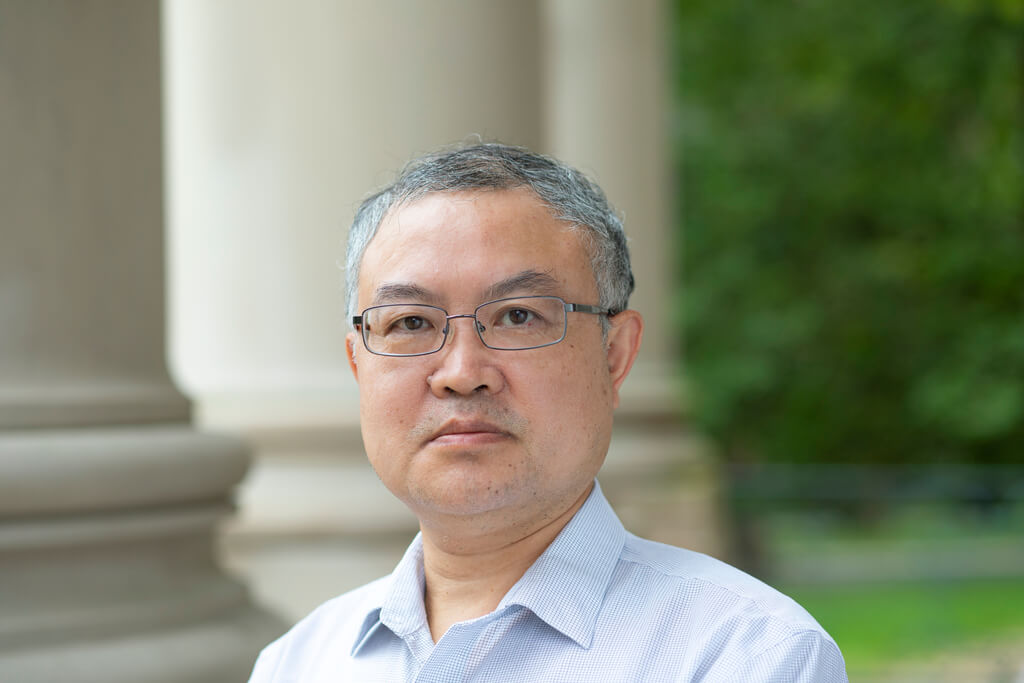
Jiacun Wang, Ph.D., professor in the Department of Computer Science and Engineering, and Monmouth software engineering alumni Luobin Cui ’22M and Chengzhang Zhu ’21M recently contributed to a study in the IEEE Transactions on Systems, Man, and Cybernetics: Systems journal that examines how artificial intelligence has transformed the way digital content is created and what the future may hold for the fast-growing technology.
The article, “The Evolution and Future Perspectives of Artificial Intelligence-Generated Content” (Vol. 56, No. 1, 2026), was co-written with Ying Tang, Ph.D., professor and undergraduate program chair of electrical and computer engineering at Rowan University.
The authors explore artificial intelligence-generated content (AIGC), which refers to text, images, audio, or video created by machine learning systems. Their review categorizes the field’s evolution into four key phases: early rule-based systems, statistical approaches, deep-learning frameworks and modern transfer-learning models. According to the authors, examining these transitions through a unified framework helps clarify how different techniques have shaped the capabilities and limitations of AIGC methods.
The study employs examples across these developmental stages to demonstrate how content generation techniques have grown more sophisticated over time, moving from rigid programmed rules to adaptable models capable of producing high-quality and diverse outputs. The authors conclude that as AI tools become more common in business, education, and entertainment, responsible development to ensure accuracy and prevent misuse will be essential.
“This paper not only traces the evolution of AIGC research and development to its current state-of-the-art capabilities but also provides valuable insights into critical issues surrounding ethics, originality, and human-AI collaboration amid the rapid pace of generative advancements,” Wang explained. “I am deeply grateful to my co-authors—particularly my two talented former MSSE students—for their invaluable contributions and dedication in bringing these important insights to light.”