
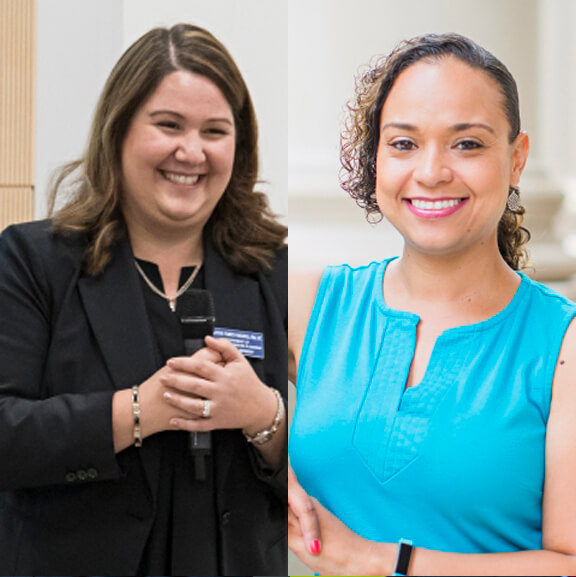
Alyson Pompeo-Fargnoli, Ph.D., and Nicole Pulliam, Ph.D., assistant professors of Educational Counseling in the School of Education, recently authored a paper, “Experiential and Transformative Learning for School Counselors: Impacts of Counseling First-Generation, Low-Income, College-Bound Students,” with graduate students Amanda Lapa and Jenny Dutil.
Pompeo-Fargnoli, who serves as the coordinator for the Monmouth Future Scholars Program (MFS), a Monmouth University-community partnership with Long Branch Schools, was interested in learning more about the experiences of the Educational Counseling program’s students. As part of the MFS program, counselors-in-training run small support groups based on college- and career-readiness topics, for low-income, first-generation, college-bound students.
Through the use of interpretative phenomenological analysis, the study, which was published in the “Journal of Counselor Preparation and Supervision,” examined the impacts of counseling low-income, first-generation, college-bound students that was conducted by counselor-in-training graduate students at Monmouth University. The study explored experiential learning from a transformative learning perspective, as well as its overall impact on school counseling student preparation.
The research concluded that school counseling graduate student interns, when placed in a culturally diverse experiential learning setting, have the potential to have a transformative learning experience and increase their counselor competencies, including multicultural competencies.
Pompeo-Fargnoli and her colleagues discussed these findings through several perspectives including social justice advocacy. Their results encourage the development of similar university-community partnerships at other colleges and universities.