
The Sound of Student Life
Twelve students share how music shapes their Monmouth experience.
Music is everywhere on campus. It leaks out of classrooms and dorm rooms, off stages and into late-night conversations. It shows up in majors that have nothing to do with it—and everything to do with it.
These students offer a glimpse of that. A lead singer chasing a chorus. A DJ reading a room. A songwriter starting with nothing and seeing what sticks. No single path, no single sound. Just a campus where music keeps finding its way in.
It’s Been “Unforgettable”
Hana McKinney fell in love with music early—“from the very first moment” her mother introduced her to classical music.
“It captivated my mind and allowed me to feel every emotion at once,” she says. “When I first performed on stage, I knew it was something I wanted to do forever.”

By her early teens, McKinney had formed the band Hana and the Sisters, performing alongside her four sisters at venues across the country—eventually opening for the Plain White T’s at the World Team Tennis All-Star Event.
Now a songwriter, lead singer, and guitarist, she’s building on that passion at Monmouth, where she’s pursuing a career in music law while balancing life as a Division I tennis player. While playing tennis and performing both demand discipline and repetition, music offers her something a bit different.
“Music gives me a constant sense of exuberance,” she says. “It is something that never fades.” Currently, she performs as a co-lead vocalist and rhythm guitarist for Corine Rose, a band she formed in 2024 with fellow Hawk Sarah Fedak. It was with that group that she experienced one of her most memorable moments at Monmouth’s Battle of the Bands.
“When we hit the chorus of ‘Shut up and dance!’ we pointed our mics toward the crowd, and they screamed it back at us,” she says. “For a moment, everyone in that room felt like part of our band. It was unforgettable.”
A Stroke of Luck
Will Horn and his indie rock band, the Blackouts, took a chance. About a year after forming and building a local following, the group cold-emailed Gordon Raphael, the producer best known for his work on The Strokes’ early records. To their surprise, he responded within two days, inviting them to record with him in Leeds, UK.

A few months later, they were in Leeds, recording 12 songs in four days.
“Gordon is an exceptionally supportive collaborator,” says Horn. “Whether he was suggesting harmonies, refining guitar parts, or offering structural feedback, his focus was always on achieving the strongest possible outcome.”
Closer to home, Horn has played iconic venues including The Stone Pony in Asbury Park and The Bitter End in New York City. Offstage, you’ll find him taking in friends’ gigs or catching shows in the city. “Music is a constant presence in my life,” he says. “The local scene offers endless opportunities to learn, perform, and connect.”
But it’s in the classroom where things have really clicked for him. A senior music industry major, Horn says what he’s learning about licensing, marketing, and artist development has enabled him “to better protect my work, advocate for myself, and navigate an industry that can often be complex and challenging.” After graduation, he aims to take that knowledge into a managerial role, supporting and guiding artists as they build their careers.
Writing Her Own Verse
For Sami Khatri, music has always been more than something to enjoy.
“I have always felt a strong connection to music from a young age,” she says, noting how that feeling deepened after a difficult transition to a new school. “I turned to music and performance as an escape. I began writing music and started to view it as an art instead of just a hobby.”

That mindset shows up in everything she does at Monmouth—both creatively and in the leadership roles she’s taken on. She founded and led the Shadow Writers Songwriting Club, performed with MU Players, choreographed productions, and contributed her original song, “Burden Like Me,” to a Blue Hawk Records release.
“I wrote ‘Burden Like Me’ as the most honest and vulnerable version of myself—I didn’t care if the lyrics were silly or if people would like it,” she says. “I just wanted to create something that was unapologetically me.”
Khatri says taking on a variety of leadership roles has helped boost her confidence, leading her to pursue a minor in leadership communication, and inspiring her to continue pursuing choreography post-graduation. Whatever she ends up pursuing next, she says she’s driven in part by a desire to create space for others like her to feel seen—using music and performance to show up as herself in ways she didn’t always see growing up.
“As a little girl, all I wanted was to see someone who looked like me on my TV,” she says. “Every time I walk into class or step on stage, I’m reminded that I am putting in the work to make my dreams come true because I know there are people out there who need to see it. We deserve to see people who look like us chasing their dreams, and I hope to be a part of that.
Turning Ideas into Sound

Kylensky Miracle is interested in how creativity and collaboration turn ideas into something real.
That thinking is behind the SongWriter Series, a competition he created through Blue Hawk Records that challenges students to write original songs in 30 minutes. Groups are given a theme, build something from scratch, and see it through to a finished track, with the winning song released as a single. “The storytelling that music creates fascinates me,” he says.
A junior finance major and honors student, Miracle is drawn to projects where he can contribute both creatively and analytically, something he’s found as vice president of BHR. “I never would have thought that such a variety of majors could come together to cultivate a community that celebrates and produces music we love.”
He hopes to bring that same approach to a career in film production. If given the chance to start tomorrow, he’d tell a story rooted in his Haitian heritage, following someone growing up in a less fortunate country and finding their way forward. A first-generation American, he sees that kind of story as both personal and universal. “It’s important to tell stories like this because they provide the world with a sense of compassion and understanding.”
She Picks the Songs
Growing up, Kaitlyn Sullivan’s house was filled with music—her dad played classic rock, her mom leaned toward yacht rock and ’90s bands, and mornings often started with MTV music videos playing a rotation of everyone’s favorites, including her own go-to: 2000s pop.

“I was exposed to a lot of different genres growing up,” she says, noting that she has one Spotify playlist that is 23 hours and 39 minutes long—a testament to her broad musical taste.
That early exposure led Sullivan, a communication major focused on media studies and production, to get involved with WMCX 88.9 FM, Monmouth’s student-run radio station.
Now in her second year as music director, she plays a key role in shaping what students hear.
“WMCX exposes students to music that they might not have heard before, whether from record companies or just older songs, but we still also play their favorites,” she says. “It’s a good mix of old and new.”
In the role, Sullivan helps build the station’s music catalog, charts new tracks, connects with record labels, hosts shows, and helps plan events—giving her hands-on experience in both media and the music industry. Beyond the day-to-day, she enjoys being able to share music with others and introduce listeners to something new.
Lately, that’s meant keeping Megan Moroney’s “Wedding Dress” on repeat.
Keys to Cues
Jeffrey Mendez remembers the moment he realized music could be more than a hobby. In 2021, he made a last-minute decision to enter a Twitch beat mixing competition hosted by multi-platinum producer SuperStarO—and won.

“That experience changed my perspective and helped me see that what I had been building was more than just a passion, it was something real, beginning to take shape,” he says.
A senior music industry major, Mendez is both a producer and pianist—leading projects for Blue Hawk Records, overseeing studio production, and collaborating with artists across campus and beyond, including through his own company, SPVTIAL STVDIOS™.
Whether he’s performing at university events or working behind the scenes, he sees his two main passions—live performance and studio production—as two sides of the same coin.
“When I am performing live on piano, I approach it almost like production in real time—I am reading the room, shaping dynamics, and building arrangements on the spot,” he says. “The live experience sharpens my instincts as a producer. It strengthens my sense of arrangement, dynamics, and storytelling.”
That focus on storytelling is also what drives his interest in pursuing a career in sync licensing—the art of placing music in film, television, and video games. Building on that interest, he has created opportunities for other students through The World of Sync, a panel series that connects emerging creatives with industry professionals across film, television, gaming, and media—offering insight into how music is placed and experienced at the highest level.
“The best sync placements create something bigger,” Mendez says, pointing to recognizable sounds like the Super Mario Bros. theme. “They spark conversations, connect people across the world, and become part of how we remember moments in culture. What excites me is the opportunity to be part of those cultural moments.”
His “thoughts arrive in symphony”
It was the Beatles that hooked Elijah Elias. Introduced to the Fab Four at a young age by his parents, he knew then he wanted to be a musician.

Now a sophomore, the singer-songwriter describes his writing process as instinctive: “I start with chords and a melody off the top of my head. And I’ve found that if I don’t start singing as soon as I have my chords down, then I won’t come out of it with a song.”
No surprise: He cites the Beatles, specifically Paul McCartney, as his biggest influence. “He has a way of blending beautiful melodies with out-of-the-ordinary chord progressions. That has inspired me to challenge my own writing in these ways.”
But it was another rock icon who recently took notice of Elias. The music industry major contributed to Blue Hawk Records’ “Runaway American Dream” EP, which featured reimagined versions of songs from Bruce Springsteen’s “Born to Run.” Elias is pictured on the album’s cover, and a smiling Springsteen was photographed holding the CD. “It’s surreal to think that, in some capacity, Bruce knows who I am.”
Monmouth has helped him grow as a musician, he says. “I used to be afraid of performing or showing people my music. Now, I have friends who push me to share and continue my musical journey.”
Never was that clearer than during a recent Blue Hawk release show, when the crowd sang along to his performance of his own song, “Save My Soul.”
“That was my ‘Why I’m here’ moment,” says Elias.
When It Lands
When Julianna Chesla was a little girl, she often found herself performing on the biggest stage she knew—her living room.

“With help from karaoke tracks on my iPad and decked in my grandmother’s accessories, I played any part I put my mind to,” she says.
Seeing her passion for performance, Chesla’s parents signed her up for school musicals and
vocal lessons. At 13, she had what she calls her “light bulb” moment, falling in love with performing while playing the lovable French candlestick Lumière in her middle school’s production of Beauty and the Beast.
At Monmouth, she’s worn a number of hats within MU Players—from acting and costuming to directing. This past spring, she made history as the first student to direct a MainStage production with Play On!, an experience that allowed the English and education major to lean into her natural storytelling abilities and delve deep into character development.
“When I read a script, I see beyond what is written on the page,” she says. “It is up for interpretation how a character talks, walks, and responds to others—who they are as a person. That is what makes a story.”
While directing was a “thrilling” experience, Chesla says one of her most memorable moments at Monmouth came while performing in Into the Woods last fall, where she was cast as one of her dream roles: the Witch.
“I used the emotions I felt in my own life to express the Witch’s own grief—and it worked,” she says, drawing from the loss of her mother. “The audience reaction to ‘Witch’s Lament’ was palpable. By the end of the show, there wasn’t a dry eye in the house.”
Mixing it Live
Victor Davidson, aka DJ Vic, doesn’t script his sets.

“I never plan what I’m going to play,” he says. “You go out there not blindfolded, but unaware of the future. And that’s when you start to DJ.”
Playing shows from Baltimore to New York City, Davidson reads the room in real time, scanning the crowd and adjusting on the fly. He comes prepared with music for different situations, able to pivot depending on the energy in front of him. The goal is simple: “Make people dance,” he says. “It’s not optional.”
Online, Davidson has built an audience across TikTok and SoundCloud, landing partnerships with McDonald’s and Twitch. There’s no crowd to read; here, it’s more about “showcasing your creativity,” he says. What works online doesn’t always translate live, but the connection still matters.
“I think the reason my community consistently shows up is because I actively engage with people, talk to them, share advice when I can,” he says. “I treat people like people, not like fans. That goes a long way.”
Just Play
Sophomore Leo Hernandez has his sights set on law school and a career in entertainment law, where he hopes to work with artists and record labels on contracts, rights, and negotiations. To prepare, he’s pursuing a double major: his political science classes focus on policy, ethics, and regulation, while his music industry classes show how records are produced, marketed, and released.

His Record Label Strategies class gave him an early look at how both worlds come together. Students find artists, produce an LP, and manage the rollout. The work moves between creative collaboration and the legal and logistical details that make a release possible.
“As a double major, I have two drastically different workloads, and there’s never a time I don’t have an assignment due,” he says. “Music helps me power through; it’s the backbone to my mental health.”
Hernandez, who plays guitar in the death metal band Paradigm NJ, says there’s nothing quite like performing on stage. But the quieter moments are just as meaningful to him. During a recent dorm room jam, he played electric guitar while a friend was on acoustic and another drummed on a pizza box using jazz brushes.
“It was one of those moments where I realized, ‘This is exactly why I love music so much,’” says Hernandez. “None of us were talking; we just played and were completely present in that moment.”
In Sync Since the Fourth Grade
Besties since elementary school, seniors Daphne Valenzuela and Camryn Moschitta have been making music together just as long—through band, choir, musical theater, and now as four-year members of Monmouth’s Pep Band. Health studies and computer science majors, respectively, the duo says music is central to their Monmouth experience: a creative outlet, a stress release, and a shared connection that carries into everything they do together.
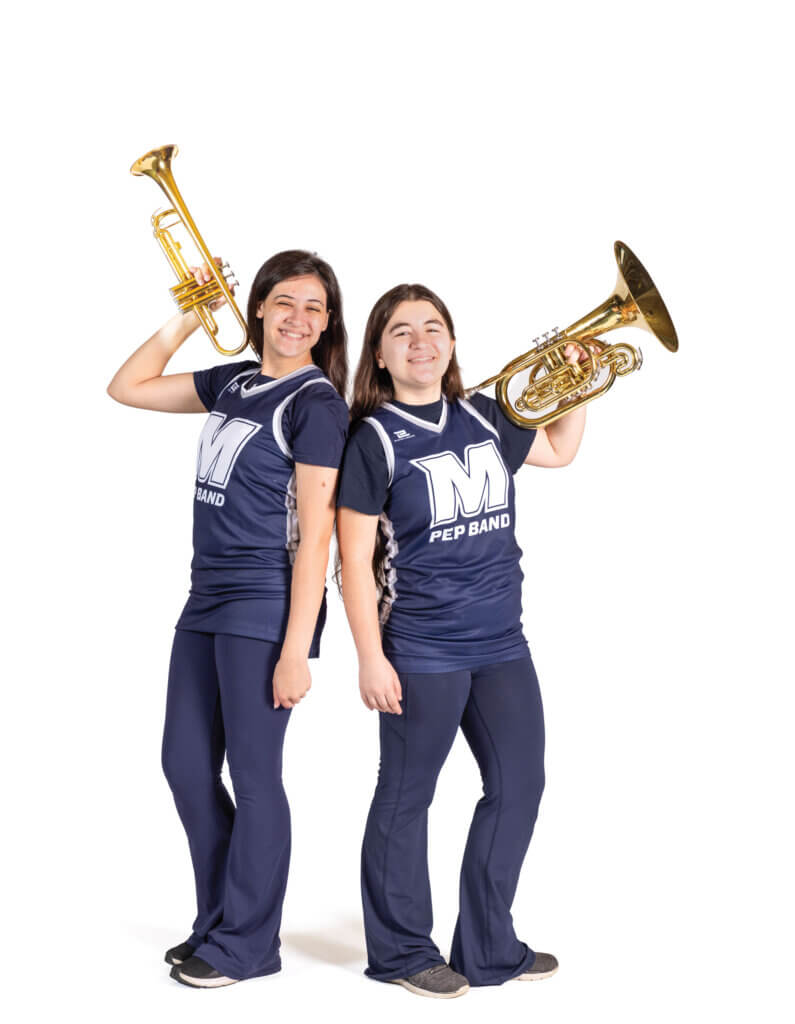
The two started performing together in fourth grade band and choir and kept it going through high school, where they were in jazz band and part of their school’s production of “Freaky Friday.” By the time they arrived at Monmouth, neither was ready to stop.
They joined Pep Band during freshman year, eventually stepping into leadership roles as officers. Valenzuela serves as wind captain, helping lead rehearsals and warm-ups, while Moschitta works as the band’s spirit officer, helping keep the energy high during games and events.
“Game days are my absolute favorite, especially basketball season,” says Valenzuela. “I love presenting ourselves as the band to everyone at the game and hearing them cheer for us and compliment our music.”
That energy is part of what’s kept both students involved over the past four years, especially during annual trips to the Coastal Athletic Association basketball tournament.
“The energy during the tournament is so different compared to the rest [of the time],” says Moschitta. “This is like the leading-up moment to everything we had played thus far and where it all really counts.”
Outside of Pep Band, both have stayed involved in music and theater through MU Players, Sea Sharps, jazz band, and as members of the pit orchestra for the music and theatre arts department’s recent production of “Into the Woods.” Neither is a music major, but both say those creative outlets became an important balance alongside demanding coursework.
“Participating in the Pep Band and the theater has given me a chance to relax over stressful schoolwork,” says Moschitta. “I also feel like it gives me an opportunity to shine and enjoy myself.”
Their friendship extends well beyond rehearsals and performances. There are nights when Moschitta shares demos of songs she’s writing while Valenzuela talks through choreography ideas inspired by whatever music is playing in the residence hall.
The two have also become each other’s biggest supporters. Moschitta calls Valenzuela “an amazing leader” whose “energy is contagious,” while Valenzuela says Moschitta “always brings the hype and energy to the games.”
Even when they’re not performing, the two remain in sync.
“I love being able to share my college experience with her and I’m so happy to have her as my best friend,” says Moschitta.“Often the best part of my day is performing with my best friend,” says Valenzuela.