The Next Chapter
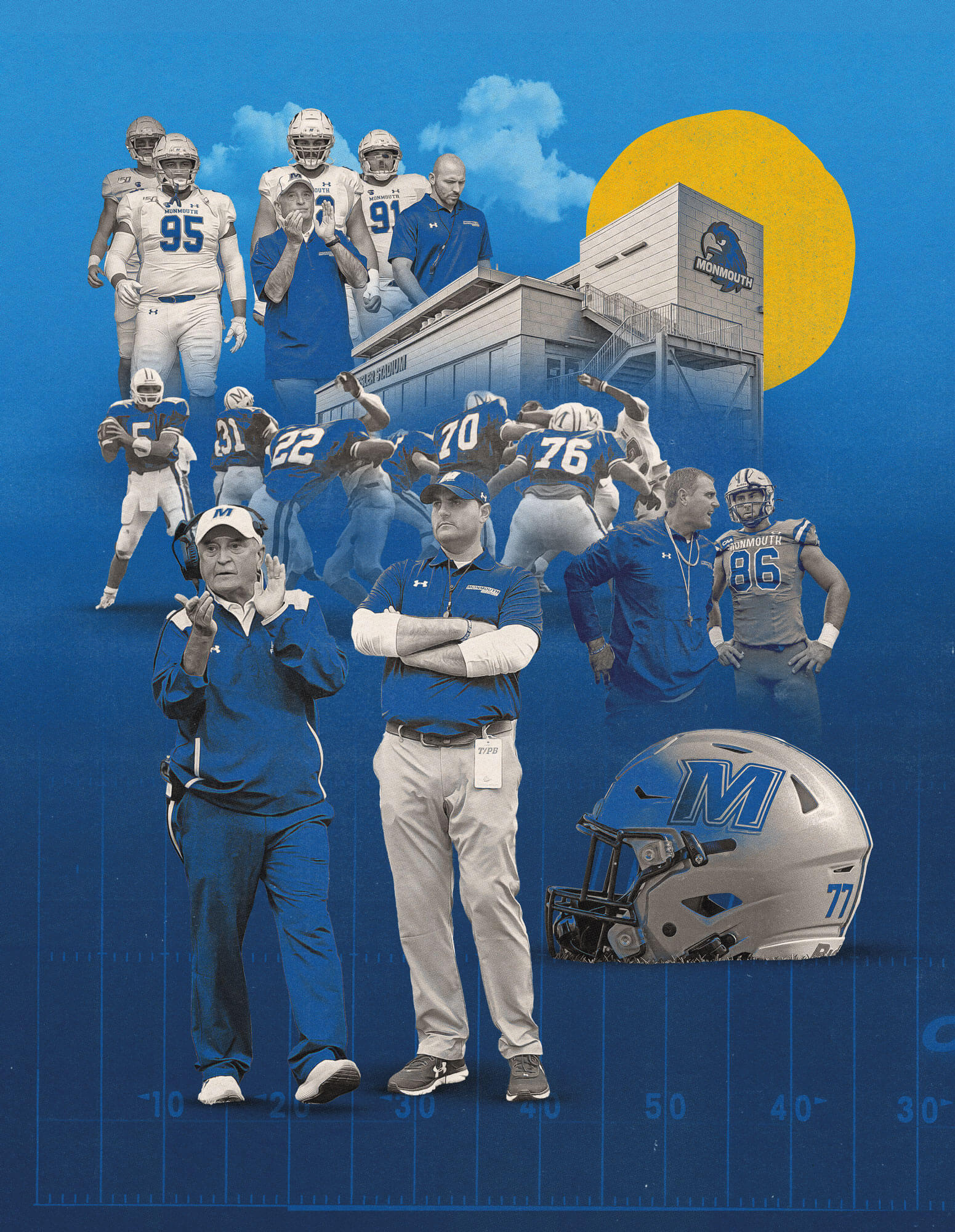
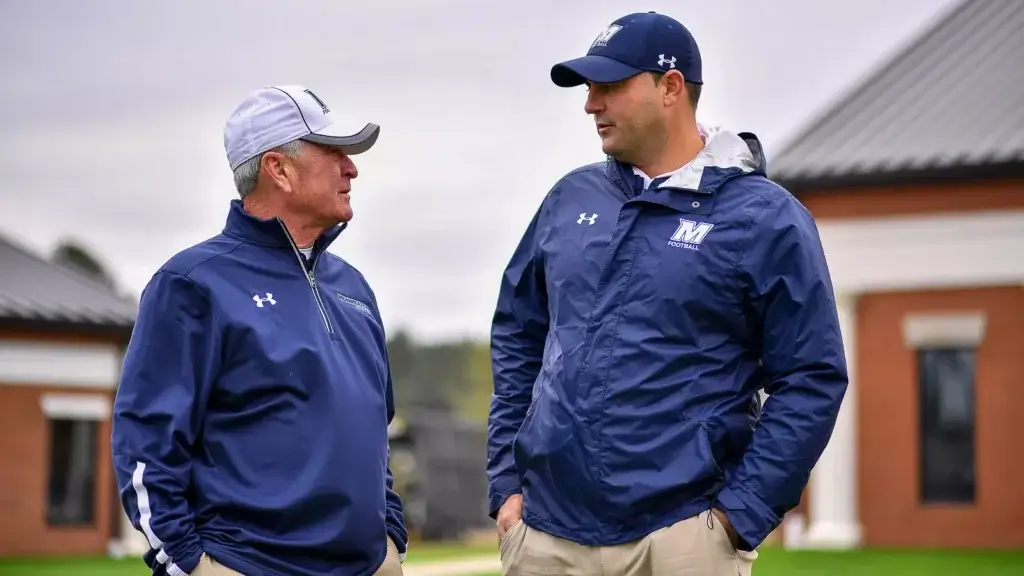
Six months after Jeff Gallo was named head coach of Monmouth football, we sat down with him and his predecessor, Kevin Callahan, the man who built the program, to reflect on the transition.
In 2024, the Monmouth football team visited Florida International University in search of its first-ever Football Bowl Subdivision (FBS) win. The game was played at Pitbull Stadium, and as the team entered, Head Coach Kevin Callahan asked his players and staff, “Who [in the heck] would name their stadium Pitbull?”
Callahan’s son, Kevin Jr., quickly explained that Pitbull was one of the most popular recording artists in the world and that he purchased the naming rights to the stadium. The senior Callahan dusted off the pop culture gaffe and led the Hawks to a thrilling 45–42 victory. The FBS triumph marked yet another program milestone since its inception in 1992.
There is a truth (and innocence) to that story that only college coaches fully understand. Knowing the likes of Pitbull and many other pop culture references is a privilege that Callahan surrendered long ago. Building a college football program from scratch, leading it to 197 victories, and capping his tenure with a 6-2 conference record in the Coastal Athletic Association (CAA) can require tunnel vision. And now, standing in the light just outside of that tunnel, Callahan can look back with pride and perhaps amazement. No one—not even Coach Cal—could have envisioned the growth and success of a program that had no field, staff, or players when it began in 1992.
For decades, the title “only head coach in the history of football at Monmouth” belonged to Callahan. That changed last December, when Callahan stepped away from coaching and into a role as special advisor to the athletic administration, and Jeff Gallo ’05, ’12M, was named the program’s second head coach.
The two men are far from strangers. Gallo played under Callahan from 2000 to 2003 and was a highly decorated offensive lineman. He joined the coaching staff in 2005 and has paced the sidelines with Callahan for 21 seasons.
Change is never easy, but this transition is rooted in familiarity. Six months into it, we asked both coaches (separately) a series of the same questions to better understand what’s changed, what hasn’t, and where the program is headed.
What is a character trait that a football player must possess to succeed at Monmouth?
KC: Discipline is the number one thing. When the program started, we didn’t have what other programs had—no scholarships, attractive facilities, or even tradition. What we did have were guys who were disciplined and had a belief that, “Yes, we can do this.” Discipline and work ethic have been the driving force behind this program.
JG: You need disciplined people with a great work ethic. The players who are successful here are disciplined and hold themselves accountable. Team chemistry is coveted but difficult to capture.
What component do you feel is essential to developing it?
KC: The entire group needs to believe that no single player is more important than the team. The roles may differ, obviously, but once you establish an attitude where everyone feels a responsibility to excel at their role and compete as one group, that’s when you can experience something special.
JG: You need to trust each other and hold each other accountable, and you need to celebrate each other. I’m Italian, and when we sit down and eat together, we celebrate each other’s successes and pick each other up when we’re down. When teams have that trust and look out for each other, it’s a beautiful thing.
What have you enjoyed most about coaching?
KC: I enjoyed the interaction with players. You have 100-plus players on your football roster and not a day goes by that a player doesn’t have an issue. It might be personal, football-related, or academic, and you may not have all the answers. But the athletes take comfort in knowing someone is there to listen and look out for them.
JG: I love helping people set goals and working with them to reach their goals and potential. And I love the brotherhood that forms when a group of people are dedicated to a common goal.
When I started as an assistant, I was living in a basement. My parents came to me and said, “What are you doing?” and I just told them, “I’ve got it.” You don’t really worry about the struggles when there is so much fulfillment from the work and everything that comes with it.
What has changed about college football—and what is the same?
KC: The biggest change is the athlete’s expectations. We’re in a world today where we’re talking about sums of money; we’re talking about NIL [name, image, and likeness]; we’re talking about facilities. It wasn’t too long ago that athletes were simply grateful for an opportunity to play college football. That still exists in many cases. But there’s so many people involved now who influence the athletes and how they approach college football.
The championship mindset is still the same. And that is, if we play together and pull for each other, we can accomplish something great.
JG: There have been a lot of changes. The transfer portal and NIL money are at the top of the list. But what’s stayed the same is that it’s all about the people. If you have the right people in your program, you can build a winning culture. I don’t think that will ever change
What is something you enjoy in your spare time that might surprise people?
KC: Well, I’m still figuring out what to do with spare time [laughs]. But I do a lot of reading. I like doing crosswords. There hasn’t been much downtime for me over the years, so I’m just now trying to figure out what my niche is.
JG: I love all kinds of music—Jimmy Buffett, Metallica, Kenny Chesney, Madonna—my taste is very eclectic. I grew up outside of the amphitheater in Camden, so we went to concerts constantly.
What about Monmouth football do you hope gives alumni pride?
KC: The continued growth of the program from where we started through today, from fielding a team of non-scholarship players, to competing in the CAA, to hopefully contending for a national championship.
JG: I hope they’re proud of how we represent the University. I hope they’re proud of how we maximize what we have and compete at a national level as a smaller, private university.
The transition is still fresh, but how have things been different?
KC: The day used to travel 100 mph, and now it hovers around five mph. Coaching college football is a 24/7 job, so the biggest change has been having more time on my hands. I’m developing a greater appreciation for things that exist outside of football.
JG: It’s a different role, but I’ve been here and know the people here. I know the players, coaches, University staff, and the processes. There will be some challenges and a learning curve for sure, but it’s not like I’m a new coach who’s drinking from a fire hydrant.
If you had one final game ball to give to someone, who would it go to?
KC: That’s a tough question. There are so many people who have influenced and helped me that deserve that game ball. Obviously, my wife, Ann Marie, immediately comes to mind, along with my son, Kevin, and daughter, Julia. Dr. Marilyn McNeil had such a major influence on my coaching career and how we developed as a program. I think I’d need to pass that ball around to a different person each week for a year.
Prior to your first game as head coach, if you could give out one game ball to someone who helped you get to this position, who would it go to?
JG: That would be Coach Cal. I met him when I was 17 years old. I’ve played for him and coached alongside him. He’s taught me so much and has been an incredible person in my life and career.
What advice do you have for Jeff as Monmouth’s new head coach?
KC: Follow what’s in your heart. Do what you feel is best for the program. You know, today is not yesterday and this game constantly changes, so you need to adapt as a head coach. Jeff is extremely intelligent, and if he follows his heart and trusts his instincts, he’ll always do what’s best for Monmouth football.
What is the best advice Coach Cal has given you about becoming Monmouth’s new head coach?
JG: He told me how important it is to just be myself. Don’t try to be someone I’m not. Be genuine, be honest, and put forth a great effort. He and I are different personality wise, but we have the same core values and beliefs. Deep down, we love Monmouth football.