The Art of the Everyday
Kristin Bluemel’s new book uncovers how women wood engravers in Depression-era Britain used a humble craft to carve out space for modern art—and for themselves.
Over a decade ago, Kristin Bluemel found herself wandering down an unexpected rabbit hole. A professor of English who specializes in 20th-century British literature, children’s literature, and book history, Bluemel had been curious about what children in Britain were reading during the Great Depression when she came across a book full of enchanting wood-engraved illustrations depicting quaint countryside scenes. While flipping through it, a short passage caught her attention. It credited three women wood engravers—Gwen Raverat, Agnes Miller Parker, and Joan Hassall—as leading innovators of the art form.
“It sparked my interest, because … by the Depression, women had gone to college, had gone to art school, but it was very hard for women to launch professional careers. Yet here are these women who, for their generation, are mentioned in the literature as being the exemplars of a popular trend,” says Bluemel. “And I thought, ‘Women haven’t been acknowledged broadly as leading the forefront of any kind of art, ever.”’
The idea that these women were recognized in their own time as cultural leaders, using wood engravings in children’s books, poetry collections, nature guides, and classic fiction to shape British culture, captured Bluemel’s imagination. That spark grew into years of research, culminating this winter in her new book, “Enchanted Wood: Engraving a Place for Women Artists in Rural Britain.”
Reviving a Lost Art
Wood engraving—a painstaking process of carving images into the hard end grain of wood blocks, inking them, and pressing them onto paper—was perfected in the late 1700s by British artist Thomas Bewick. His breakthrough allowed for fine detailing and, more importantly, made it possible to print images and text together on the page at the same time. This made illustrated books dramatically cheaper and more accessible to the growing middle and lower classes.
By the late 1800s, however, his technique had nearly vanished with the rise of photography and industrial printing. Wood engraving retreated to elite private presses, valued mainly for its ornate, decorative qualities. Then, during the Depression, a curious thing happened: A new generation of rural women artists revived and popularized Bewick’s technique. They turned away from the high-style aesthetic of the private presses and instead returned to a form that could reach a wider audience.
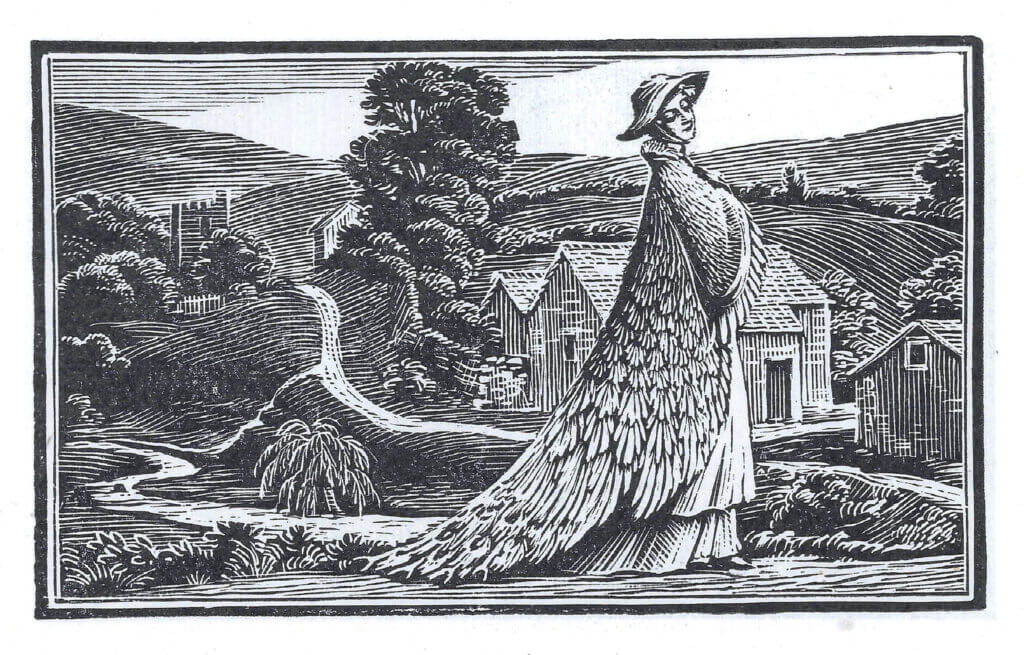
Joan Hassall, one of Thomas Bewick’s most devoted acolytes, enchanted readers with this delicate wood engraving from the Scottish fairy tale “Rashie Coat,” depicting the moment “the fairy cam again, and telt her to put on the coat o’ feathers.” The work exemplifies the expressive wood-engraving tradition that inspired Kristin Bluemel’s forthcoming book, out this December. Illustration reproduced by permission of the estate of Joan Hassall/Simon Lawrence.
That accessibility, Bluemel says, made it a “surprisingly modern medium,” and one that allowed women living in rural areas to work professionally from home at a time when few female artists could earn a living. “They weren’t doing fancy portraits or oil paintings—they were doing these little, humble, everyday artworks for books … and they were commercially successful,” says Bluemel. “They found a way to do their art in mass-distributed, mass-marketed trade books, which were priced for the people.”
The Cult of the Countryside
What made this movement especially interesting was that these highly trained women lived scattered across rural Britain, far from metropolises like London. Their work began in small towns and villages and made its way into urban markets—the reverse of the usual artistic flow.
Not only that, their engravings—of birds, fields, and farmlands—were expressions of a shared and intentional effort to celebrate rural life at a time when industrialization was rampant and the pace of modern life seemed to be reshaping traditional values. “During the ‘cult of the countryside’ between the two world wars, people in England became fixated on anything having to do with the countryside,” says Bluemel. “Which is weird, because England was the first nation to industrialize … so almost in reaction to that, in the ’30s, there was an idealization of the countryside.”
Bluemel argues that this revival also invites feminist interpretations like her own: By reclaiming an old technique and modernizing it, these women gave artistic value to ordinary life and the rural experience at a time of economic crisis and social upheaval. “It’s interesting that this kind of illustration is progressive or modern or experimental in the eyes of the art historians, and yet most people look at it and they say, ‘Oh, how quaint, how sweet, how old-fashioned,’” she says. “So, it’s both progressive and old-fashioned; it’s new and it’s old; it’s modern and it’s antique.”
Reclaiming Rural Modernity
Bluemel’s fascination with these engravers wasn’t just academic. Raised in small-town New England, she understands the pull of the countryside and the misconceptions that often surround it. “I was trying to argue that there was a modern reality experienced by women artists living in the rural places that they loved,” she says. “Nobody gets it. It’s like, ‘You go to a rural area you’re stepping into the past.’ No!”
When Bluemel first began publishing articles on the engravers—including a fourth, Clare Leighton—she met resistance from reviewers who dismissed her premise. “My readers … said, ‘These aren’t feminists, they’re old-fashioned,’” she recalls. “They couldn’t believe and wouldn’t see in the images of animals or fields and woods that there can be something modern about the countryside.”
But she persisted, co-editing “Rural Modernity in Britain: A Critical Intervention” in 2018 to lay the groundwork for her larger argument—that rural life could, in fact, be a birthplace of modern art and culture. Her perseverance paid off: In 2022, she was appointed Leverhulme Visiting Professor at Newcastle University in England, where she continued her research in the very landscapes in which Bewick once worked.
Soon after, she received a publication grant from the Leonard A. Lauder Research Center for Modern Art at The Metropolitan Museum of Art. “I got a grant from the Met—they bought the argument. They believed it!” she says. “It’s significant.”
Bluemel now describes the engravers’ work as intermodernist, which is a bridge between high modernist art and post-war popular culture—and far from quaint. In other words, these artists proved that modern art didn’t have to come from big cities or avant-garde studios. It could come from women carving birds into boxwood at their kitchen tables.
For Bluemel, that realization still feels timely. “There’s a kind of connection between what was happening about 100 years ago and what’s going on now with AI and everything being so speedy and fast and electronic … people are yearning for these real experiences,” she says. “Thinking about rural life and looking at pictures that are made of wood and paper … it is a connection to nature, and I hope some people discover the art and find it enchanting.”