Roll Camera
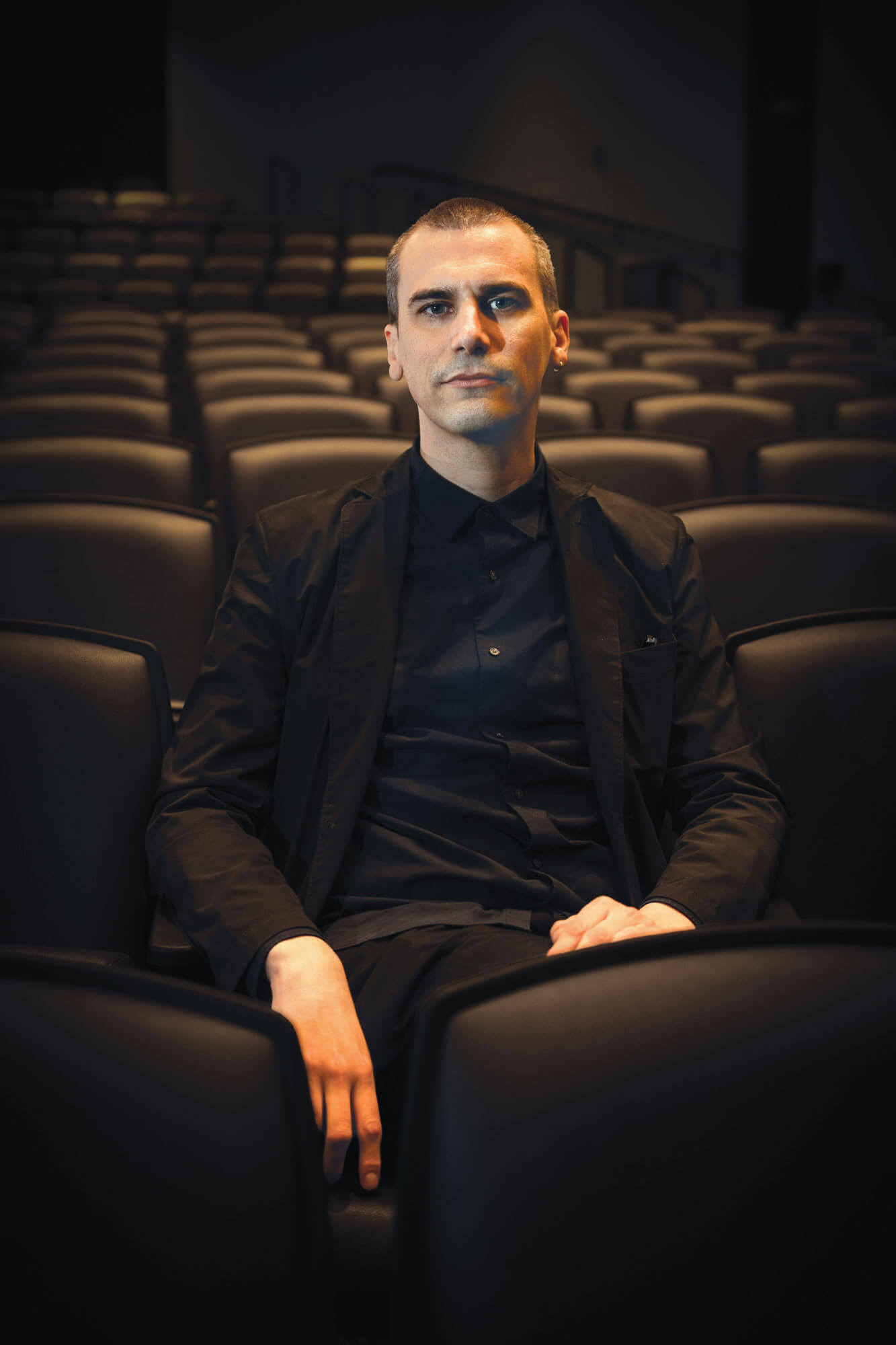
As Monmouth develops new film programs and Netflix builds a $1 billion production hub near campus, Jake Yuzna sees opportunity for students.
Jake Yuzna caught the filmmaking bug early.
“I was interested in many different art forms, but it was always film and this, or film and that,” says Yuzna. “Eventually, I realized there was one constant.”
As a child, that meant frequent trips to video stores, midnight movies, and weekend matinees. One week it might be a 1930s monster movie, the next an international drama, sci-fi epic, or arthouse release.
“I watched everything.”
Yuzna moved quickly from fan to filmmaker.
Shortly after graduating from college, their first feature, “Open,” premiered at the Berlin International Film Festival, where it became the first American film to receive the Teddy Jury Prize. Making that film reinforced a philosophy that still guides Yuzna’s work: learn by doing and begin even when the path ahead is uncertain.
Last fall, Yuzna brought that mindset to Monmouth as an assistant professor of communication. What drew them here was the opportunity to help build something new. The University is developing a filmmaking and cinema studies major that will emphasize hands-on production alongside the study of film history, theory, and how filmmaking shapes individuals and society.
Before that program launches, Monmouth will begin offering a new minor in sci-fi, fantasy, and horror filmmaking this fall. Often referred to collectively as “genre” film, these stories include elements outside accepted reality, everything from superheroes and space epics to ghost stories and psychological thrillers. Yuzna says the program is the first of its kind in North America.
The timing is notable. Netflix is constructing a $1 billion production hub roughly four miles from campus, part of a broader expansion of film and television production across New Jersey. For Yuzna, the development represents a renewed chapter for film production in the state.
“New Jersey really was the birthplace of the film industry in this country,” says Yuzna. “It’s exciting to see that come back almost 150 years later.”
Large studios rarely operate in isolation, says Yuzna. They tend to attract post-production houses, sound and mixing studios, marketing firms, and other supporting businesses. The result is an ecosystem that extends well beyond the set.
For students, that expansion creates more opportunities. Whether they hope to direct, edit, manage productions, or work in marketing or finance, a grounding in how films are made—the kind emphasized in Monmouth’s new programs—provides a shared foundation.
“Being able to understand each world is really vital,” says Yuzna.
Cue the Score
Some movies are inseparable from their music. Film professor Jake Yuzna highlights influential film scores and why they matter.
“Forbidden Planet,” 1956
Created by husband-and-wife duo Bebe and Louis Barron, this score is now recognized as the first entirely electronic score for a film. After emerging from the avant-garde scene in New York City, where they worked with John Cage, Maya Deren, and others, the Barrons crafted a radically new approach to music for film that continues to resonate today.
“Psycho,” 1960
There are few film scores that have invaded popular culture as much as Bernard Herrmann’s score for Alfred Hitchcock’s “Psycho.” Taking advantage of the film’s lower budget, Herrmann wrote for orchestra rather than a full symphonic ensemble, instead of following Hitchcock’s request for a jazz score. The result is a piece of music so iconic that it is recognizable after only a note or two.
“Suspiria,” 1977
Created by the Italian prog-rock band Goblin for Dario Argento’s horror classic, this iconic score reflects the film’s story of an American dancer who moves to a Berlin ballet school that might be run by witches. Its atmospheric mix of whispers, haunting melodies, and synthesizers has cemented it as one of the most influential scores of the genre.
“Star Wars,” 1977
Composed and conducted by John Williams, the score for “Star Wars” brought together a variety of classic styles to forge an American classic. Performed by the London Symphony Orchestra, the score for “Star Wars” was so popular upon release that its LP peaked at number 10 on the Billboard 100, with a disco reworking of the film’s theme reaching number one in the United States.
“Halloween,” 1978
Not only did John Carpenter direct and co-write this film that ushered in the teen “slasher” genre, but he also composed the now-classic film score. Inspired by Goblin’s soundtrack to “Suspiria,” Carpenter created a score consisting of a piano melody played in a 10/8 or “complex 5/4” time signature. The result was a score that haunts both the silver screen and Halloween festivities for nearly a quarter of a century.
“Blade Runner,” 1982
Composed by Greek electronic musician Vangelis, the “Blade Runner” score opened new vistas for mainstream science fiction music. Recorded, mixed, and produced by Vangelis on an ad-hoc basis by improvising pieces in synchronization while watching videotapes of scenes from the film.
“Akira,” 1988
Few films did more to introduce the Western world to Japanese anime than Katsuhiro Otomo’s “Akira.” Helping to redefine what global science fiction and animation could be, “Akira” combined adult themes, eye-popping animation, and a soundtrack that blurred traditional and contemporary musical styles. Created by the Japanese musical collective Geinoh Yamashirogumi, the score combined digital synthesizers, Indonesian bamboo percussion, Noh music, and progressive rock into a legendary score.
“Batman,” 1989
The 1989 film Batman ushered in the superhero movie as we know it today. But at the time, the then-untested director Tim Burton and his musical collaborator Danny Elfman were not a sure bet. It was after Elfman shared the main theme, also known as the “march,” with producers that he was hired for the project. The resulting score and film forever changed the public’s concept of Batman and the superhero film genre.
“Candyman,” 1992
Composed by Philip Glass, the soundtrack for Bernard Rose’s “Candyman” was a departure for the horror genre. Mostly known for his work outside of cinema, Glass had previously composed scores for documentary works, including classics like Godfrey Reggio’s “Koyaanisqatsi” and Errol Morris’s “The Thin Blue Line,” before turning his talents to the horror genre for the first time.