Finding a Mystery Planet—With Math
Student Researchers: Felipe Marcal, Jason Sullivan, Matthew Walter, and Adina Kestenbaum (visiting student from the University of Michigan)
Faculty Mentor: Torrey Gallagher, Ph.D., Associate Professor of Mathematics
In the 1840s, astronomers noticed that Uranus wasn’t orbiting exactly as predicted. They deduced that some other unseen planet must be pulling on it, and after calculating where to look, they spotted Neptune.
Inspired by that astronomical detective work, a team of Monmouth researchers is examining a similar question: If a planet’s path doesn’t match expectations, what can math reveal about what’s pulling it off course?
Building a Model Universe
Instead of recreating the full solar system, the team built a simplified one with two orbiting planets—one known and one hidden. Using Python, they simulated how the unseen planet’s gravity would shift the visible planet off course, then searched the data for clues to when and where the hidden body might appear.
Zeroing In on Deviations
The team focused on the moments when the known planet strayed furthest from its expected orbit. By plotting those peaks alongside the angles between the two planets, they tested whether consistent patterns emerged—and how those patterns changed over time.
Wrestling With Uncertainty
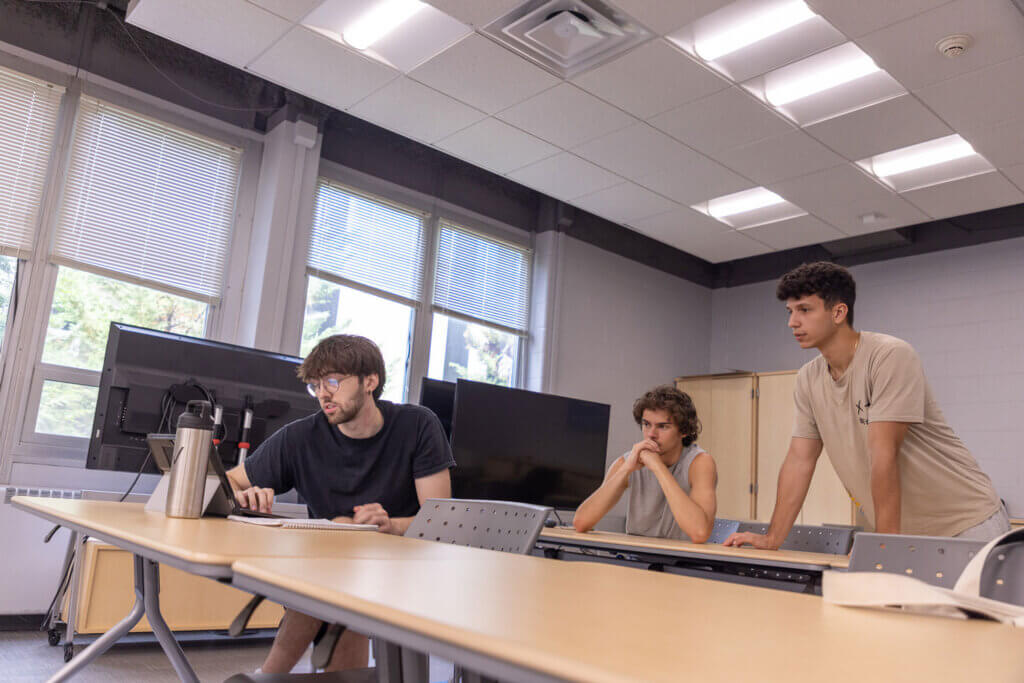
One of the biggest challenges to their work was separating genuine orbital behavior from potential programming errors. Was a planet flying off course because of physics—or because of a bug in the solver? Students described the work as a constant tug-of-war between math, physics, and code. That comes with the territory, says Gallagher: “Part of research is figuring out the right question to even ask.”
Still Searching for Order in the Orbits
The researchers haven’t solved the puzzle yet, but the work is continuing this semester as part of a new math research course. That’s giving more students the opportunity to refine the models, test new ideas, and apply the methods in different contexts. And while the project is theoretical at its core, Gallagher—who jokes that his background in pure math means “applications are literally the last thing I think of”—says the techniques the students are using could be useful in fields like electrical systems or magnetism. In the meantime, the project is giving them hands-on experience in exploratory research, as well as a glimpse of how math opens windows onto the universe.