Catching a Silent Killer—With AI
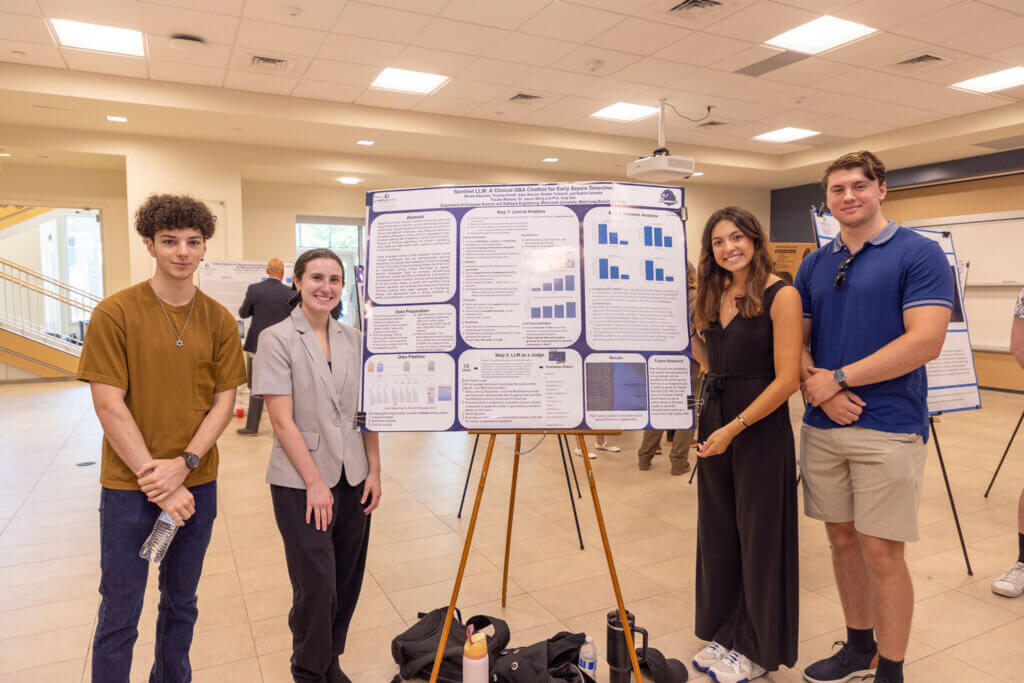
Student Researchers: Brooke Tortorelli, Miriam Abecasis, Isaac Sasson, Sophia Velandia, and Thomas Farrell
Faculty Mentors: Jiacun Wang, Ph.D., Professor of Computer Science and Software Engineering, and Arup Das, Adjunct Professor of Computer Science and Software Engineering
Sepsis, the body’s life-threatening response to infection, is one of the leading causes of death in U.S. hospitals. Early detection is key to survival, but spotting the warning signs can be difficult—especially in high-pressure clinical environments where staff are stretched thin.
To address that challenge, a group of Monmouth researchers is developing Sepsis Sentinel LLM, a clinical chatbot powered by a large language model (LLM), an artificial intelligence system trained to process and generate natural language. Unlike general-purpose LLMs like ChatGPT, Sepsis Sentinel will be trained exclusively on clinically vetted, sepsis-specific knowledge. The goal: to provide frontline health care workers with fast, reliable answers to urgent questions when every second counts.
Built for One Job
The team began by reviewing the latest medical literature and generating more than 2,500 sepsis-specific question-and-answer (QA) pairs to form the foundation of its training dataset. But before they could train the model, they needed to refine that content—eliminating duplicates, reducing noise, and ensuring each entry was accurate and relevant to clinical practice.
Making Their Model Smarter
To do that, the team built a custom, three-step filtering pipeline to clean and improve its dataset. First, they did a lexical analysis using ROUGE scoring and n-gram comparisons to find and remove duplicate QA pairs as well as pairs that used the same or nearly the same words. Next, they used an AI model trained on biomedical texts to conduct higher-level semantic filtering, eliminating QA pairs that were worded differently but essentially asked the same thing. Lastly, they used a separate LLM to evaluate and score each remaining QA pair for clarity, fluency, and clinical relevance—ensuring their dataset was both clean and credible.
Toward Real-World Impact
Once their dataset is complete, the team will begin training and testing its chatbot. The long-term goal is to provide a tool that can be deployed in hospital environments—ideally, installed right at nurses’ stations—to assist with real-time clinical questions. In the meantime, the students are also preparing a paper detailing their custom data-filtering pipeline, with plans to submit it for publication.