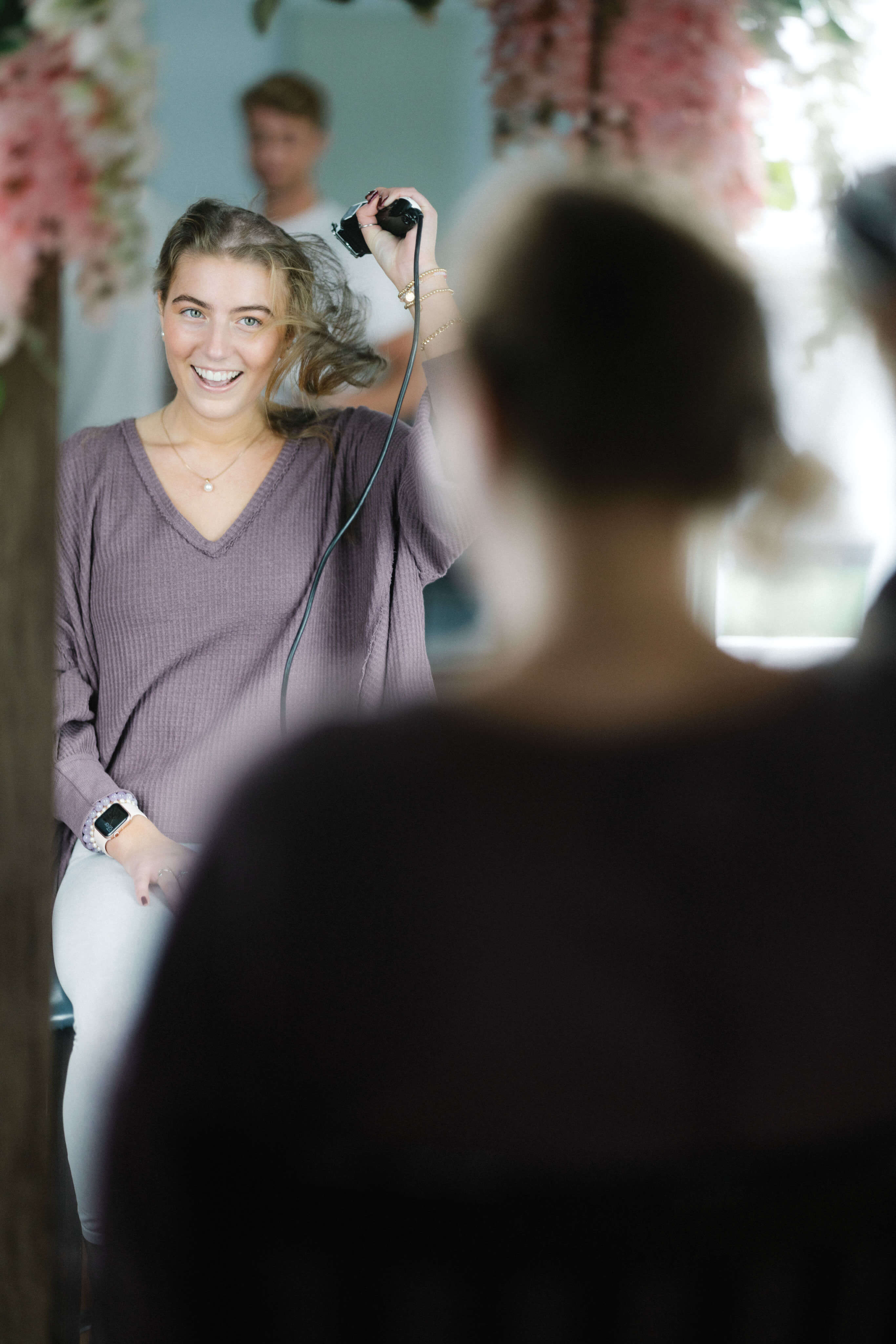
Cancer Picked the Wrong Girl
Twice diagnosed before age 22, Alayna Riozzi-Bodine refused to back down, transforming her fight into a mission that’s reshaping care for other young patients.
If you saw 17-year-old Alayna Riozzi-Bodine in the summer of 2021, she was probably running, swimming, or otherwise in motion. Her days started with two hours of triathlon training at dawn. Then she clocked in for a 9-to-6 beach lifeguarding shift and two rigorous staff workouts, followed by varsity volleyball practice at night.
Even the most seasoned athlete would have been exhausted. So, when Alayna felt depleted—worn out to a point she’d never experienced before—everyone assured her it was normal, and she just kept going.
She flew to Milwaukee that August for the USA Triathlon National Championships, but it wasn’t the fun trip she’d expected. She slept in her hotel room all day, emerging only to eat or train. After finishing the race, she turned to her dad, who had come to cheer her on. “I feel like I’m dying,” she told him.
“I just can’t explain the fatigue that I was feeling,” she remembers now. “I really felt like my body was shutting down.”
It was exactly one month later, the night before her senior year of high school began, that Alayna noticed the hard lump near her collarbone. Her first week of school turned into doctor’s visits and an emergency biopsy. Then came the diagnosis: stage 2 Hodgkin lymphoma. Cancer.
She was shocked. “My first thought was, ‘Am I going to live?’” she remembers. This wasn’t how her senior year was supposed to look. While her friends filled a group chat with outfit options for their upcoming school dance, Alayna was debating whether to freeze her eggs. Rounds of chemo bookended her 18th birthday.
But even in the toughest moments, she knew she had a choice. “In this situation—my mom and I would say this all the time—either you laugh or you cry,” she says. So, they cracked jokes whenever they could, raced wheelchairs down the hospital halls, and brought home a wiggly new puppy named Daisy.
When Alayna was declared cancer-free in early 2022, they were overjoyed. They had no idea the challenges that still lay ahead—or how many other lives she would impact in the next few years.
Everyone noticed Alayna’s beautiful hair. It spilled down her back in soft waves or bouncy curls or straight strands, depending on the day. The sun lightened its honey-gold further, weaving in platinum streaks when she spent time on the beach—which, growing up in Shark River Hills, New Jersey, was often.
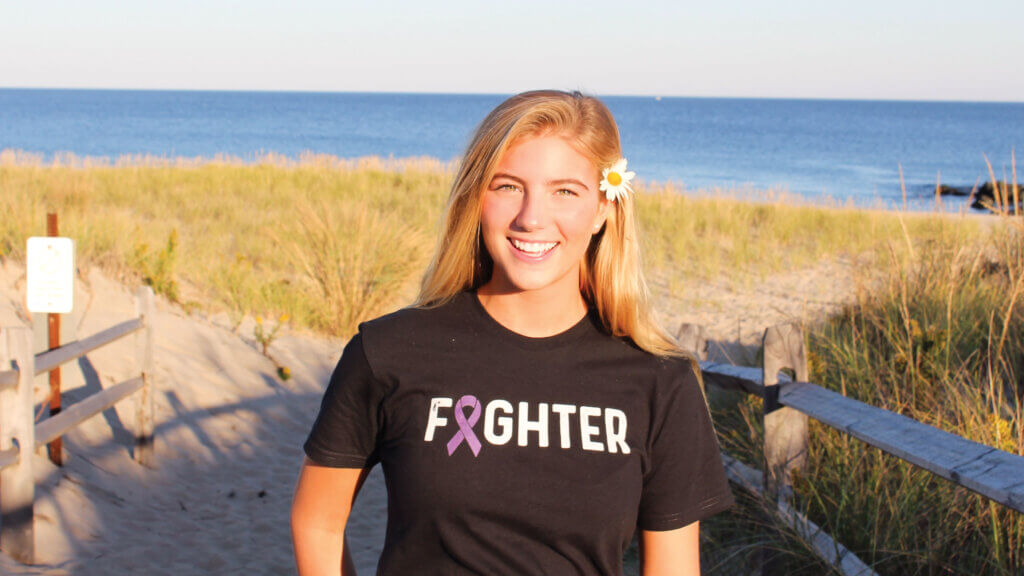
Alayna pictured in 2021 during her first battle with cancer, when she was 17.
“My hair was a really big part of my identity,” she says. As soon as she received her cancer diagnosis in 2021, she worried about losing it. This wasn’t about vanity. “I was so scared to lose myself through my treatment,” she says.
With her mom’s help, Alayna became Memorial Sloan Kettering’s first pediatric patient to use a cold cap—a device that chills the scalp to reduce hair loss from chemotherapy. It worked; her long blond hair stayed in place through all eight rounds of chemo. “I could look in the mirror and see myself,” she says. “You have no idea how much that means to someone going through cancer treatment. You don’t feel consumed by the cancer. You feel in control when everything feels out of control.”
As she documented her cancer battle on social media and talked to people at the hospital, many asked how she possibly had all her hair. Very few had heard of the cold cap, especially patients her own age. “My mom and I saw the need for change,” she says. They focused their new nonprofit, the Alayna Jayne Foundation, on donating cold caps to other young patients and spreading the word that this technology exists.
“There’s always a negative side that you can fall into, or there’s a positive side and a positive outlook that you can have,” Alayna says. She continually chose the positive—by sharing her journey, connecting with other patients, and launching her foundation. It has now funded cold caps for a dozen other girls, most of whom have kept all their hair, too.
With her treatments complete and cancer seemingly gone, “I jumped right back into the world,” she says. She went to her senior prom and graduated with the rest of her high school class. She continued to fundraise and advocate through her foundation. And that fall, she enrolled at Monmouth University as a nursing major. It was a career she’d always considered, but her recent experience as a patient had cemented it.
“It made me fall more in love with the nursing community,” she says. “They saved my life. I really just want to go in and make a difference and impact the medical community the way they impacted me.”
But just as everything was settling back to normal, Alayna received her one-year post-treatment scans.
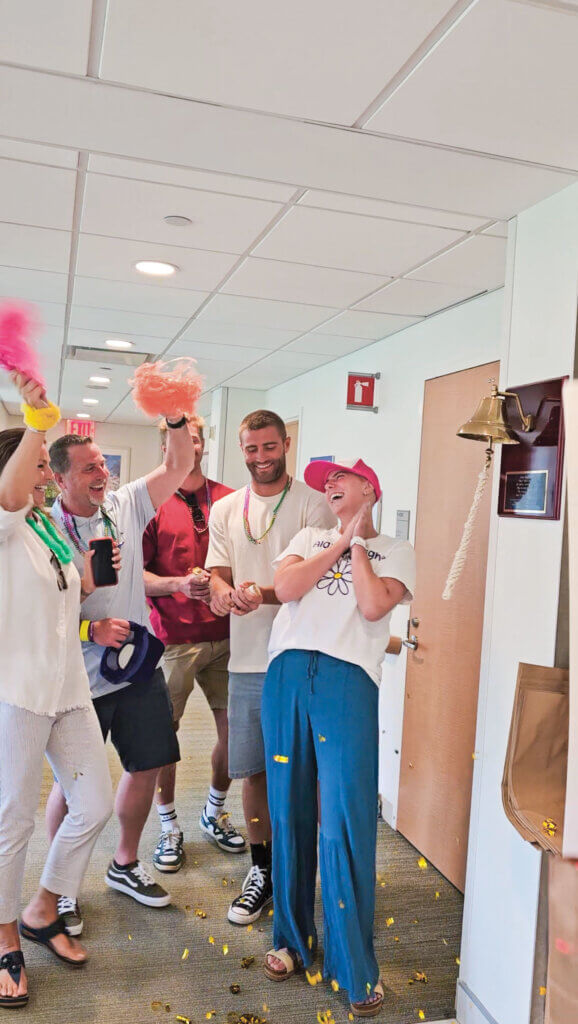
Alayna, learning she was cancer-free—for
a second time—in 2024.
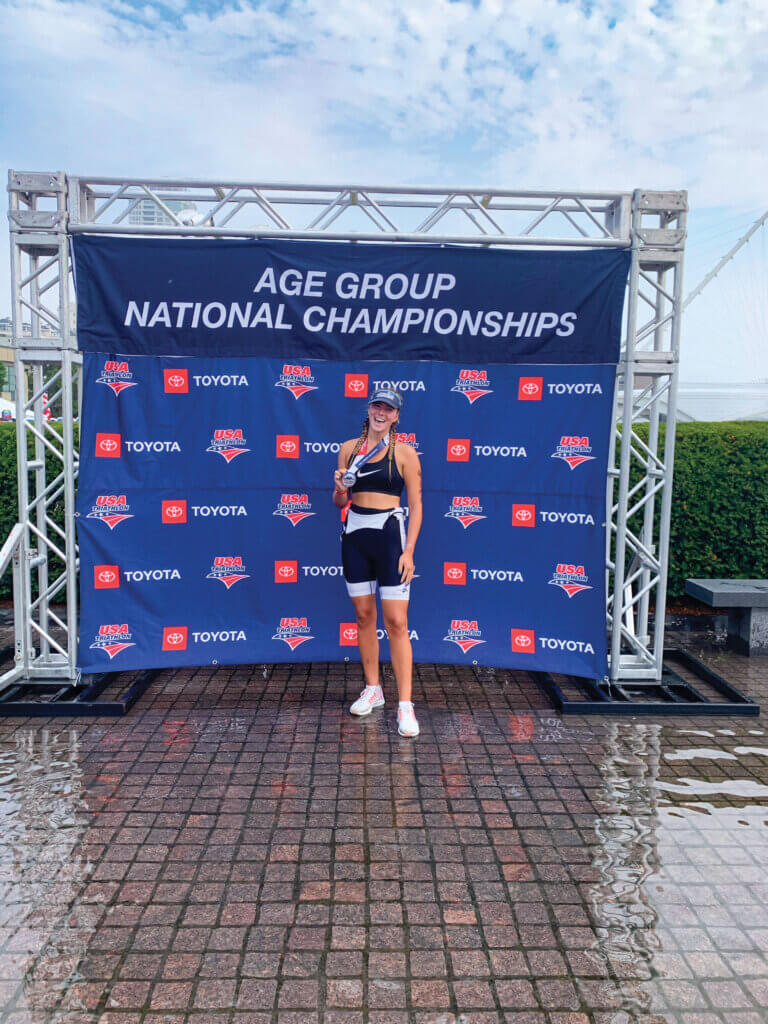
Alayna shows off her medal after running a triathlon in 2022.
It was February of 2023, the spring semester of her first year at Monmouth, and the scans picked up a small spot on her chest.
By the summer, it had grown. Alayna’s cancer was back, and this time, she couldn’t use the cold cap for her chemo. She lost her hair—and saw firsthand exactly how important her foundation work has been.
When she stopped responding to chemotherapy, her doctor recommended a bone marrow transplant using Alayna’s own stem cells. She spent five weeks in strict isolation at the hospital, confined to a single room, while her body endured its most grueling challenge yet.
Still, she and her mom grasped for any bright spots they could find. If Alayna had to live inside a hospital room, they would make that room lovely. They hung up color-changing LED lights, brought in custom bedding, and filled the walls with photos and inspirational messages.
Alayna wore pink socks that announced she was kicking cancer’s ass. After shaving off her rapidly shedding hair, she got a new novelty T-shirt: “My oncologist does my hair.”
She emerged from the experience with more ideas for her nonprofit. The Alayna Jayne Foundation now offers hospital room makeovers for other bone marrow transplant patients and sends teen patients and their caregivers on Daisy Retreats at a local cancer respite center. It also awards scholarships to students from Alayna’s high school and Monmouth’s nursing program, supporting individuals whose lives have been affected by cancer.
“Even at that moment in time that she was so sick herself, she was still doing good and still giving back,” says her mom, Elaine Riozzi-Bodine. “She has always had that positive energy,” Elaine continues. “She walks in and it’s just like a beam of sunshine enters the room. This has just taken it to a whole other level. There’s so much warmth that she exudes—loving warmth. As dark as some of those days were, we just took the negative and turned it into a positive.”
Things happen for a reason, Alayna says, and she believes she endured these battles to come out the other side and “spread awareness, spread positivity, and just help others. … Being able to share my experience has really helped me heal.”
Nursing Professor Margia McDonald didn’t know any of that when Alayna joined her pediatric nursing clinical last year. Alayna’s strong clinical skills and hardworking nature stood out from early on (“I could tell she was going to be one of the great students,” McDonald says), but otherwise she blended right in with her peers.
It wasn’t until the group headed to Jersey Shore University Medical Center one morning that Alayna mentioned the bell.
In many hospitals, it’s tradition for pediatric cancer patients to ring a wall-mounted bell when they finish their treatment—a tangible way to celebrate the unseeable. But on one of her visits to Jersey Shore UMC, Alayna had noticed that there wasn’t a bell. So, the Alayna Jayne Foundation donated one in 2023.
This past April, Alayna was back on that same hospital floor, a year out from her bone marrow transplant. It was the final day of her clinical rotation there. With her blond hair now short and curly as it grows back in—a different texture than before for a changed Alayna—she rang the bell, this time as a budding nurse rather than a patient.
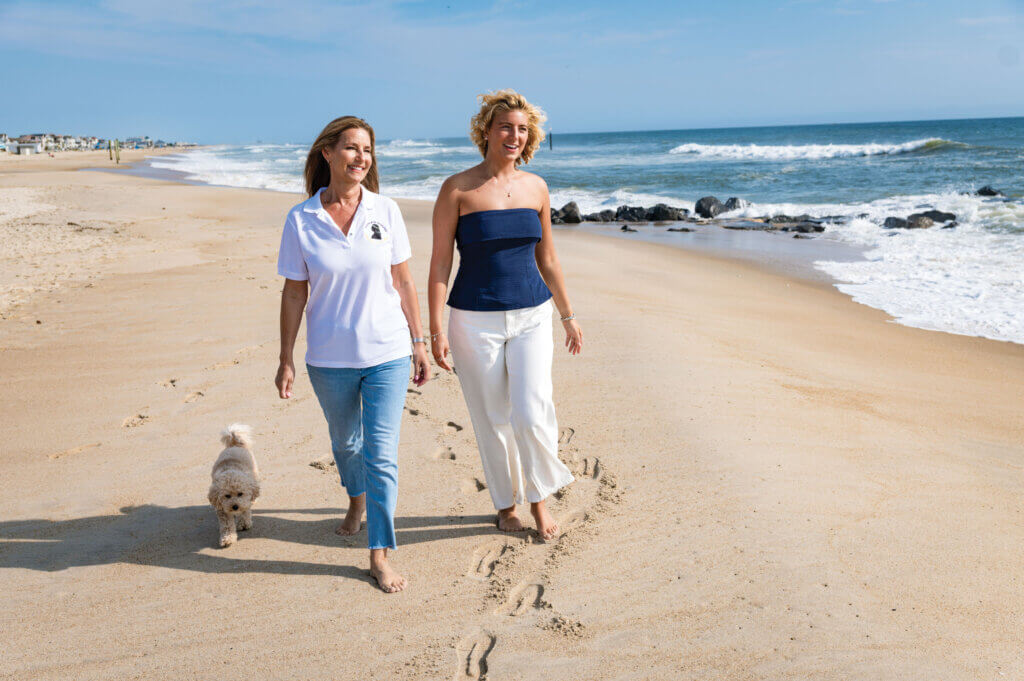
Living as a survivor, Alayna enjoys a warm sunny day on a beach walk with her mom, Elaine, and dog, Daisy. Photo by John Emerson.
She’d kept up with her coursework even as she battled cancer for a second time, and she’s still slated to graduate with her original nursing cohort next spring. “My schoolwork became an outlet for me looking toward the future and seeing a life after cancer,” she says. “I know my future is going to be as a nurse helping others, and I’m so excited to be in that role soon.”
McDonald has no doubt that she’ll excel. “No one can understand the lived experience of a patient unless they’ve actually lived it themselves,” she says. “There’s just a different level of understanding and compassion that comes with that.”
In July, for the first time in four years, Alayna passed the one-year mark of being cancer-free. She was back to lifeguarding at the beach a few months after her transplant and spent this past summer there too. In May, she traveled across Italy, first with her family, and then as part of a six-week study abroad program through Monmouth. She’s even begun training for another triathlon.
“I am in a great place, but I do want people to know that cancer doesn’t end when you finish treatment or get the words that you’re cancer-free,” she says. “Cancer stays with you for the rest of your life. Every day is still a challenge for all patients. But every day, I’m just grateful to be here.”