Bruce at Full Volume
In 1992, a Monmouth freshman blasted Springsteen from his Elmwood Hall dorm room, waiting for someone else to hear it. Thirty years later, his daughter found that audience.
One of the things I looked forward to most about going off to college in 1992 was something I had been missing since my older brother left for the University of Scranton six years earlier: late-night conversations with someone lying awake in the bed across a darkened room. Often, our chats focused on the music of Bruce Springsteen, with a heavy emphasis on the two cassettes we were listening to most in the early ’80s: “Born to Run” and “Nebraska.”
But I spent my entire first year at Monmouth with no roommate. It might sound like a dream scenario for someone who was—and still is—a bit of a loner, but it wasn’t.
The morning after my first night on campus, I woke up in my room in Elmwood Hall and saw that the bed across from mine was empty. I assumed my roommate had crashed elsewhere, but when that bed stayed empty night after night, I realized he wasn’t coming back. No one else ever moved in.
For the next eight months, I had no one.
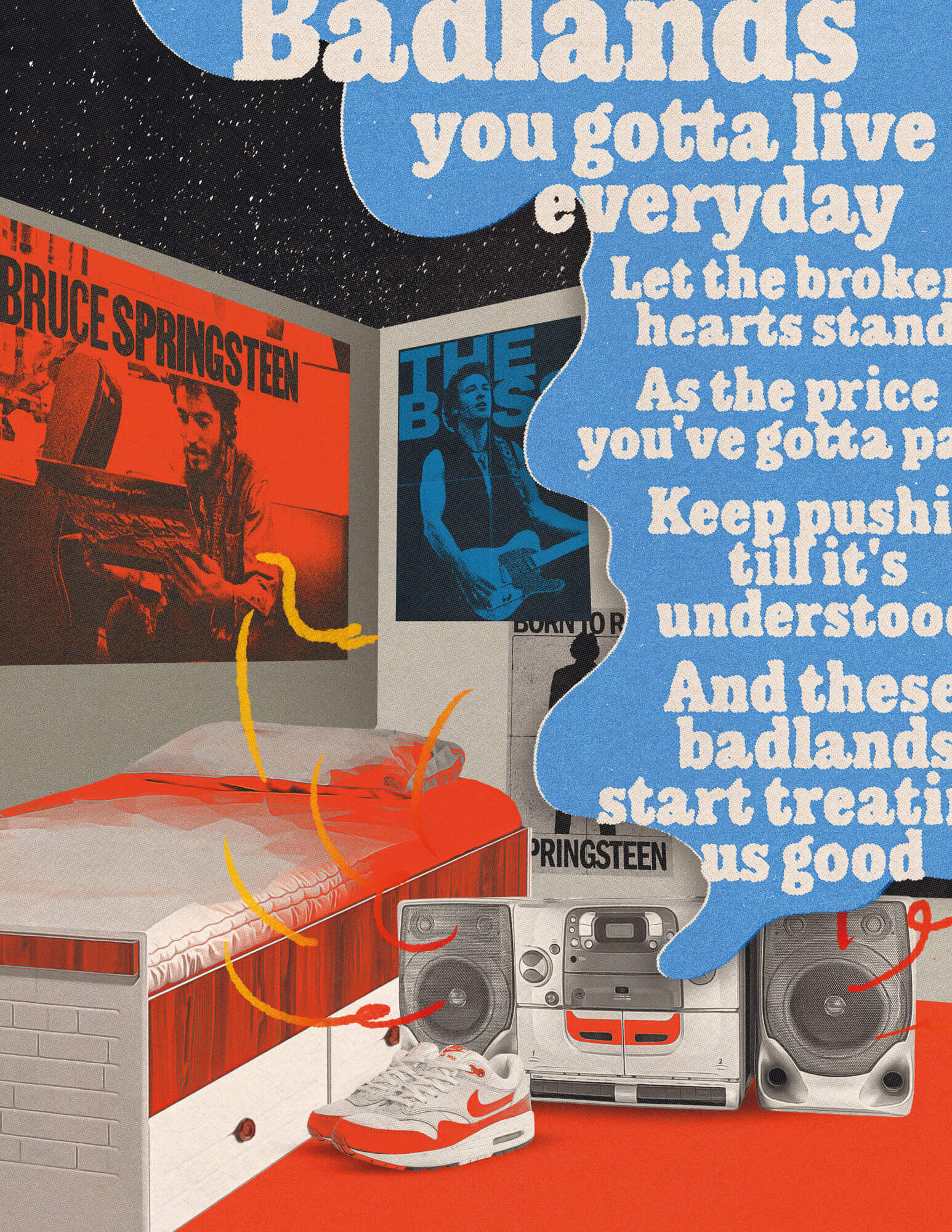
What I did have, though, was one of the best stereos on the first floor of Elmwood. Silver with metallic red accents, the stereo held six CDs. I filled each slot with a Bruce album, including the two that had been released together toward the tail end of my senior year of high school: “Human Touch” and “Lucky Town.”
I might have had no one to talk to every night, but I did have the only person I really wanted to listen to: Bruce. And I made sure that everyone else on my floor could also hear what he had to say. I’d sit back in my bed reading the album’s liner notes as I blasted whatever album I happened to be into that week, sometimes with my door pulled closed, sometimes with it wide open.
To my surprise, I never got much of a reaction from the other Elmwood occupants. For the first few weeks I lived there, I waited for someone, anyone, to enter and say, “Hey man, I’m a big Bruce fan too. Turn that up!” But as Bruce says on track 11 of “Tunnel of Love,” “When you’re alone, you’re alone.” And I was alone—not only in my room, but also as a huge Springsteen fan at Monmouth in the early- to mid-’90s. The place that is now the worldwide headquarters for all things Bruce was a much different place 30 years ago. It was, to me at that time, a town full of losers.
Like many, part of the reason I attended Monmouth was its location. But what separated me from many of the other students who enrolled there was that its proximity to the beach was merely a bonus. I wanted to be in the middle of Bruce country, and I had assumed I wouldn’t be the only one there for the same reason.
Pushing play on my CD player and turning the volume up until “Badlands” echoed down the hallway, I waited for someone to walk into my room playing the air drums. I even made the now embarrassing assumption that blasting “Man’s Job” would draw young women into my room, like seagulls flocking to the washed-up carcass of a crab on Seven Presidents Oceanfront Park. Boy, was I wrong about that. In fact, I had to recruit people to entertain my love of Bruce.
On Nov. 11, 1992, a friend joined me on a walk across campus to the Student Center to watch “Bruce Springsteen in Concert/Plugged,” an electric version of the popular “Unplugged” acoustic series MTV aired back then. I expected to have to fight for a seat close to the television that hung from the wall near what is now a Dunkin. Instead, my friend and I had our choice of seats and could turn the TV up as loud as we wanted to. There was no one around to disturb.
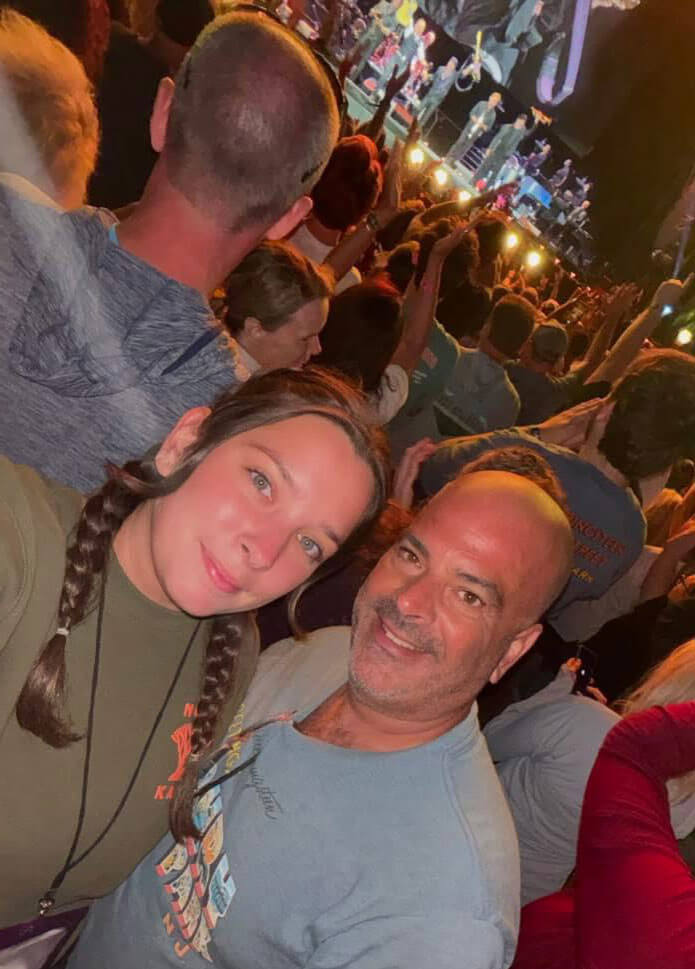
Two years later, as a junior with my own three-hour show on WMCX, Monmouth’s student-run radio station, I knew I had at least two listeners. One was the friend who had watched that show with me. The other was a senior who had the nerve to tell me, on more than one occasion, that I was “losing listeners” by taking 15 minutes out of my three-hour show to play three Bruce songs in a row, something I did regularly.
Maybe that guy had a small point when you think about the songs that were popular on college campuses at the time: “Gangsta’s Paradise” by Coolio, “Waterfalls” by TLC, “You Oughta Know” by Alanis Morissette.
When we went to bars and clubs in Long Branch and Asbury Park, the most popular song was House of Pain’s “Jump Around,” a rowdy hip-hop/dance track with a 25-second intro that partygoers responded to the way a stadium full of Bruce fans react to the opening notes of “Rosalita.”
Much of the music of the day seemed silly and meaningless to me. But that’s what most college kids wanted—not deep, heartfelt songs, even if the guy writing them used to play right here on campus.
Still, there I was pushing Bruce’s stuff upon an audience that didn’t really exist on campus. With 1,000 watts of power behind me, I kept doing what I wanted to from the third floor of the Student Center, my silly senior friend be damned.
Like that imaginary audience, another thing that did not exist at the time was the internet, at least in the form we know it today. Had it, I might have known about the little house about a block from the beach on West End Court in Long Branch where Bruce wrote a good portion of his “Born to Run” album.
On mild fall and spring nights, when no one wanted to listen to Bruce with me, I would strap a Walkman to my hip and jog from campus to the beach, finishing my run on the boardwalk directly across from a set of apartment buildings that are now Monmouth residence halls. My route took me right past 2nd Ave., a street that intersects West End Court, and would have, had I veered off instead of staying straight toward the ocean, taken me directly past rock ’n’ roll history.
But I had no idea the “Born to Run” house existed. Of course, someone from campus could have educated me, but unfortunately for this Bruce fan, I showed up about 30 years too soon—long before the Bruce Springsteen Center for American Music opened its doors and Monmouth offered courses such as Bruce Springsteen’s America: Land of Hope and Dreams.
After surviving my first year without a roommate, and spending some very loud but lonely nights in my room, I eventually did end up sharing living space with others, first in a suite in Cedar Hall and then on the far side of campus in the Great Lawn apartments. I lugged my stereo and growing collection of Bruce CDs to each stop, always expecting the music—and my interest in the man who created it—to be received the way I thought it would be when I first arrived on campus in 1992. It never was.
At least not for me.
But this story took a dramatic turn in 2020, when my daughter, Abigail ’24, enrolled at Monmouth and got to live out the Bruce dream that had eluded me. A two-time president of Blue Hawk Records, the student-run record label on campus, Abby spent several springs and summers interning at the Stone Pony, the Asbury Park rock ’n’ roll bar Bruce helped make famous. She was a student employee at the Springsteen Center, where she spent time surrounded by artifacts that, had I had access to when I was in college, would have made my head explode.
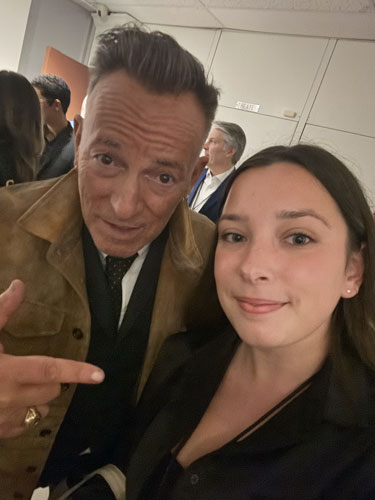
And in moments that would have been unimaginable for the Elmwood Hall freshman who spent many lonely nights finding companionship in Bruce’s music, my daughter eventually got the chance to spend some time with the actual man—multiple times, right there on campus.
The most personal encounter followed an American Music Honors event inside Pollak Theatre. In a selfie Abby took, she and Bruce lean into each other, smiling, as Bruce looks into the camera while aiming his right index finger in her direction, as he’s known to do while posing with fans.
I smiled when that photo popped up on my phone a few minutes after it was taken. And then, I thought back to all those nights I spent in my dorm room at Monmouth and in the WMCX studio—a Bruce fan on campus with no one to share my love of his music with.
Now, 30 years later, that campus is where fans from all over the world will gather to do just that.
As an old college friend of mine once said, “It’s been a long time coming—but now it’s here.”