Advancing Marine Research—With eDNA
Student Researchers: Harmony Lighty, Emma Owendoff Najarian (visiting student from Lehigh University), Chris Reigel
Faculty Mentor: Jason Adolf, Ph.D., Endowed Professor of Marine Science
Environmental DNA—or eDNA—is transforming the way scientists study aquatic life. By collecting water samples and analyzing genetic traces shed by organisms, researchers can uncover which species live in a given place without ever having to cast a net.
This summer, Jason Adolf and his students put the method to work on three fronts: testing whether oyster reef restorations in New York are improving habitat, establishing a broader ecological baseline for New Jersey’s offshore wind development, and building a more sensitive eDNA probe to detect endangered Atlantic sturgeon. Together, the projects show how eDNA provides a faster, noninvasive, and more comprehensive view of biodiversity—one that can support conservation, guide restoration, and improve how we monitor ecosystems in a changing world.
Shellfish Success Story
At Manhattan’s Gansevoort Peninsula, Adolf collaborated with Lighty and Owendoff Najarian to study recently restored oyster reefs. The team wanted to know whether the reefs were doing their job: creating habitat and boosting biodiversity. Water samples from reef and nonreef sites were analyzed and compared for eDNA. The samples showed the presence of oyster toadfish and skilletfish—two species strongly associated with oyster reefs—offering clear proof that the reefs are working as intended. Since oyster restorations are costly and complex, having a reliable and noninvasive way to confirm success strengthens the case for expanding them in urban waters. The team plans to return in 2027 to see whether reef-associated species continue to increase as the restoration matures.
Casting a Wider Net
Closer to home, Lighty also led a project examining eDNA samples collected along New Jersey’s coast as part of offshore wind development planning. Traditional trawl nets capture mostly fish, but her analysis expanded the lens to include nonfish species often missed in standard surveys. The results showed DNA from bottlenose dolphins, fin whales, and seabirds alongside fish species, helping to build the baseline data that regulators and developers will rely on as turbines are built. This matters because once construction begins, trawling in turbine areas will no longer be feasible, making eDNA one of the only practical monitoring tools available. The team plans to keep collecting samples at different sites to track how species vary by season and location, building toward a long-term monitoring effort as wind energy expands—one that’s less disruptive and more inclusive than other traditional methods.
Sturgeon Signals
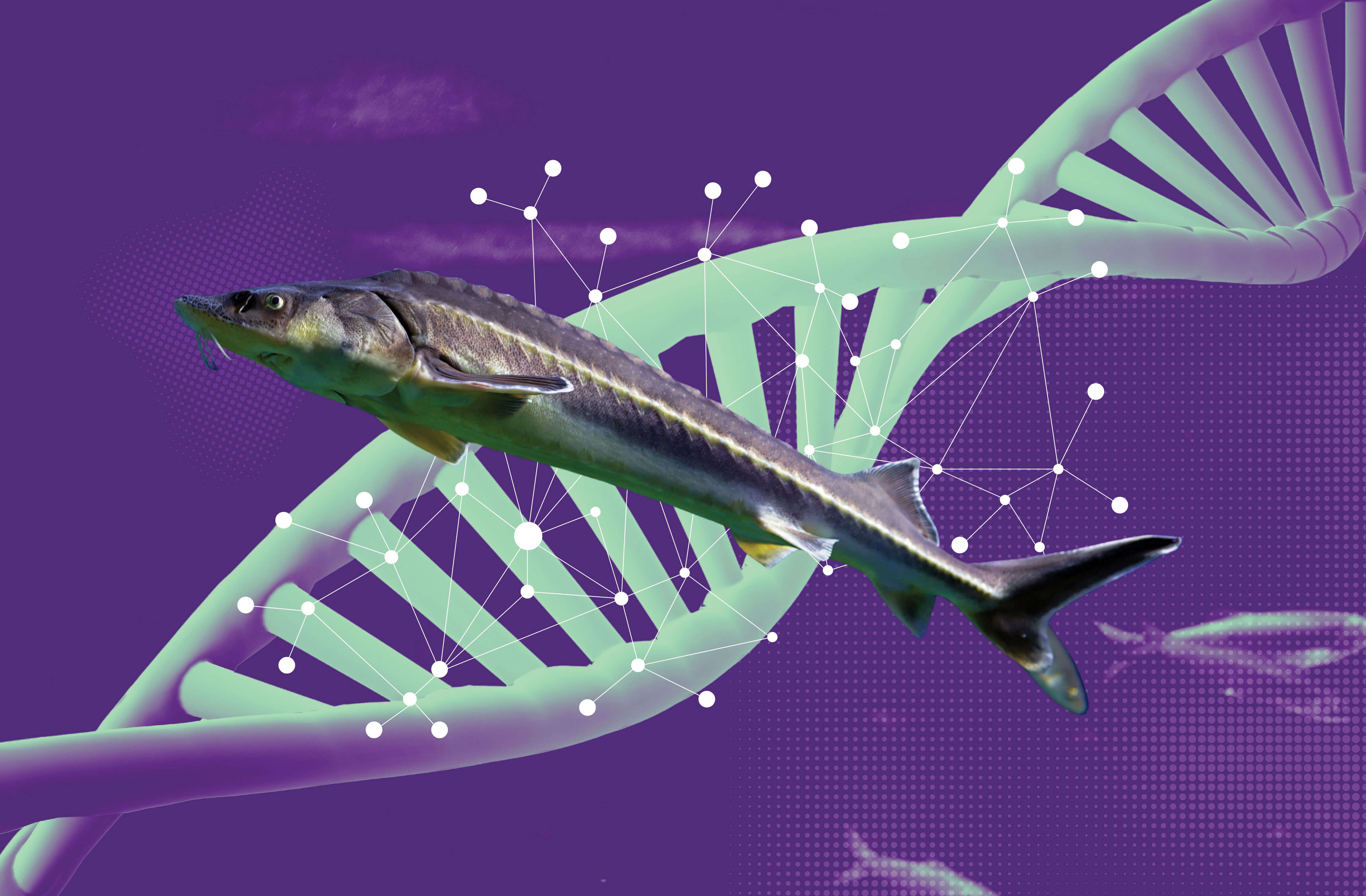
For Reigel, the challenge was a bit different: figuring out how to improve detection of Atlantic sturgeon, an endangered fish that’s tough to track once it’s done spawning in freshwater rivers and returns to the open ocean. Current DNA tests fail to pick up sturgeon DNA in ocean water, where genetic traces are scarce and diluted. Working with Monmouth’s Environmental DNA/Marine Fisheries Senior Scientist Liz Clark and Associate Professor of Biology Keith Dunton, Reigel redesigned the probe to better pick up those faint traces. Early results show the new probe can detect sturgeon at levels where older methods could not. This advancement could give conservationists a faster, noninvasive way to confirm sturgeon presence across their range—replacing costly gillnets or acoustic tagging with a simple water sample. The team is preparing the study for publication as it continues to test in the field, where its success could pave the way for broader use—and serve as a model for improving eDNA tools for other endangered species.